Body Image Barriers That Stop People From Going to the Gym
Fear of judgment keeps millions from working out, starting long before they enter the gym.
What gymtimidation means and how widespread it is
A major international health body says one in four adults worldwide doesn't hit the activity levels doctors recommend. Among teenagers it's worse: over 80% fall short. The usual explanation blames time, money, or laziness. Wrong on all three counts. Body image and self-consciousness keep people off the gym floor more than any logistics problem ever could, and the proof is sitting right in the numbers on gym membership: women stay less active than men, even as gym participation among women has grown. That gap only makes sense if the barrier appears after the membership card gets swiped, not before.
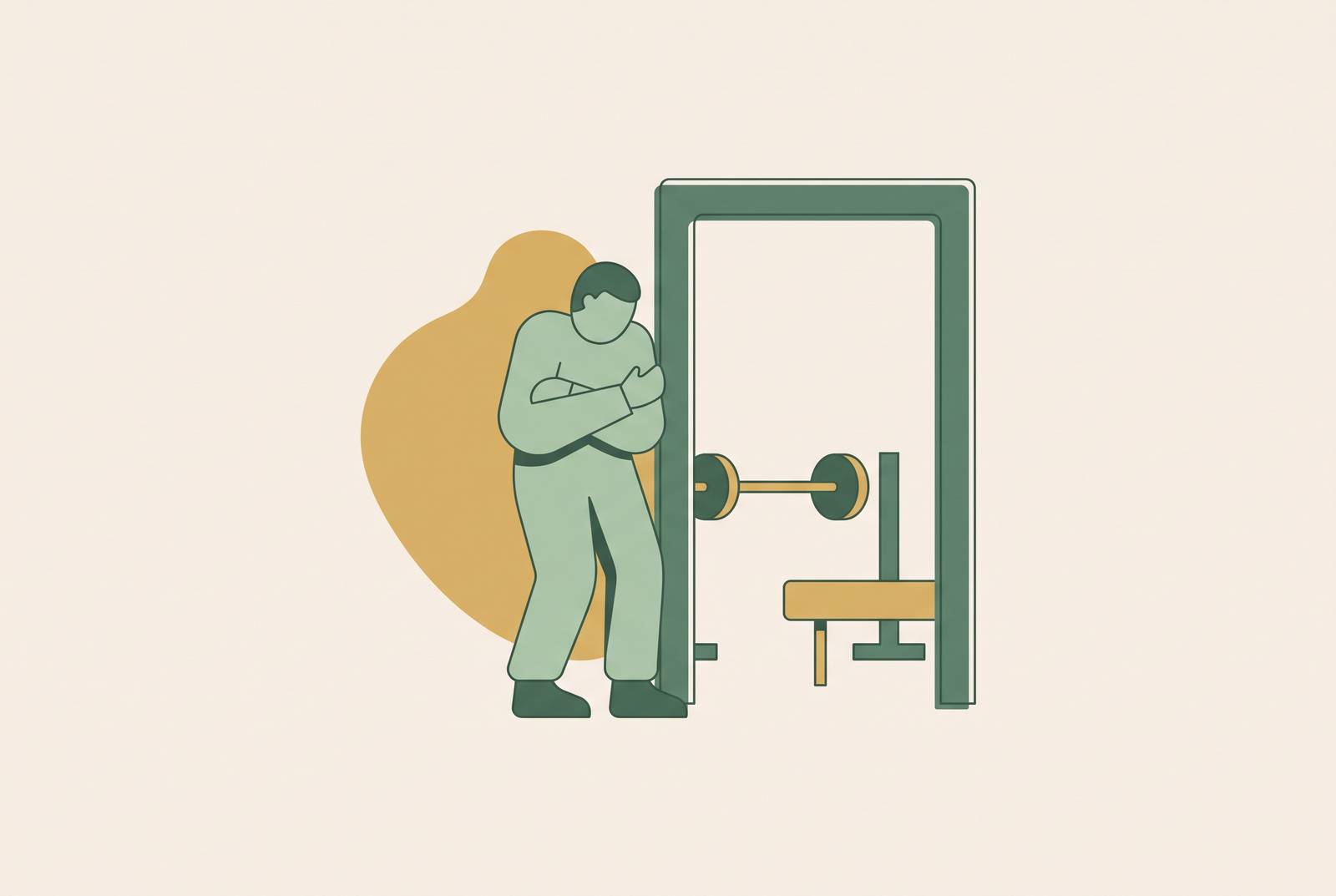
Planet Fitness trademarked the word "gymtimidation," but the thing it names is visible throughout the research under other labels. Stripping the branding off means one specific thing: fear or insecurity triggered by the gym environment itself, separate from the exercise.
The scale surprises most people. A 2,000-person survey from Isopure and OnePoll found about half of Americans have felt gymtimidated at some point. Thirty-two percent said working out near someone visibly in great shape sets it off. Thirty-one percent carry a broader anxiety about "getting in shape" in public, and 17% said the discomfort centers on the opposite sex, a smaller slice, but not nothing.
A separate survey from the Flex Fitness App found nearly half of respondents believe other gym-goers are watching and judging them mid-workout. More than 40% of that group have felt this way for over five years, a belief people carry into the gym year after year rather than dismiss as first-day nerves. That's a belief people carry for years, not first-day nerves. That's a belief people carry into the gym year after year, reinforced every time they walk past someone who looks like they already know what they're doing.
The gender gap inside the gym: what the research finds for women specifically
A mixed-methods study by Cowley and Schneider, published in PLOS ONE in January 2025, surveyed 279 women between 17 and 60, most of them current gym-goers (84.2%), and mapped four recurring themes in how women experience gym spaces.
"Never enough" describes constant judgment on both appearance and performance. "Often too much" covers the flip side: self-criticism, anxiety over what to wear, an internal commentary that never fully shuts off. "Always on display" points outward, toward harassment, competition for floor space, and the sense that a woman's presence in the gym depends on how she looks while she's there. "Sometimes empowered" is the counterweight: women in the study described real gains, new skills, pushback against gender norms, spaces that actually felt supportive.
The harassment number is the one that should stop anyone mid-scroll: 71.9% of participants said they'd received unsolicited comments from men while working out. That's most of the sample, not a handful of loud complaints from the fringe. Several women described feeling like intruders in the weights room specifically, and that lines up with something anyone who's watched a gym floor for five minutes already suspects: gyms are informally gender-segregated by equipment, even when no sign anywhere says so out loud.
The psychological mechanisms that turn discomfort into avoidance
Social Physique Anxiety, SPA for short, is the clinical name for fear of being judged on your body specifically, a subtype distinct from general social anxiety. It's been shown to deter exercise altogether, especially among people with higher BMI, and people with higher SPA scores gravitate toward private workout spaces over public gyms. Makes sense. Nobody wants an audience for something they already feel anxious about.
A 2026 cross-sectional study in Frontiers in Psychology traced the fuller chain. Body image disturbance leads to shame, and shame accounts for a meaningful chunk of the link between that disturbance and skipping exercise. This lines up with self-conscious emotion theory, where shame acts as what researchers call a "global self-denial" emotion: it doesn't flag one behavior as bad, it convicts the whole self. Once the whole self feels indicted, the easiest fix is skipping the room where the verdict gets delivered.
Call it a defense mechanism working exactly as designed, just aimed at the wrong target.
Weight stigma as a distinct layer on top of body image anxiety
Weight stigma is its own animal, separate from garden-variety body image anxiety. It's prejudice, discrimination, and negative stereotyping based on weight or body shape, and it functions as a social stressor, not a private insecurity someone can think their way out of.
Research on weight stigma and exercise finds that stigma pushes people toward avoidance through more than one route. External judgment doesn't stay external for long. It gets absorbed, rewritten as self-judgment, and starts generating its own anxiety independent of whoever made the original comment.
Peer ridicule and gym environments that don't feel welcoming are measurable, significant contributors to people skipping physical activity, and that's a documented behavioral outcome, not a hunch.
How the gym environment amplifies what people already feel
Some of this comes down to design, not just psychology. Research has identified specific built-environment factors, facility location, room layout, equipment arrangement, plain old crowdedness, that function as real barriers to exercise independent of anyone's mental state walking in the door.
Mirrors deserve their own paragraph. In the Cowley/Schneider research, mirrors turned out to be one of the most polarizing features in the whole gym. Some women liked them for checking form. Others found them distracting, or a direct trigger for self-consciousness. A mirror reflects back exactly the kind of scrutiny some people came to the gym hoping to escape for an hour, and that split reaction says the object itself isn't neutral.
Social comparison is also worsened by the presence of visibly fit members nearby and the modern pressure to document physical progress for an audience that isn't even in the room. Then there's the free weights section. A Myprotein survey found 37% of respondents named it the single most intimidating part of the gym, and it is widely noted as among the most gender-segregated spaces on the gym floor. Those two facts sitting next to each other are not a coincidence.
The effect of fitspiration content on body image before someone walks through the door
The damage doesn't start at the gym door. It starts on a phone screen, well before anyone laces up.
"Fitspiration" content has scaled into something enormous. By March 2024, over 500,000 videos carried related hashtags, and the category had already logged more than a billion views by early 2022. On Instagram alone, #fitspo sits on more than 72 million posts, a firehose aimed at anyone who opens the app before breakfast.
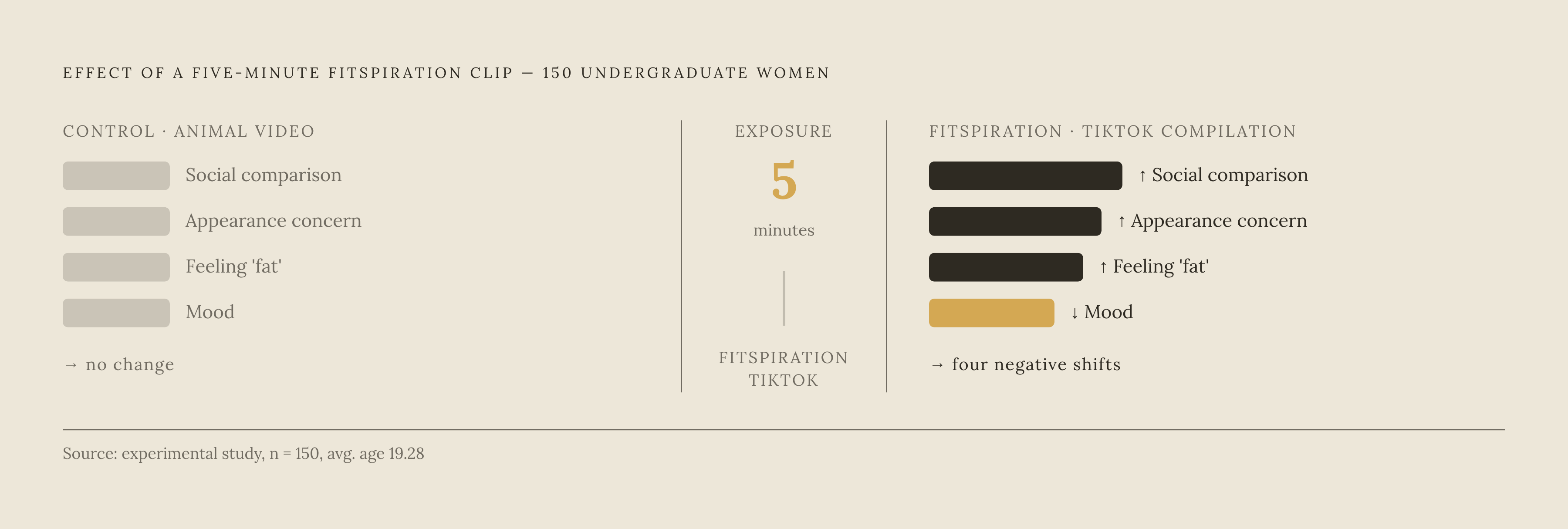
A 2025 study indexed on PubMed ran a direct experiment: 150 undergraduate women, average age 19.28, watched either a five-minute compilation of fitspiration TikToks or a control video of animals. The fitspiration group came out with more social comparison, more appearance concerns, more feelings of being "fat," and a measurable dip in mood, relative to the control group. Five minutes, roughly the time it takes to microwave a burrito, was enough to shift how these women felt about their own bodies.
Earlier research lines up with this too: fitspiration exposure has been linked to lower body satisfaction and worse mood. The research record shows fitspiration content has grown dramatically over the past decade, with the figures on views and tagged posts reflecting a category that barely existed before smartphones. The exposure keeps compounding, and it compounds before anyone even changes into gym clothes.
Men experience body image barriers too, though they show up differently
None of this is exclusive to women, even though it gets studied that way more often. Research by Piatkowski and colleagues, published in the Journal of Community and Applied Social Psychology, found most participants in their mixed-methods study believed body image concerns run widespread among people who weight train. Body image concerns and drives toward muscularity came up repeatedly as themes participants connected to their experiences within gym culture.
The pressure just points a different direction. Where gym culture often pushes women toward thinness, it pushes men toward bulk and visible muscularity. Different targets, same underlying mechanism: an appearance ideal that quietly replaces the original reason someone started working out. Social Physique Anxiety applies to men just as much as women in how the framework was built, even if the conversation around it skews one way.
That skew is visible directly in the numbers. A UK fitness poll found 17% of women report gym intimidation compared to just 5% of men. That gap says less about who's actually feeling intimidated and more about who's willing to say so out loud, and treating it as proof men don't struggle here would be a mistake the data doesn't support.
Why naming these barriers matters more than pushing through them alone
Pushing through gymtimidation on willpower alone is the wrong prescription, and the research backs that up directly. The avoidance loop feeds itself: skipping the gym erodes confidence, eroded confidence deepens body image concerns, and deepened concerns make the next skipped session easier to justify. Grit doesn't break that loop. Naming the mechanism does, because a feeling with a known cause is a lot easier to work with than a vague, floating sense of dread.
The Cowley/Schneider research offers a useful counterpoint. Plenty of women in the study reported real empowerment: new skills, pushback against old gender norms, gym environments that felt supportive rather than judgmental. Same setting, opposite outcome. That split comes down to environment and social context, not personal toughness. The gym itself isn't the fixed variable most people assume it is.
Separate research from Frontiers in Psychology shows confidence, specifically self-efficacy, accounts for 46.7% of the variance in whether someone sticks with a fitness routine. Not willpower. Confidence. Cowley and Schneider identified "empowering places" and "empowering self" as their own categories, separate from the negative themes entirely, where community and companionship change the experience of the room. Same equipment, same mirrors, same free weights section. The result depends on who's standing next to you and whether the room feels like it's on your side.
Sources
- “I sometimes feel like I can’t win!”: An exploratory mixed-methods study of women’s body image and experiences of exercising in gym settings
- Frontiers | Impact of body image on women’s fitness persistence: the chain mediation role of self-efficacy and exercise motivation
- Understanding muscularity, physique anxiety, and the experience of body image enhancement among men and women: A mixed‐methods study - Piatkowski - 2024 - Journal of Community & Applied Social Psychology - Wiley Online Library
- pmc.ncbi.nlm.nih.gov
- us.myprotein.com
- frontiersin.org
- konquerfitness.com.au
- pubmed.ncbi.nlm.nih.gov