How Repeatedly Quitting Fitness Affects Motivation Over Time
Each quit rewires your brain to make the next attempt harder.
Most people quit a new fitness routine within five months. Over 80% do, according to research cited by SPENGA Sugar Land, and the drop-off isn't random noise scattered across the calendar. It clusters hard at the start, then again at every restart after that, and each cycle leaves the next attempt a little weaker than the one before it.
That's the part almost nobody talks about. Quitting fitness isn't just losing your aerobic capacity and your quad strength. It's quietly rewiring how your brain handles motivation, confidence, and effort itself, so that attempt number four feels heavier than attempt number one, even when your goals haven't changed at all.
Why motivation spikes at the start and then collapses so reliably
The data on when people quit is almost comically precise. Analysis of activity logs has flagged the second Friday in January as the single worst dropout day of the year, sometimes nicknamed "Quitter's Day," and 80 to 92% of resolutions are dead by February, per fitbosspro.com's reporting. Most of those don't even make it two weeks.
Here's the mechanical reason. New starters run on willpower, and willpower is a finite resource, according to Vibefam's research. Nobody has infinite willpower sitting in a drawer somewhere waiting to be deployed at 6 a.m. It gets spent, and it needs refilling, and most fitness plans are not built with that in mind.
Then there's the intensity mismatch. People go from a baseline of zero straight to six days a week, which is a bit like learning to swim by jumping off a cruise ship. Miss one session under that plan and the all-or-nothing brain doesn't file it as "one missed session." It files it as "the whole week is ruined," and once the week's ruined, so is the motivation to salvage it.
Psychology Today's Kompf laid out the resulting chain in May 2025: long, intense workouts create friction, friction creates inconsistency, and inconsistency erodes confidence. It's a compounding loop, not a one-time setback.
Dopamine drives all of it. When visible results don't appear fast enough, motivation collapses, per fitbosspro.com's 2026 analysis. Worse, the basal ganglia need repeated cue-behavior-reward loops to turn a behavior into an actual habit. Early quitters bail before the behavior has had time to become automatic. They're not weak-willed. They just ran out of runway before automaticity kicked in.
This first quit is mostly mechanical, willpower depletion running headfirst into an unrealistic structure. What happens after the second and third quit is a different animal entirely.
What changes psychologically after the second, third, and fourth quit
Past behavior is the strongest predictor of future behavior, Kompf noted in his May 2025 column. Every missed workout makes the next skip easier. Every completed one reinforces the identity of someone who moves.
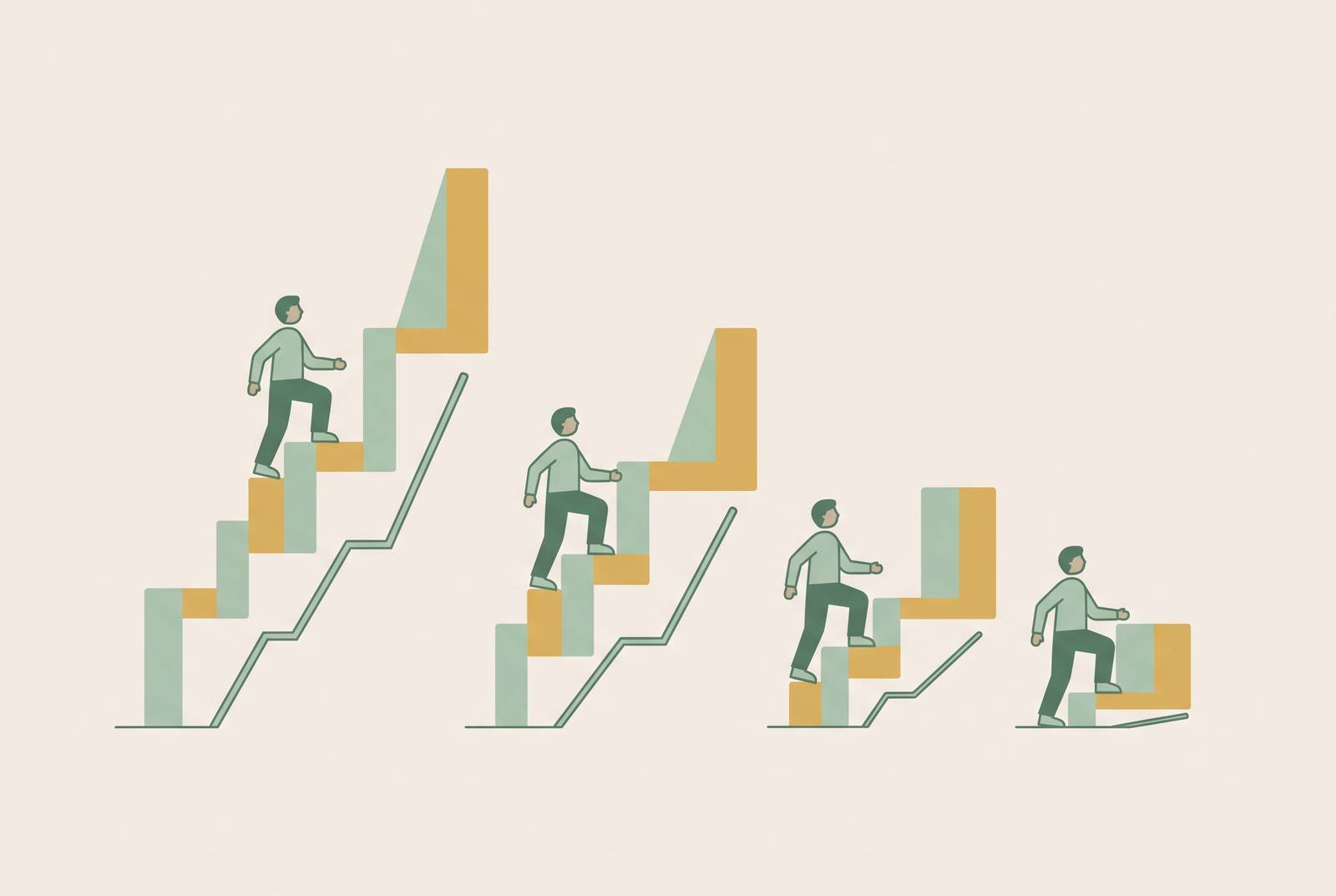
Flip that statement around and it gets uncomfortable fast. Each quit makes the next quit more likely, not because willpower gets weaker with age or repetition, but because the behavioral record just keeps accumulating evidence against you. The brain isn't grading on a curve. It's keeping a ledger.
All-or-nothing thinking deepens the same way. Each failed cycle doesn't just repeat the distortion, it confirms it, turning a passing thought into a permanent lens. That's the part that makes cycle four feel so different from cycle one: the doubt isn't a reaction anymore. It's the starting assumption.
Self-efficacy takes the real hit here, and it's measurable. Research consistently links exercise self-efficacy to sustained activity, finding that confidence and consistency reinforce each other. Each successful session tops up the confidence reservoir, and each quit drains it. Broader reviews of health behavior research have consistently identified self-efficacy as a key motivational correlate across major behavior change frameworks.
So serial quitters aren't simply "less motivated." That framing undersells what's actually happening. They're progressively less convinced that effort produces a different outcome than it did last time, which is a much harder hole to climb out of than low motivation on its own.
How learned helplessness takes hold when the quit cycle repeats long enough
The American Psychological Association, via reporting from Medical News Today, defines learned helplessness as what happens when someone repeatedly faces stressful, uncontrollable situations and stops exercising control even after control becomes available again. Martin Seligman's foundational learned helplessness research first mapped this out in the 1960s. The fitness version runs on the same wiring: repeated non-reward trains the nervous system to stop linking effort with outcome.
Grinder Gym's framing of the fitness-specific pattern is blunt and accurate. People chasing fast change jump into programs too intense for where they actually are. Results don't appear, the body and mind burn out, and the belief that follows is "I'm just not cut out for this."" That belief isn't a conclusion. That belief isn't a conclusion, it's a symptom.
Lack of visible progress does most of the damage here. Early gym-goers chasing weight loss or muscle gain are chasing outcomes that take real time to show up physically, and most people give up on the effort before the adaptation window has even closed. They quit right before the payoff would've arrived, which is its own kind of cruel timing.
Learned helplessness, once established, tends to produce low self-esteem, low expectations of success, low motivation, reduced persistence, and an inability to ask for help. Anyone who says they've "tried everything" and still quit isn't confessing weak character. They may well be describing a conditioned response their own nervous system picked up along the way.
Helplessness is learned. Which means, mechanically, it can be unlearned too.
Why the type of motivation used to restart matters as much as the decision to restart
Not all motivation is created equal, and the research on this is consistent. More autonomous, intrinsic forms of motivation predict long-term exercise adherence better than "identified regulation" (motivation based on recognizing a behavior's importance), which is decent at getting people to start but weaker at keeping them going, per research summarized on ScienceDirect. A review in PMC found intrinsic motivation produces lasting effects on participation, while extrinsic motivation delivers short-term gains that fizzle out.
Research on goal persistence has found that goals rooted in personal enjoyment, curiosity, or satisfaction tend to outlast goals driven by external reward or plain practicality. Research has found intrinsic motivation beats extrinsic motivation at predicting goal adherence over time.
Most restarts are triggered by something external. New Year's Day. A health scare. A wedding six months out. Kompf pointed out in May 2025 that the desire to get active often starts with good intentions, the equipment gets bought, the gym membership gets signed, but the motivation is situational. It's borrowed from the moment, not built into the person.
So the external trigger fades (as they always do), and the routine fades right along with it. The better question isn't "am I motivated enough?" It's "motivated by what, and for whom?" Those two questions get very different answers, and only one of them survives February.
The physical reset that compounds the psychological one
Aerobic fitness falls apart fast once you stop training. VO2 max can drop 4 to 7% in just two to three weeks, and roughly 10 to 14% by the one-month mark, according to InBody USA. Strength holds up better, showing only a small dip at the two-week point.
The evidence on detraining is consistent: aerobic gains can erode significantly after just weeks off, with VO2 max continuing to fall the longer training stops. That's not a slow leak. That's a faucet left running.
This is where the physical and psychological damage start feeding each other directly. Every restart means more soreness, more gasping for air, slower visible progress, right at the exact moment when someone's motivational and confidence reserves are already running on empty from the last quit. The body works hard, feels terrible doing it, and shows nothing for it. That's not a separate problem from learned helplessness. That's the loop, delivered fresh.
There's a small mercy buried in here: prior training does appear to confer some physical advantage on return, even after a significant break. But don't lean on that too hard. The psychological rebuild doesn't get the same shortcut. Muscle fibers might remember. Confidence doesn't work that way.
That gap right there, between the physical truth (it comes back quicker than you think) and the psychological experience (it still feels exactly like starting from zero), is itself part of what keeps people stuck.
What interrupts the cycle rather than just restarting it
Restarting isn't the hard part. Restarting differently is. Kompf's September 2025 piece makes the case for identity-based framing over outcome-based goals: "I'm becoming the type of person who moves daily" survives a bad week in a way "I want to lose 10 pounds" simply doesn't, because identity holds steady while motivation swings around like a pendulum.
Small, consistent actions are far more likely to actually become habits than big dramatic ones, per Kompf's columns. A five-minute walk is doable on a bad day. A five-minute lift is repeatable when a full session isn't. Each time you show up, however briefly, it reinforces the identity and the muscle.
The all-or-nothing distortion needs to be named and dismantled directly: missing one session is not a failed week. The real goal is shrinking the gap between quitting and returning, and then shrinking it again. Days, not months.
Friction needs to be removed structurally. That means scheduling workouts like appointments, decided in advance instead of negotiated in the moment when motivation is nowhere to be found. It means matching the plan to actual current fitness, not the aspirational version of yourself from three years ago, since the ACSM research found that people who complete the initial ramp-up period maintain adherence for six to eight months afterward. The ramp is the hinge the whole thing swings on. And it means cutting setup friction wherever it hides: gear visible and ready, location convenient, session short enough that starting doesn't feel like a negotiation.
Self-efficacy gets rebuilt the boring way, through the accumulation of small wins, not one big dramatic recommitment speech. Each completed session is a data point, and every data point chips away at the helplessness narrative one small piece at a time.
Intrinsic motivation can be built. Connecting exercise to enjoyment, curiosity, or identity rather than appearance or a countdown clock changes both which restarts stick and how they feel while they're happening. A 2025 cross-sectional study by Xiao and colleagues in Frontiers in Psychology (425 participants) found that fitness-related social media use significantly predicted intrinsic motivation, with indirect effects through that intrinsic motivation accounting for roughly 18.57% of the total effect on exercise behavior. Curated social environments, in other words, can feed the intrinsic pathway instead of just the extrinsic one.
Why shared accountability changes the psychological equation
Loneliness ranks as one of the three primary psychological drivers of dropout, according to Vibefam's research. People working out with zero meaningful social interaction have no emotional anchor holding them there, and they leave the moment they start feeling like outsiders in their own routine.
The retention numbers back this up hard. Boutique and higher-end gyms, which build community into the structure itself rather than bolting it on, retain members at rates as high as 75%, compared to 50 to 60% at traditional gyms, per LinkedIn retention data. Members who make it past the two-year mark become 90% less likely to cancel at all. Community isn't a nice bonus feature. It's load-bearing.
A partner or a community turns consistency from a private negotiation with an already-depleted self into a shared commitment instead. A partner or a community turns consistency from a private negotiation with an already-depleted self into a shared commitment instead. Showing up stops being purely an internal willpower transaction the moment someone else is watching, or waiting, or just quietly expecting you to text back "done."
The distinction that actually matters is supportive versus controlling accountability. Controlling accountability, the guilt-trip check-in, the shame-based nudge, can end up replicating the exact dynamic that deepens learned helplessness in the first place. Supportive accountability does the opposite. It builds a repair loop instead of a punishment loop, which is the whole difference.
Celebrating the act of showing up, regardless of what the scale or the stopwatch says, directly counters the all-or-nothing frame that got someone into this mess to begin with. A workout photo sent to a partner. A quick check-in. A silly, low-stakes wager over who skips fewer sessions this month. These make the behavioral win visible immediately, long before the body gets around to producing a visible one of its own.
Partners don't even need to train side by side to get the benefit. Exercising separately while staying connected still delivers the social structure that matters, because the goal was never physical proximity. It's just having someone else hold the intention alongside you, so it isn't sitting on your shoulders alone.
Shared goals, visible progress, mutual encouragement, and a bit of playfulness (the friendly wager, the small reward, the goofy photo) directly target the loneliness and the invisible-progress problem that the research keeps flagging as primary dropout causes. None of that is an optimization trick bolted onto a workout app. It's the connective tissue that makes consistency survivable in the first place.
Which loops back to where this started. The quit cycle damages motivation's psychological infrastructure through repetition, and that infrastructure gets rebuilt the exact same way it broke: through repetition. The only real difference is that repetition gets a lot easier to sustain when somebody else is in the habit right alongside you.
Sources
- The Psychology of Fitness Commitments: Why Members Quit (and How to Fix It) | Vibefam
- The Psychology of Sustainable Fitness
- Stop Falling Off Your Workout Routine
- The impact of fitness social media use on exercise behavior: the chained mediating role of intrinsic motivation and exercise intention
- Why So Many People Quit Fitness
- Why Your Fitness Motivation Disappears After 2 Weeks (And How to Fix It)
- grindergym.com
- medicalnewstoday.com