Realistic First Month Expectations for Returning Exercisers
Your muscle memory returns faster than it left, but your tendons didn't get the memo.

Getting back into training after a break is a math problem people insist on solving with feelings. The body remembers more than it feels like it does. The real obstacle in month one isn't cardiovascular capacity or muscle fiber, it's the habit of grading every rusty rep against a version of yourself that no longer exists.
Starting from zero, nobody has a ghost to compete with. Coming back, you've got an exact one: the weight you used to squat, the pace you used to hold, the jeans that used to fit. That number doesn't disappear just because you took four months off. It sits there, and every session gets measured against it, and the gap between memory and Tuesday's workout turns into guilt fast. Guilt turns into "if I can't do what I used to do, what's the point," which is the exact thinking that produced the break in the first place. This piece skips the pep talk. The frustration you're likely to feel around day 10 isn't a verdict; it's a data point you saw coming, because this piece maps out, week by week, what month one actually looks like in the body.
What detraining does to the body, and how fast
Cardio goes first, and it goes fast. VO2 max can drop as much as 7% after two to four weeks of doing nothing, and blood volume falls by roughly 9% in that same window. That's why a light jog after a break feels like sprinting: less blood, less oxygen delivery, more panting.
Strength is the tortoise here. Research from Mujika and Padilla (2000) found trained individuals held onto strength for up to three weeks of complete inactivity. Meaningful losses, in the 10 to 20% range, appear only after eight to twelve weeks of total detraining. So if the break was six weeks, the strength that feels gone probably isn't.
Muscle size holds up better than the mirror suggests too. Roughly 5 to 10% of muscle shrinks after six months without training, which sounds bad until you realize a chunk of that "flat" look is glycogen leaving the muscle, not the muscle itself leaving the building. Glycogen refills within days of restarting.
What actually explains the strength drop, then? Neural. The brain gets lazy at recruiting muscle fibers before the fibers themselves shrink, which is why lifts feel weak well before size changes.
A break caused by injury or illness is not the same animal as an elective pause. The losses run deeper, and the return needs to be slower. If that's the situation, everything below still applies, just with a longer runway.
The biology that makes coming back faster than starting over
Muscle memory is cellular fact, not a nice phrase invented to make you feel better. It's cellular. When a muscle fiber trains, satellite cells donate extra nuclei to help it grow and repair, and those nuclei don't leave when training stops.
A 2025 study tracked participants through 10 weeks of training, 10 weeks of detraining, and 10 weeks of retraining. Myonuclear number went up during the training phase and stuck around almost entirely through the detraining phase, even as fiber size shrank. The nuclei stayed on payroll during the layoff. Research has pointed to myonuclear retention as the leading mechanism behind cellular muscle memory. The practical version: previously built muscle tends to come back two to three times faster than it took to build the first time.
Motor patterns get the same treatment. The brain holds onto the shape of a squat or a running stride even after the body forgets how to execute it smoothly, so technique returns before fitness does.
Tendons and ligaments didn't get the memo, though. Connective tissue rebuilds much slower than muscle does, and that mismatch is the single biggest reason returning exercisers get hurt. Muscle feels ready. Tendons are not. Spacing out intense tendon-loading sessions gives collagen time to actually repair, instead of accumulating damage under a muscle that feels fine.
There's a longer-term reassurance buried in this too: a 2025 study tracked participants through 10 weeks of training, 10 weeks of detraining, and 10 weeks of retraining, and found that the break didn't erase the gains. The break wasn't the setback it felt like.
How break length shapes the realistic recovery window
Off for one to three months? Expect four to eight weeks back to your old baseline. Muscle memory is doing its best work in this range.
Off for three to six months? Budget two to three months of consistent training. Month one rebuilds the foundation. Months two and three close the actual gap.
Off for six to twelve months? Plan on three to four months of focused work, mostly because cardio and connective tissue lag behind the muscle, which usually bounced back further than expected.
The "half-time rule" says it takes about half the length of the break to get back to where you were, but this only holds for breaks under three months. Beyond that, the timeline stretches, and it doesn't stretch in a straight line.
A useful ceiling to keep in your head: most people recover 70 to 80% of previous strength within eight to twelve weeks of restarting, even after a long layoff. Age affects recovery differently than people assume. Older adults lose fitness at nearly twice the rate of younger people, but that affects the starting line, not the finish. Someone in their 40s or 50s needs more recovery time stitched between sessions to account for that faster rate of loss.
People who kept some activity going during the break, even a little, tend to regain fitness 25 to 30% faster than people who went fully sedentary. None of this is meant to depress you with math. It's meant to tell you where you're standing on the map, so week two's frustration reads as expected, not as proof something's wrong.
What the first two weeks feel like, and what is driving it
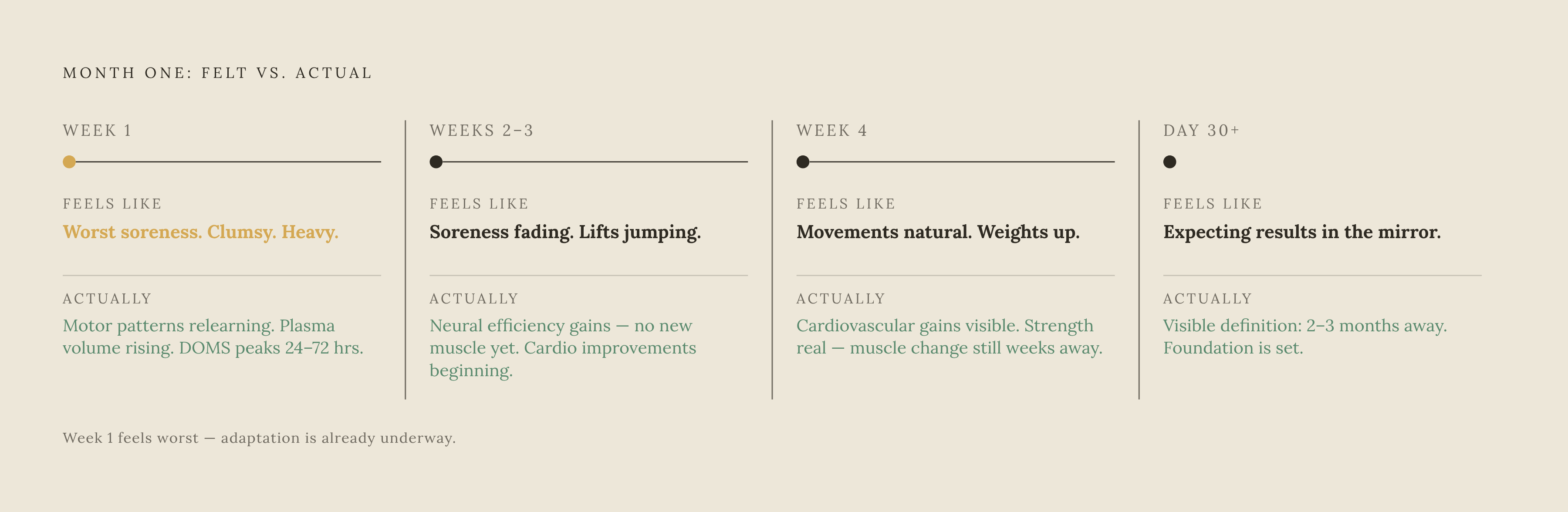
Week one is usually the worst part of the whole month, and almost nobody warns you about that in advance. Everything feels foreign. Cardio feels embarrassing. Soreness occurs in muscles you forgot you had.
Underneath that, though, useful things are happening. The nervous system is relearning old motor patterns rather than adding muscle yet. Blood plasma volume is climbing back up, and resting heart rate may already be inching down. None of it is visible. None of it should be yet.
Soreness (DOMS) typically peaks 24 to 72 hours after an unfamiliar session, driven mostly by microtrauma from eccentric loading (the lowering part of a movement), not by injury. It's most brutal in the first sessions back and eases from there.
Cardio output also lags behind strength for these first two weeks, so expect to be more winded between sets than memory says you should be. Cardiovascular improvements typically begin appearing within two to four weeks of consistent exercise. Movements like squats, hinges, and even running form feel less automatic than remembered because they're partly skill, and skill retrieval is happening in real time during those first sessions. It is not a measure of effort. This is the exact stretch where the comparison loop from the opening does the most damage, so naming it ahead of time takes some of the sting out.
Weeks two through four: what shifts
By weeks three and four, soreness starts fading substantially, even without changing the program at all. The muscle adapts fast to prevent repeat microtrauma, which is why the same session feels significantly easier the second time around.
Movements start feeling smoother around this point too. Neural efficiency improves, so effort finally goes toward the work instead of getting burned on coordination. Lifts can jump noticeably in this window, sometimes surprising people, but that's the brain getting better at using the muscle that was already there, not new muscle being built.
Energy, sleep, and mood tend to improve before anything visible changes. B-One Training reports that most people notice a jump in energy within two weeks. Cardio improvements become noticeable in the same two-to-four-week stretch as the heart strengthens and blood volume climbs back toward normal.
What's still missing at this point: visible muscle definition, meaningful fat loss. Those run on longer timelines and shouldn't be the benchmark for week three. If there's a partner or a shared training context in the picture, name this stretch out loud together. Showing up, sleeping better, and moving without feeling like a rusted hinge are real wins that appear before anything is visible in a photo.
What to realistically expect by day 30
By day 30, expect noticeably better energy and steadier mood, often better sleep too. DOMS should feel like a distant memory compared to week one. Movements feel more natural, less like translating a foreign language. Daily stuff, stairs, walking, recovering between sets, gets easier. Working weights or reps have likely gone up, driven mainly by the nervous system getting sharper, not by new muscle.
What's not there yet matters just as much. Visible muscle definition or a body composition change in the mirror usually needs two to three months of consistent work, not one. Liftstrong notes that comments from other people about your physique run on an even longer clock, generally three to six months out. And the scale is a liar in week one specifically: new exercise causes mild inflammation and temporary water retention that can mask fat loss for the first two to three weeks. If the number on the scale hasn't budged, that's water noise, not a verdict on your effort.
Day 30 is the end of the rebuilding phase, the foundation that months two and three actually build on. It's the end of the rebuilding phase, the foundation that months two and three actually build on. Micky Lal, cited by Healthline, makes the point that visible change depends on consistency, intensity, nutrition, and individual factors, and no single timeline fits everyone. Treating month one as preparation instead of transformation is just the accurate bar. It's just the accurate one.
How to structure the first month without repeating the most common mistake
The single most common mistake: coming back at the old weights, the old volume, the old pace. It produces crushing soreness, sometimes an actual injury, and often another break, which is the exact cycle the returning exerciser is trying to escape in the first place.
Start at roughly 50% of previous capacity, whether that's measured in weight, distance, or duration. That's not a concession to weakness, that's what the research supports as the actual starting point. Train two to three times a week, which gives enough stimulus without robbing the body of recovery time between sessions. Begin sessions at 10 to 15 minutes and build from there, using something like a five-minute-per-week progression so tissue that's still rebuilding resilience doesn't get outpaced. Keep weekly volume increases under 10%.
Connective tissue is the real bottleneck here, more than muscle. Tendons adapt slower than muscle does, and that mismatch means the limiting factor in month one usually isn't strength, it's how much load the tendons can absorb without complaining. A chunk of what's happening is skill retrieval, not strength building, so form matters more than load in these early weeks. Get the pattern right before adding weight.
Rest days aren't a gap in the plan. They're the part of the plan doing the actual adapting. For self-monitoring without any equipment, the talk test works fine (can you hold a conversation during the effort), alongside rating perceived exertion at a 4 to 6 out of 10. And for anyone in their 40s or 50s, build extra recovery into the schedule on purpose rather than discovering the need for it the hard way. The ceiling isn't lower. The runway to get there is just a little longer.
How a training partner changes what the first month feels like
Month one is the highest dropout window in the entire process, and it's not close. Soreness, invisible results, and the ghost of a former self all occur at the same time, which is exactly the moment external accountability earns its keep.
Consistency is the one variable that separates an actual foundation from a false start, and shared accountability keeps consistency alive because it removes friction. A partner doesn't need to match your fitness level, and doesn't even need to train at the same time as you. A check-in, a photo of a finished session, a friendly bet about hitting three workouts this week, all of that changes the psychological weight of just showing up.
Celebrating that someone showed up matters more in month one than celebrating a number on the bar. The neural and cardiovascular work happening in weeks one through four is real progress, it just doesn't photograph well, and a partner who understands that can actually say so out loud. Simple shared goals, three sessions this week rather than a weight target or a time goal, line up with what the biology of month one is actually delivering.
Tools built around this idea, something like a Partner Fitness Review model of photos, friendly wagers, and honest back-and-forth encouragement, turn the roughest stretch of week one into the relational glue that makes week four feel inevitable instead of optional. The best system for month one is whichever one makes showing up feel connected to something bigger than what the mirror says today. It's whichever one makes showing up feel connected to something bigger than what the mirror says today.
Sources
- How long does it take to rebuild fitness after a long break? – RP3 Rowing
- What’s a realistic fitness routine for someone who hasn’t worked out in months? – RP3 Rowing
- Returning to the Gym After a Long Break: Comeback Guide
- jacked.coach
- getfitcraft.com
- How much can you improve your fitness after years of inactivity? - B-One Training
- healthline.com


