Minimum Viable Workout for Someone Who Hates Exercise
Just 15 minutes of movement a week cuts mortality risk by 14 percent.
What the science says about where health gains come from
Forget the 150-minutes-a-week guideline for a second. It's not wrong, exactly, but leading with it is a mistake, and it's probably why so many people never start. The biggest drop in health risk doesn't come from hitting that number. It comes from moving at all instead of not moving, full stop.
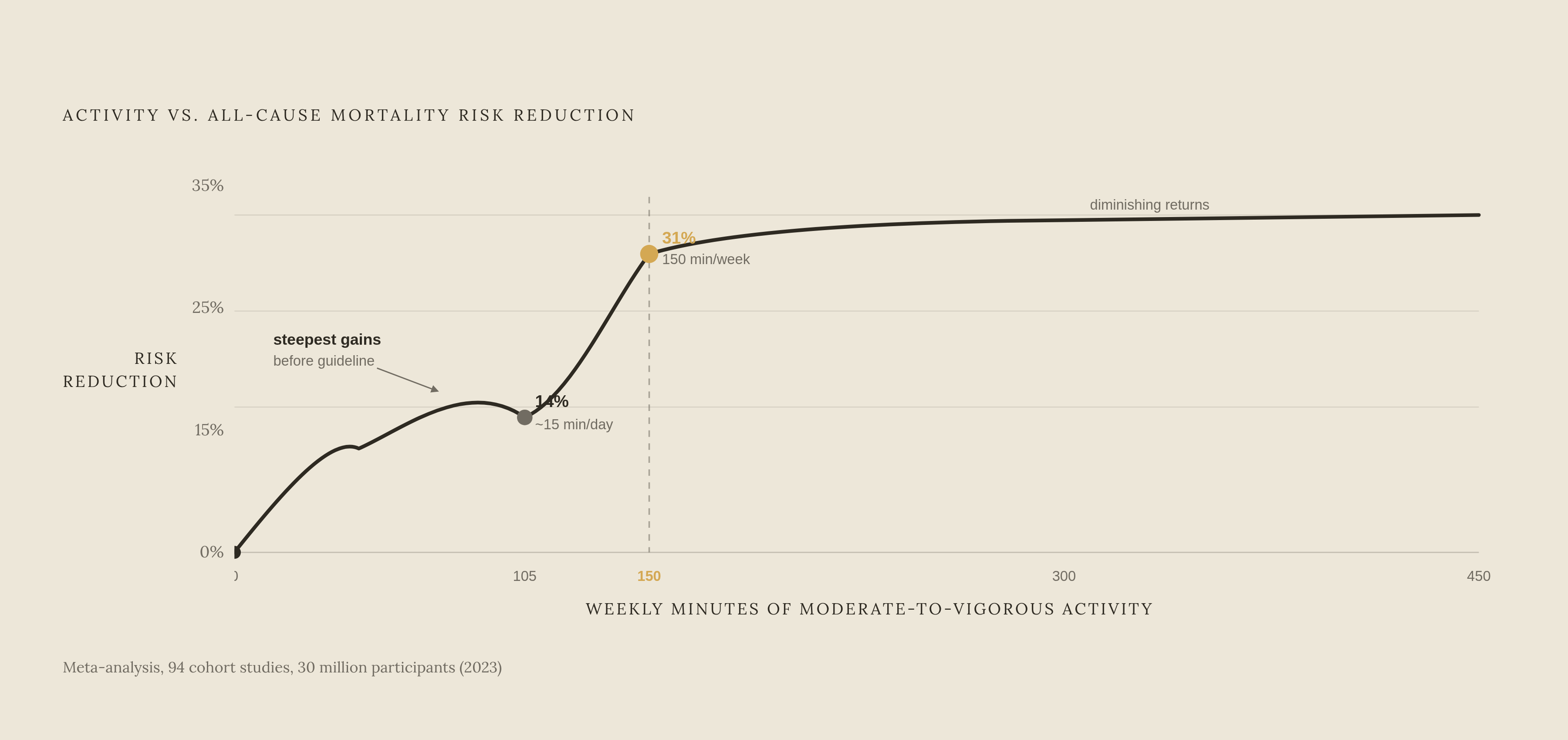
A 2023 dose-response meta-analysis pooling 94 cohort studies and more than 30 million participants mapped out the curve, and the shape of it should change how anyone thinks about a "workout." Hitting around 150 minutes of moderate-to-vigorous activity a week tracked with roughly a 31% lower risk of dying from any cause, compared to doing nothing. More kept helping, but each extra chunk bought less than the last one. The curve bends hard early and flattens fast, with the greatest gains concentrated at the low end of the activity range.
Even falling short of the guideline counted for a lot. People who exercised less than the recommended dose still saw close to a 20% lower risk of death compared to people who did nothing at all, and the floor sits lower than most people assume. Just 15 minutes of moderate activity a day tied to a 14% drop in all-cause mortality versus no activity.
The WHO caught up to this in 2020 and quietly dropped its old rule requiring activity to come in chunks of at least 10 minutes to count. "Every move counts" "Every move counts" is the actual policy now. For anyone who's spent years assuming a gym membership and a spare hour are the entry fee before movement is worth anything, that rule change is the whole ballgame. The floor works. Nobody serious is asking for the ceiling.
Walking as the most forgiving entry point (and how little is enough)
The 10,000-step target never came from a lab. It came from a marketing campaign for a pedometer decades back, and it stuck around the way chain letters stick around: nobody questioned it hard enough to make it stop. Most adults are somewhere between 4,000 and 5,000 steps on an average Tuesday. The "goal" was always further from where people stand than it needed to be.
A large global review covering 57 studies found that 7,000 steps a day delivers benefits for reducing early death and disease close to what 10,000 produces. That's the goalpost moving nearly a third closer to where most people already are, and it's the number worth aiming for instead of the round one a pedometer salesman picked.
Timing beats total count, too, and most step-counters miss this point. A study out of the University of Sydney, published in Annals of Internal Medicine, found that walking in uninterrupted stretches of 10 to 15 minutes cut cardiovascular disease risk by two thirds, beating the same step total taken in scattered, stop-start bursts across the day. Walking around 100 steps a minute (a brisk, slightly-late-for-something clip) beats a stroll on payoff.
Scaling the smallest version of this up makes the numbers get strange. Research in JAMA Internal Medicine estimated that adding just 10 minutes of daily walking, across the population, could prevent as many as 110,000 premature adult deaths a year. Someone doing almost nothing right now can close the gap to 7,000 steps with a couple of 10 to 15 minute walks, and that fits inside a lunch break. No new shoes required. No new personality, either.
Strength training at the minimum works: one set, once a week.
Lifting weights has an image problem. It sounds like something that needs a coach, a plan, and four days carved out of a week that has no free days left in it. None of that is true at the minimum dose, and treating the minimum dose as a lesser, watered-down version of "real" training keeps people out of the weight room.
David Behm, a researcher at Memorial University of Newfoundland, told NPR that someone brand new to strength training should start with one session a week: one set of six to twelve reps, on a handful of multijoint moves like squats, chest presses, and rows. That's the whole plan for the first three months. No five-day split, no periodization spreadsheet, no app asking for a credit card before it lets you in.
James Steele's research backs this up at scale. Tracking nearly 15,000 people over as long as seven years, training about once a week for roughly 20 minutes total, participants got 30% to 50% stronger. A peer-reviewed overview in Sports Medicine (Nuzzo et al., March 2024) confirms single-set training and so-called "weekend warrior" schedules carry the strongest evidence among minimal-dose approaches, and every minimal-dose strategy the researchers reviewed produced real strength gains.
Intensity is the catch, and it's non-negotiable. The set has to get pushed close to failure, where the last rep is a negotiation. That intensity is the variable making 20 minutes a week actually work instead of just feeling like it should.
None of this makes one set a week the ceiling. A 2026 study in BMC Sports Science (Coskun & Kafkas) found multiple-set programs beat single-set programs on muscle growth (cross-sectional area up 11.3% versus 6 to 8%) and on strength gains in the bench press (+19.8%) and squat (+14.8%). More sets win, every time, when someone's willing to do them. But the Sports Medicine review's own language cuts through the comparison: "something is better than nothing," and "every muscle contraction counts." For someone who hates exercise, one session, a few moves, one hard set each, is a real workout. Not a participation trophy.
What ultra-short home exercise produces in five minutes a day
Twenty minutes a week still sounds like too much to some people, and there's data on something even smaller: five minutes a day, at home, no equipment, no excuse involving traffic to a gym.
A study published by Springer (Kirk et al.) tested exactly that: a 5-minute daily bodyweight routine over four weeks with sedentary participants. The moves were unglamorous on purpose, basic bodyweight exercises with simple progressions as people got stronger. No dumbbells, no bands, no subscription pinging a phone at 6 a.m.
After four weeks, participants saw meaningful improvements in muscle strength and flexibility, plus real jumps in strength endurance and measurable mental health improvements. The number that actually matters for someone who dreads exercise sits apart from all of those, though: adherence was notably high. Nearly everyone who started, finished.
A program with great numbers on paper that nobody sticks to is worth nothing. A five-minute program that almost everyone completes is worth quite a lot, even when the per-session gains look small next to a full gym workout. That's the whole logic behind the WHO dropping its old 10-minute minimum. Five minutes still counts, and the data backs that up rather than just permitting it.
HIIT as an option for people who are bored, not just busy
HIIT gets sold as the answer for people short on time. The sharper case for it is people who are short on patience with steady-state cardio, a different problem. Brief bursts at 80 to 100% of peak heart rate, mixed with rest, match or beat moderate continuous training on cardiorespiratory fitness in a fraction of the time.
The enjoyment angle gets buried in most coverage, and it shouldn't be. Research has found participants tend to rate HIIT sessions as more enjoyable than steady moderate cardio, with a clear majority saying they preferred it. Those were recreationally active people already, not folks coming off the couch cold. "This solves boredom once a base already exists," the lesson goes."" It's "this solves boredom once a base already exists."
Tabata runs 8 rounds of 20 seconds of work with 10 seconds of rest, just 4 minutes of actual effort, and it improves both aerobic and anaerobic fitness. The 7-minute workout, developed by exercise physiologists Brett Klika and Chris Jordan, strings together familiar bodyweight moves (jumping jacks, push-ups) in 30-second bursts with 5 seconds of rest between them. Researchers keep finding real endurance and health gains from it despite how short it runs.
It carries a higher injury risk for true beginners, and researchers note it isn't the safest starting point for people with poor cardiorespiratory fitness or a shaky track record of sticking with anything. Start with walking, or the 5-minute bodyweight routine, instead. Graduate to HIIT once showing up stops being the hard part, not before.
Why a low-dose routine fails without a structure for showing up
None of the numbers above matter if the plan only lives on paper. Across studies of fitness club members and the general population, the two most commonly cited barriers to sticking with exercise are lack of time and lack of motivation. That's a scheduling problem dressed up as a willpower problem.
Implementation intentions, a dry academic term for a simple move, mean deciding in advance exactly when, where, and how a behavior happens. "I'll walk 15 minutes every weekday at 7:30 a.m., right after coffee" Behavioral research cited by ACE Fitness shows this beats "I'll try to walk more" by a wide margin. Building a habit takes consistent repetition over weeks before showing up stops feeling like a decision.
Enjoyment isn't optional, and treating it as a soft, feelings-based afterthought rather than a design requirement is where most plans quietly fall apart. If running feels like punishment, swapping in hiking, dancing, or strength training applies the same evidence the rest of this piece leans on. The dose itself should grow the way weight on a barbell grows: gradually. Handing someone a five-day program because it's theoretically optimal is a classic coaching mistake. Adding one more day, one more set, five more minutes of walking, works as progressive overload applied to behavior instead of muscle.
Accountability helps too, but only the light-touch kind. Someone noticing a person showed up, without grading how well they did it, moves the needle on motivation more than any dashboard or streak counter ever will. Shared habits outlast solo resolutions. Pick one thing, tie it to something already happening daily (coffee, the commute), and keep it small enough that skipping it takes more effort than doing it.
Putting it together: a concrete minimum that a real person who hates exercise can start Monday
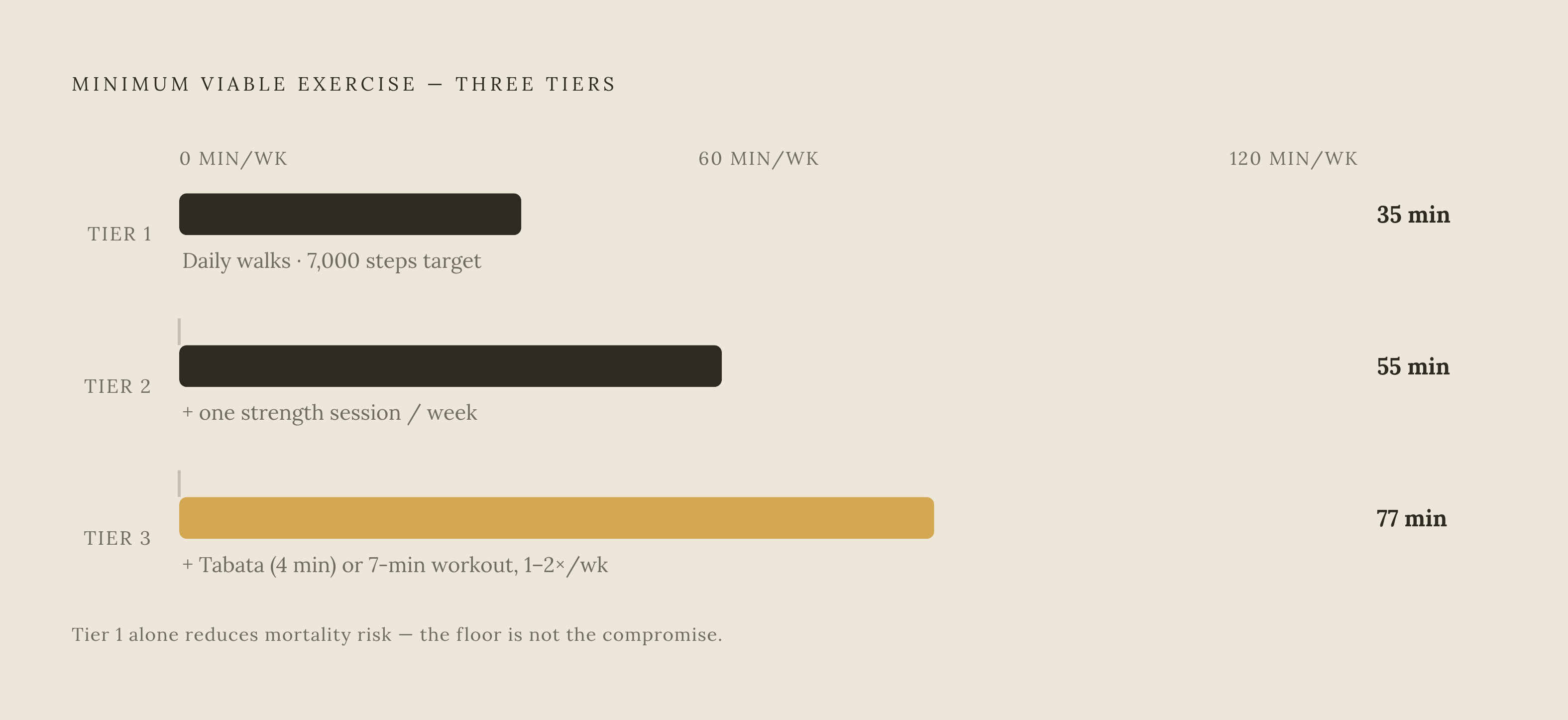
Sort this by how much time and willingness exists right now, not by fitness level. Fitness level is a lagging indicator. Willingness is the thing that actually predicts Monday.
Tier 1, the absolute floor: five minutes of bodyweight work at home daily (basic moves like chair squats, wall push-ups, and similar exercises, the Kirk et al. protocol), or a 10 to 15 minute continuous walk on three or more days a week, building toward 7,000 daily steps.
Tier 2, a bit more, still small: one strength session a week (a handful of compound moves, one set each, pushed close to failure), stacked on daily walks approaching 7,000 steps in 10 to 15 minute chunks.
Tier 3, once showing up stops being the hard part: add one Tabata session (4 minutes) or the 7-minute workout, once or twice a week.
What does this actually buy someone? Real reductions in mortality risk, strength gains in the 30 to 50% range from studies built around a single weekly session, and measurable mental health improvements backed by data rather than good intentions. None of this is optimal, and it shouldn't get sold as optimal. Single-set training won't build maximum muscle. Short walks won't max out cardiovascular fitness the way marathon training would. Nobody serious is claiming otherwise.
The real competition was never between this plan and the optimal one. It was between a great plan abandoned by February and a modest one still running in December, and the second one wins every time that matters. The minimum viable workout is whatever version a specific, exercise-averse person keeps doing next week, and the week after that, not whatever version scores best in a study nobody involved actually read. A shared goal with a friend, partner, or family member, even something as small as a step count check-in, makes coming back after a missed day more likely. Nobody has to do the workout together for the connection to hold the whole thing up.
Sources
- The minimal effective dose of exercise for real health benefits | Prenuvo blog
- What’s the Minimum Effective Dose of Exercise? - Storm Fitness Academy
- Research says this is the 'minimum dose' of gym time you need to see results : NPR
- The Minimum Effective Dose: How Little Exercise Can Still Extend Lifespan - Pierre Health
- link.springer.com
- Resistance Exercise Minimal Dose Strategies for Increasing Muscle Strength in the General Population: an Overview
- researchgate.net
- acefitness.org