Why Missing One Workout Turns Into Missing a Month
One missed workout triggers self-judgment that turns a lapse into a relapse.
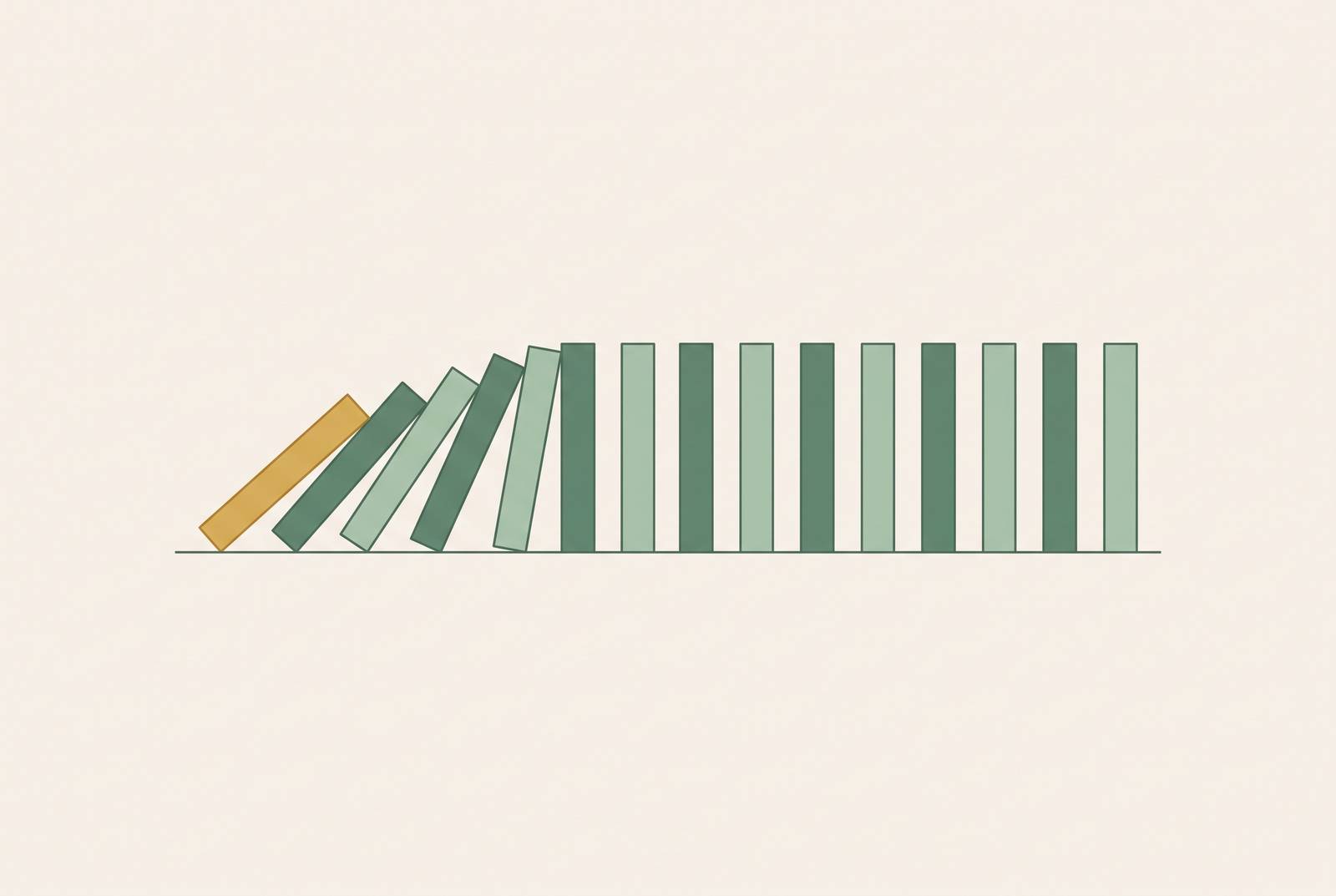
About one in three gym members quit within a year. Eighty percent of resolution exercisers have already bailed by February. About one in three gym members quit within a year, and eighty percent of resolution exercisers have already bailed by February, a sharp cliff rather than a slow leak. It's a cliff, and when the fall happens determines how much of the year's membership base is lost before it can be recovered.
Behavioral tracking has even put a date on it. The second Friday in January (January 9 in 2026) marks the point where resolution-driven exercisers quit in the largest numbers, nicknamed "Quitters' Day." A single day, precise enough to name, doesn't look like boredom or a busy week at work. It looks like a psychological trigger going off on schedule. Most of the people who quit meant to keep going. The gap between meaning to and actually doing it is the real subject here, not some referendum on willpower.
What the abstinence violation effect is and why it matters here
Addiction researchers Marlatt and Gordon named this back in 1985, long before anyone thought to apply it to gym attendance. The abstinence violation effect describes what happens when one slip triggers a landslide of self-judgment, the "I already blew it, so why bother" spiral, that ends with someone dropping the goal.
The miss itself rarely does the damage. The story someone tells about the miss does. Skipping a Tuesday workout costs exactly one Tuesday workout. Deciding that the skip proves you're a failure who can't stick to anything costs the whole plan.
Behavioral scientists also call this the "what-the-hell effect," a friendlier name for the same collapse. Crossing the mental line once flips the internal logic: why half-follow a plan that's already ruined?
Research by Roordink et al. draws a line between a lapse and a relapse: a lapse causes only a brief interruption, while a relapse causes a full return to sedentary life. A lapse is a short return to inactivity, a week off, maybe less. A relapse is a pattern of lapses stacking into a full return to sedentary life. Catching the lapse before it becomes the relapse is the entire game here. One is a pothole. The other is the road closing.
How all-or-nothing thinking turns a scheduling problem into a self-concept problem
A late-2025 study in BMC Public Health, led by University of Michigan researcher Michelle Segar, ran four focus groups with 27 adults, ages 19 to 79, all repeat offenders when it came to failing to keep an exercise habit going. Segar's finding: all-or-nothing thinking kicks in the moment a specific exercise plan stops being workable. Instead of adjusting the plan, people scrap it whole.
Four patterns kept appearing in the data.
Rigid, idealized criteria came first: a session only counts if it runs 45 to 60 minutes, involves real intensity, and happens inside an actual gym. Anything short of that rounds down to zero in someone's head. Active excuse-hunting also appeared in the data, especially among older participants who found exercise physically effortful and emotionally loaded, which made skipping feel like relief rather than failure. Segar's team also flagged what they called "exercise is expendable": when the calendar tightens, the workout is the first thing cut, because skipping it feels consequence-free in the moment. That rarely happens; it just feels that way. It just feels that way. Strangest of all was the genuine confusion participants had about their own inactivity. Plenty of them remembered enjoying exercise. The activity was never the problem. The mindset wrapped around it was.
Decades of public health messaging trained people to think in thresholds: hit your reps, hit your minutes, don't break the streak. That messaging taught a generation that movement below the line doesn't count for anything, and newer research says that's backwards, some movement beats none by a wide margin. The older, stricter rule is still baked into most people's heads regardless, and it doesn't unlearn easily.
Segar's team found these skip decisions get made "outside of awareness." That makes the mindset genuinely dangerous. It isn't an argument happening in someone's head that a good counterpoint could win. It operates before conscious thought and makes the call before the person even clocks that a decision was on the table.
Missing twice, not missing once, is the real inflection point
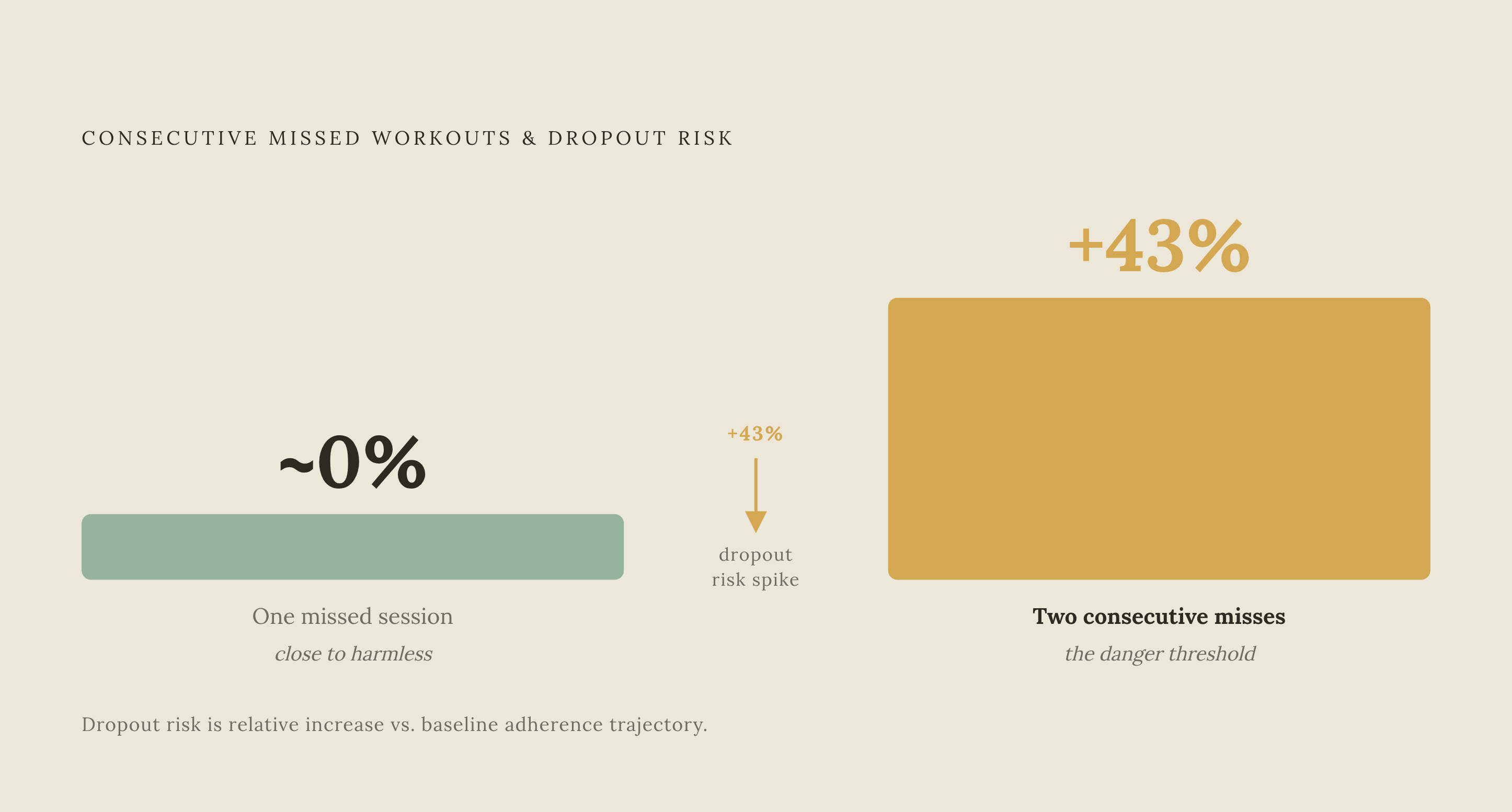
Frame this one and put it on a wall: missing one workout barely dents long-term habit formation. Missing two in a row is where the risk spikes, associated with a 43% jump in dropout risk.
"Never miss twice" used to sound like folk wisdom. Now it's just data. The asymmetry carries the whole argument: one skipped session is close to harmless, but two in a row starts reinforcing a pattern of absence that sharply raises the odds of dropping out altogether.
A study in the International Journal of Behavioral Medicine, drawing on 176 Latina participants in an exercise intervention, found lapse probability at 18% after one month. By month four, that number climbed to 34%. Risk didn't shrink as the routine matured, it grew. That guts the comfortable assumption that once you're "in a groove," you're safe. The groove doesn't protect anyone the way people assume it will.
Streaks deserve real skepticism here too. A visible streak counter motivates hard, right up until it breaks, and then the abstinence violation effect lands with extra force because the streak was the entire motivation. Snap it, and there's nothing left holding the routine up. Gamified streaks can end up manufacturing the exact dropout they were built to prevent.
Habit fragility at the moment of the first missed session
The 21-days-to-form-a-habit claim needs to die. It traces back to a misreading of Maxwell Maltz's writing decades ago and has no real science behind it.
A systematic review out of the University of South Australia found the median window for forming a new habit runs 59 to 66 days, with a full range from 4 days to 335 days, and averages landing anywhere from 106 to 154 days depending on the study. That range is too wide to predict anyone's individual timeline, and that's kind of the point. Habits don't run on a universal schedule.
Most people hit their first missed workout well before any habit has actually locked in. They're running on raw motivation, not automatic behavior. The psychological cost of a miss is highest at exactly the moment it's most dangerous. Bad timing, built right into the system.
That wide range helps explain why generic, one-size-fits-all plans tend to snap under the first bit of pressure. Stress compounds the problem, which is why travel, illness, and work chaos repeatedly appear as the classic dropout triggers, any disruption to a routine that hasn't fully solidified yet can send someone back to the old pattern.
None of this is about blame. It comes down to timing, and the timing is stacked against people at exactly the point they're most exposed.
The self-criticism loop that makes recovery harder than the original miss
Self-criticism does more than feel bad. Self-criticism does more than feel bad, research on self-compassion points to physiological stress responses, including cortisol release, as part of the picture. That kind of chronic stress response can work against the next workout getting scheduled. The body keeps score whether anyone's asking it to or not.
A systematic review by Roordink and colleagues, published in Psychology & Health, identified self-efficacy, a person's belief in their own ability to bounce back, as a key predictor of whether a lapse becomes a relapse. Shame goes straight after that belief. It erodes the exact trait that predicts whether someone recovers.
Research on lapse and relapse in both diet and exercise adherence has consistently identified negative emotion as among the most common triggers. The emotional spiral is the mechanism of the real problem, not something separate from it. It is the mechanism.
An identity layer produces this pattern: each workout builds or damages a person's self-concept as "someone who exercises." Writing in Psychology Today (Kompf, 2025) frames each workout as a small piece of evidence for the self-concept "I am someone who exercises." Each missed session sends the opposite signal. On its own, that's manageable. Wrapped in a shame spiral, the signal gets amplified until the whole story flips, and "I'm someone who works out" quietly turns into "I used to."
What interrupts the cascade before it becomes a month off
"Never miss twice" works as more than a motivational sticker. It functions as a cognitive circuit breaker. Building in the expectation that one miss is normal strips out the binary thinking the abstinence violation effect needs to survive. No binary, no spiral, nothing for the shame story to grab onto.
Friction matters before the miss ever happens. Kompf's Psychology Today piece points to proximity: if starting a workout takes ten decisions and a drawer full of gear to dig through, inertia wins before effort even gets a vote. Laying out clothes the night before, keeping equipment visible, cutting the steps between deciding and doing, none of that is complicated. It's just environmental design.
Implementation intentions help too, the "after I [x], I will work out" structure. Tying a workout to something already happening, rather than a vague intention to exercise more, produces meaningfully better adherence.
Social accountability turns out to be one of the sturdiest catch-nets around. Group class attendees stay roughly 20% longer than solo exercisers, which lines up with Self-Determination Theory's claim that relatedness, connection with other people, is one of three pillars behind motivation that actually lasts. Research from IHRSA and Dr. Paul Bedford found that 87% of members who get a genuinely positive onboarding experience stick around six months or more. The social texture of those first few weeks shapes long-term retention more than the workouts themselves. A partner who notices the first skip and responds with curiosity instead of judgment is basically an informal, human version of the never-miss-twice rule. No app required.
Self-compassion belongs in this list too, and it's not the same thing as making excuses. Treating a missed session the way an actual friend would, with context and a little grace, starves the shame spiral of what it needs to grow, without lowering the bar on the goal itself.
What gets tracked matters as much as whether tracking happens. A 2018 study in the Journal of Sport and Exercise Psychology found people tracking process, sessions completed per week, showed substantially higher six-month adherence than people tracking outcomes like weight or body fat. The win becomes showing up.
Timing consistency helps more than most people expect, too. A Health Psychology study found people who worked out at the same time every day had notably higher adherence than people with a floating schedule. Fixed timing kills the daily re-negotiation with yourself, and that negotiation is exactly where willpower quietly bleeds out.
How a partner or shared routine changes the math on skipping
The abstinence violation effect feeds on isolation. Shame gets loudest in private, so a partner who knows about a missed session changes the entire internal monologue, simply by turning the lapse social instead of secret.
Shared fitness doesn't require two people on the same treadmill at the same hour. A workout photo, a two-line check-in text, a lighthearted bet over who logs more sessions this week, all of it builds the relatedness Self-Determination Theory points to as a pillar of intrinsic motivation, without demanding matching calendars. The goal is a net underneath the routine, not a synchronized performance sitting on top of it.
Tone decides whether that accountability helps or backfires. A partner who asks "what got in the way?" keeps the door open after a missed session. A partner who applies pressure instead slams it shut and usually makes the shame worse. Simple shared goals, three sessions this week, say, give two people something concrete to root for without turning the whole arrangement into a performance review.
Missing a shared goal should lead to a conversation. Whether one missed session turns into a quick reconnect or a slow drift away from the whole arrangement comes down to the tone the two people already built before the miss happened. Apps, streak counters, photos, wagers, none of that is the system, those are just furniture. The relationship carrying the routine is the actual system, and the best tool is whichever one both people actually keep opening.

