Starting a Workout Routine With a Friend When Neither of You Is Fit
A friend at your exact fitness level beats going solo—if you both resist the urge to overdo it.
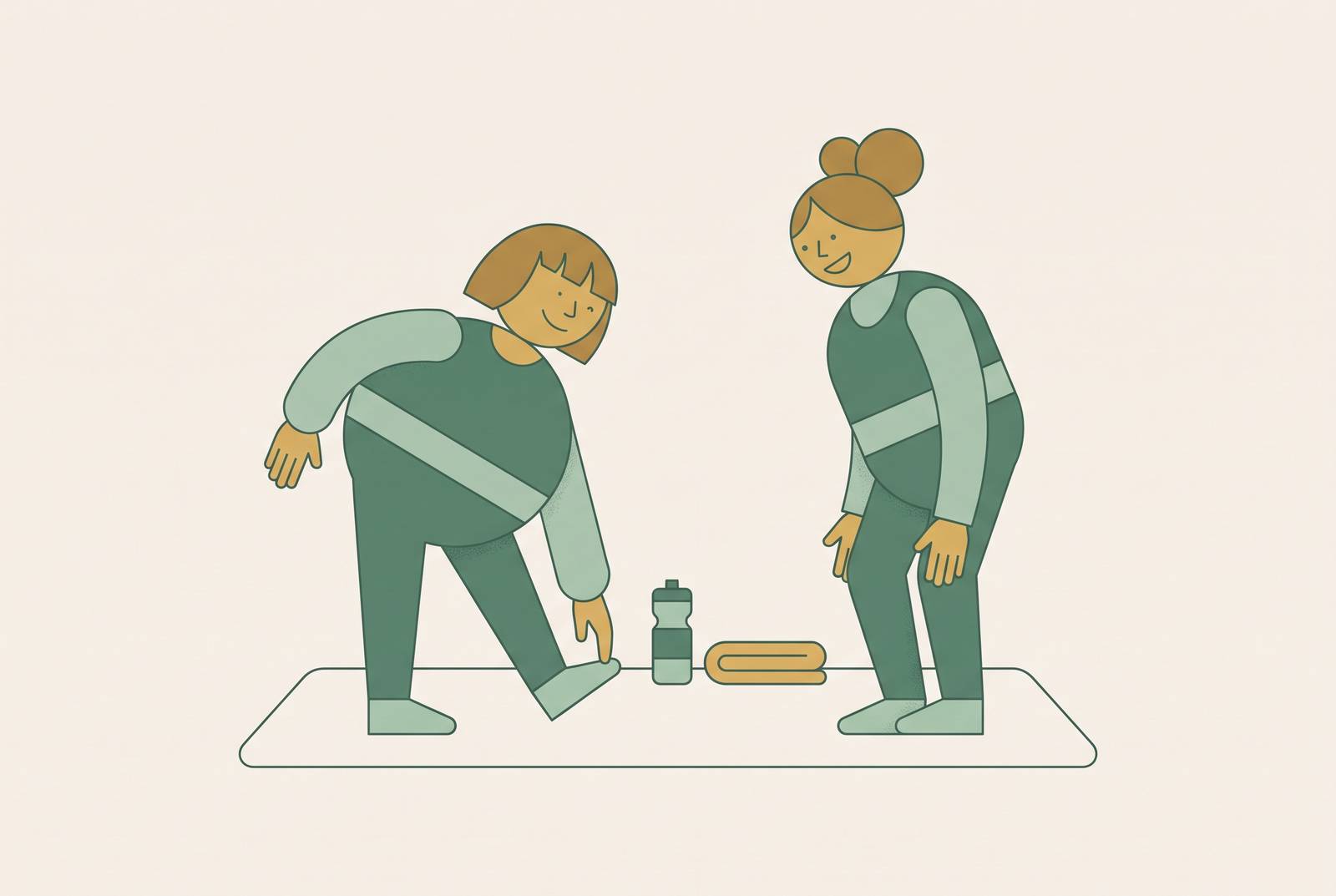
Roughly one in four adults in a given country adults gets basically no exercise, and even the more generous surveys can't get adherence to activity guidelines above two-thirds. That's not a knowledge problem. Almost everyone knows they should move more. What stops most people is the gap between knowing that and actually lacing up the shoes, and that gap is usually paved with intimidation.
One 2022 study cited by America's Health Rankings pinned a substantial 8.3% of deaths among nondisabled adults 25 and older on physical inactivity. That's not a rounding error. But nobody skips the gym because they're unaware inactivity is bad for them. They skip it because walking into a room full of people who already know what they're doing feels like showing up to a poker game where everyone else has read the rulebook and you're still figuring out which cards you're holding.
Performance pressure combined with intimidation produces paralysis. Starting alone means your only reference point is people already further along the curve, which makes a first attempt feel like a public audition for a role you haven't rehearsed. None of this is a personal failing. It's the predictable result of a specific set of conditions, and those conditions have a specific fix: a friend who's in exactly the same boat.
What the research says about exercising with another person
Start with the number that sounds almost made up: a Michigan State University study found people who worked out with a partner increased their workout duration and intensity by up to 200%. That jump doesn't come from politeness or company; something mechanical is happening. Something mechanical is happening.
Part of the answer is a documented quirk of human motivation called the Köhler Effect. Dr. Susie Reiner, assistant professor of Exercise and Sport Science at Seton Hall University (and formerly a postdoctoral researcher at the University of Kentucky's Sports Medicine Research Institute), explained in a Peloton piece: working out with others, especially in pairs, creates a competitive atmosphere, and people push harder simply because they know someone else is also trying. Mirror neurons back this up. Watching another person move sharpens your own focus and effort, almost by reflex.
Accountability data makes the case even harder to argue with. The American Society of Training and Development found that committing a goal to another person gives you a 65% shot at following through. Regular check-ins push that to 95%. A small 2020 study of nine romantic couples, published in the Journal of Racial and Ethnic Health Disparities, found that partners who exercised together logged about 20 more minutes of weekly activity than people going it alone. Research has found similar results: an exercise companion boosts activity, and an emotionally supportive one boosts it more. The BE FIT trial (Patel et al., JAMA Internal Medicine, 2017) tracked 200 adults across 94 families and found the team-based, gamified group hit step goals on 53% of days versus 32% for the control group, a gain of roughly 1,000 extra daily steps.
None of this means accountability is a silver bullet. There is a real divide between what gets someone off the couch and what keeps them showing up six months later; the two are not the same engine. Accountability also splits into two flavors. Accountability that is chosen and supportive tends to work differently than accountability that runs on guilt or imposed obligation, and the distinction shapes how long the habit actually lasts. Keep that distinction in your back pocket; it matters later.
Why two unfit people starting together is an advantage, not a liability
Multiple sources land on the same advice: pick a workout partner near your own fitness level. People who exercise with a similarly-fit friend tend to encourage each other and push harder together, BetterHealth Victoria notes. Peloton's piece makes the flip side clear too: when your partner is way out of your league, discouragement and comparison increase quickly.
Two beginners starting from zero satisfy that condition automatically. Nobody negotiated it, nobody had to slow down for the other. Neither person is ahead, so neither person is dragging anyone else along, and that changes the entire emotional tone of the first month.
Shared struggle also builds something research keeps finding value in: closeness. Research on shared physical challenges has found that people who felt they relied on each other and cooperated more came out of it feeling closer, with a real bump in overall wellbeing. Fumbling through a first attempt at a plank together does something similar, on a smaller scale. There's no performance hierarchy to bruise anyone's ego, no quiet resentment building because one person keeps waiting on the other.
Calling two out-of-shape people "a liability" gets the framing backwards. Two people starting at the same square aren't a problem waiting for a fix, they're standing on the exact spot where lasting partnerships tend to form. Research has found that emotional support, encouragement, empathy, actually celebrating small wins, mattered more for keeping exercise habits alive than practical logistics like a shared carpool or a laminated workout plan. Translation: showing up for each other beats showing up with a spreadsheet.
The single biggest risk two beginners face: doing too much too soon
Exercise equipment and activity caused an estimated 564,845 injuries in 2024, the single largest category of sports and recreation injuries tracked. That's the backdrop against which every enthusiastic beginner should read the next few paragraphs.
Muscles, tendons, and joints need time to adapt. Jumping from sedentary to vigorous also happens to be the window of highest cardiac risk for someone unaccustomed to exertion. A 2025 study in the National Library of Medicine found stress fractures tend to peak two to three weeks after a sudden jump in training intensity, which is exactly the window when two newly motivated friends start daring each other to add another set.
That's the catch with pairs specifically. The same dynamic that pushes two people to work harder together can tip mutual encouragement into a quiet arms race neither person meant to start. One person adds five minutes, the other matches it, and within two weeks the "we're just getting started" pace has turned into something neither body signed up for.
Watch for the signs: soreness that won't quit, dragging fatigue, restless sleep, a low mood, dread creeping in before a session that used to feel fine. Those aren't weakness, they're data. Overtraining raises injury risk, and rest days aren't a reward you earn, they're part of the program. Agree upfront, before either of you needs to say it out loud, that backing off is part of the plan. It's the move that keeps you both in the game long enough to actually get somewhere.
Social media doesn't help. Fitness experts warn that the pressure to chase elite physiques and advanced routines, often without any instruction behind them, sets beginners up for injury, burnout, or just quitting in disgust. Two beginners egging each other toward a social-media workout routine neither of them is conditioned for is a faster route to the couch than to the finish line.
How to build a schedule two beginners can keep
The American College of Sports Medicine's 2025 guidelines put the target at 150 minutes of moderate activity a week, plus at least two days of strength work. Three sessions a week is the recommended starting frequency, enough to build the habit without outrunning recovery. Most beginners eventually build toward more frequent sessions, mixing upper body, lower body, and some mobility work.
A sample starter week, adapted from a December 2024 piece by Maximize Potential, looks almost insultingly modest:
- Monday: a 15-minute walk or light jog
- Wednesday: 10 minutes of bodyweight work, squats, push-ups, planks
- Friday: 20 minutes of yoga or stretching
In week one, the goal isn't a personal record, it's proving to your own brain that showing up is something you actually do now. Build the schedule together rather than one person handing the other a plan; shared authorship means neither of you feels like you're following someone else's homework, which matters a lot when week three gets busy and motivation dips.
Before starting, a quick medical check-up is worth the hour, especially after a long stretch of inactivity. A basic physical can catch something that would otherwise turn a good-faith training plan into an injury. Snap a "before" photo and jot down a plain baseline, how many push-ups, how far a walk feels, because progress that's invisible day-to-day becomes obvious in hindsight. Put the sessions on the calendar like any other standing plan with a friend. Same day, same time, every week. Removing the weekly negotiation over "when should we go" removes one more excuse from the table.
Setting goals the pair can share without creating pressure
SMART goals (Specific, Measurable, Achievable, Realistic, Time-framed) exist for a clear reason: structure keeps motivation from evaporating the moment direction gets fuzzy. Short-term fitness goals work best when the horizon is close enough to feel real. Solid beginner-level targets include finishing a 30-day strength program, walking 30 minutes daily for a month, or running a 5K.
Big goals need to get chopped up. If the long-term aim is 20 real push-ups, an intermediate milestone (say, five knee push-ups by the end of week two) gives the pair something to actually hit on the way there.
Split process goals from outcome goals. A process goal (we show up three times this week) is fully within the pair's control and can be celebrated together, no asterisks. An outcome goal (someone's weight, someone's mile time) rides on genetics, history, and body type, and turning that into a shared scoreboard invites comparison nobody asked for.
Dr. Gail Matthews at Dominican University of California found that people who wrote down their goals and sent weekly progress updates to a friend succeeded more than twice as often, over 70% compared to 35% for people who kept goals private. The act of telling someone, not just deciding something, is doing the heavy lifting. A one-line text or a quick photo each week does more for momentum than any tracking app both of you will abandon by March. And when one of you misses a target, that's a conversation starter, not a confession booth. Whether the partnership runs on autonomous accountability (supportive, chosen) or controlled accountability (guilt-driven, imposed) decides whether a missed week brings you closer or quietly drives a wedge.
The form problem: what two beginners can and cannot do for each other
An extra set of eyes counts for something. YMCA Whittier points out that a workout partner can catch form mistakes and flag safety issues neither person would notice alone, mid-set, in a mirror, by themselves.
If neither of you knows what correct form looks like, you're not correcting each other, you're synchronizing the same mistake. Two people confidently squatting with the same rounded lower back isn't accountability, it's a matched set of future chiropractor visits.
That's an argument for feeding the buddy system a little outside expertise early on. It's an argument for feeding it a little outside expertise early on. One session with a trainer to nail the fundamentals, a handful of instructional videos from a credentialed source, or a group fitness class where an instructor is correcting form for both of you at once, any of these closes the gap cheaply. And there's something almost refreshing about a pair who can turn to each other mid-set and say, "I don't think we're doing this right." That kind of honesty is its own form of accountability, and it sets a far healthier tone than two people quietly competing to look like they know what they're doing. Shared tools, the kind that just track who showed up and when, can keep the connection alive between sessions without either of you needing to become a self-taught kinesiologist.
What to do when one person progresses faster
Two people can do the exact same workout for months and see completely different results. That's not a motivation gap, it's biology. Genetics, sleep, stress, hormones, prior training history, all of it shapes how a body adapts, and none of it is something either person controls by trying harder.
When the gap becomes visible (one person's running a mile easier, the other's still catching their breath at the same distance), comparison creeps in fast. The person behind starts to feel inadequate. The person ahead starts to feel held back. Neither feeling does either of them any good.
This is exactly where the British Journal of Health Psychology finding earns its keep: emotional support, encouragement, empathy, actually celebrating each other's wins, mattered more for sustaining exercise habits than any practical logistics ever did. A few things keep asymmetric progress from curdling a partnership. Keep the shared goals at the process level (we showed up three times this week) rather than the outcome level (whose numbers look better). Celebrate individual milestones on their own terms, without quietly measuring one against the other. If one person's ready for a harder variation, do the same movement at different intensities in the same session, same plank, different hold time. A lighthearted reward tied to consistency (showing up), never to performance, keeps the stakes fun instead of tense.
Peloton's April 2025 piece adds a useful nudge here: if one partner starts feeling inadequate during shared training, a little self-reflection and self-encouragement goes a long way, remembering that everyone's running their own genetic and biological race quiets the comparison spiral fast.
What actually holds a partnership like this together is mutual respect for each other's effort. It's mutual respect for each other's effort. A pair that can sit with uneven progress without it curdling into resentment has built something most solo exercisers never get access to: two people who started knowing nothing, together, and came out the other side with a shared vocabulary of bad first attempts, dumb inside jokes, and small wins nobody else witnessed. No optimized solo program manufactures that. It only happens because two unfit people showed up, at the same low point, and decided to figure it out side by side.
Sources
- Benefits of Working Out with a Friend | YMCA OF SOUTH FLORIDA
- 5 Science-Backed Benefits of Working Out with Friends
- The Power of Partnership: 8 Benefits of Working Out with a Friend or Workout Buddy - YMCA Whittier
- Exercise with a friend
- ptsmc.com
- maximizepotentialtx.com
- Social reward and support effects on exercise experiences and performance: Evidence from parkrun
- Better together: The impact of exercising with a romantic partner - Kyrsten Sackett-Fox, Judith Gere, John A. Updegraff, 2021

