How to Start Exercising Again After Years Off
Rebuild fitness faster than you lost it by understanding what happens to your body during downtime.
WHO data show that about 1.8 billion adults worldwide don't move enough to meet basic health guidelines. That's 31.3% of the global adult population. In one national estimate, roughly a quarter of adults report zero leisure-time physical activity. This is a story about how to come back once you've stopped, and why the return trip matters more than people think. It's a story about how to come back once you've stopped, and why the return trip matters more than people think.
The numbers get more interesting when you dig in. Thirty-one million adults age 50 or older in that same country are inactive beyond the basic stuff daily living requires, which torpedoes the idea that this is some young-person's-excuse problem. And the inactivity gap tracks income hard: adults in households under $25,000 a year show inactivity rates more than four times higher than adults making $150,000 or more. Structural. Demographic. Not a character flaw.
Given how many people are restarting from a real deconditioned baseline (not "I skipped two workouts" deconditioned, but "I haven't jogged since a previous presidential administration" deconditioned), it helps to know exactly what happened to the body in the meantime. Then the comeback plan makes a lot more sense.
What happens to the body during years of inactivity
Cardiovascular fitness is the first thing to go, and it goes fast. Within one to two weeks off, it's already declining. By the two-to-four-week mark, blood volume drops somewhere in the 5-10% range, and the standard measure of how efficiently the body uses oxygen can fall by up to 7%. The mechanism is fairly mechanical, if you'll forgive the pun: less blood volume means less fills the heart's ventricles when standing or moving upright, so the whole oxygen-delivery pipeline gets less efficient.
Strength is the tortoise to cardio's hare. Two weeks of total rest barely dents it. Losses start around week three, and by week four, real strength loss appears, alongside endurance losses that occur even earlier than that.
Tendons and ligaments do not read the same recovery calendar as muscles. Muscle can rebuild strength faster than connective tissue can adapt to new load, and that mismatch is a leading cause of comeback injuries. Dr. Trevor Turner of CartiNova/Pravida Health put it simply: even someone in decent cardiovascular shape still has tendons and ligaments that take much longer to catch up. Older adults feel all of this more sharply, losing both strength and fitness faster and more completely than younger adults once activity stops.
Someone sidelined by an injury or illness experiences more disruption to muscle protein synthesis than someone who just got busy and stopped showing up. Both are valid reasons to have stopped. Neither is a moral failing. And none of this is a reason to panic or delay starting again, since it's just the terrain.
Why previous training is not wasted (the muscle memory effect)
"Muscle memory" gets thrown around loosely, but it's really two separate things working together. One is motor learning: the neural wiring for movements like a squat or a swim stroke stays remarkably durable, even after years away. The other is physiological, and it's the more surprising one. Trained muscle holds onto myonuclei, essentially the control centers that manage protein synthesis inside a muscle fiber, even as the muscle itself shrinks during a long break.
Research has found that the effects of prior strength training can persist long after subsequent inactivity, because those myonuclei added during training stick around even through significant atrophy. Research in Frontiers in Nutrition backs this up: a study in young adults showed that myonuclear number gained during training was almost entirely retained after 16 weeks of detraining, even though muscle fiber size and mass dropped. This research area still has real debate in it. Different study designs produce different results, and there are technical limitations to how myonuclei get counted. Nobody's claiming settled science here.
What it means practically: someone getting back into lifting after a long layoff typically rebuilds their previous muscle size considerably faster than it originally took to build it. Strength often comes back quickly as well, since the neural pathways for familiar lifts tend to reactivate early in the return process.
The catch is that this advantage scales with history. Someone who trained hard for years has a deeper reserve than someone who trained casually for six months. And for someone who has genuinely never exercised before, none of the myonuclei banking applies, there's no vault to reopen. Starting small still matters just as much for that person, though. They're not reactivating old gains, they're making a deposit for a future version of themselves who will benefit later.
Realistic timelines for getting fitness back (what the research says)
The honest answer is a range, not a number. For moderate breaks, two to 12 weeks generally gets someone feeling back to a previous fitness level, but that range assumes weeks or a couple of months off, not years.
For breaks of six months or longer, expect the timeline to stretch. Regaining previous conditioning typically takes two to three months of consistent training. Getting back to, or eventually surpassing, previous strength levels tends to run three to six months, sometimes longer.
The good news is that motivation-boosting wins appear well before full recovery does:
- Energy levels noticeably improve within about two weeks
- Cardiovascular gains become apparent in three to six weeks
- Strength gains become noticeable within roughly two months
Mobility follows a similar curve, small improvements in range of motion and stiffness appear within two to three weeks of consistent stretching, with more meaningful gains occurring around the four-to-six-week mark. One research benchmark found muscular strength returned to pre-break levels after about eight weeks of retraining, reinforcing a genuinely encouraging pattern: getting back to where someone used to be is almost always faster than it was to get there the first time.
None of this should get flattened into a false promise like "six weeks and you're back." Age, prior training history, and plain consistency all move these numbers around. The range is the honest answer, not a hedge.
Whether to see a doctor before starting
Should there be a doctor's visit before lacing up? Sometimes yes, and the guidelines are fairly clear about when.
Joint guidelines from sports and strength conditioning bodies recommend a pre-participation exam from a primary care or sports medicine physician before starting training after a long absence, to screen against serious risks that can arise when someone goes hard too fast after time off.
One sports medicine body has actually moved away from blanket risk-factor checklists in favor of a stratified algorithm, one that looks at current activity level, chronic disease history, symptoms, and intended exercise intensity. The explicit goal there is removing unnecessary medical hurdles, not adding them.
For most people, a simpler tool does the job: the PAR-Q+ (Physical Activity Readiness Questionnaire for Everyone), a standard self-screening checklist. The tool is designed so that most people can clear themselves for activity with no issues, while those with a medical or mental health flag get directed toward further evaluation before proceeding. That distinction matters, it's a meaningful minority, not a rounding error.
Some researchers have questioned whether universal pre-exercise screening is even necessary, noting that the field still needs more discussion on the relationship between screening protocols and actual adverse event outcomes. Translation: screening exists to reduce risk, not to predict every possible outcome with certainty.
The practical rule of thumb: anyone returning after an injury, a long-term illness, a chronic condition, or anyone significantly older should get cleared by a doctor first. Everyone else can reasonably self-check with the PAR-Q+ and move forward. Screening should remove a barrier, not build a new one.
The case for starting far slower than feels necessary
Once cleared, medically or by common sense, the instinct for a lot of returning exercisers is to make up for lost time. That instinct is exactly backwards, and it's the single biggest reason comebacks stall out.
The evidence-based approach is "start low, go slow." In medically supervised return-to-exercise programs, initial sessions often run just 20 to 30 minutes of moderate aerobic activity, three times a week. That's it, the evidence-based approach doesn't call for more than moderate, brief sessions at the start. Physicians see a predictable seasonal pattern: spring brings a spike in overuse injuries and joint pain, almost always tied to rushing back into activity. Dr. Turner treats the first two weeks like a rehearsal, not a performance. That advice wasn't written just for seniors, though it applies to them especially.
Remember the connective tissue lag from earlier? This is where it bites. Muscles adapt to renewed load faster than tendons and ligaments do, and that gap is the physiological engine behind most early-comeback injuries, tendinopathy and stress fractures chief among them.
Texas A&M's Howdy Health program offers a blunt, useful rule: start at about half of whatever the previous baseline was. Used to walk three miles? Try a mile and a half. Used to lift 10 pounds? Grab the 5s. Adjust upward from there, once the body says it's ready.
Some muscle soreness in the first days back is normal, and it's not a badge of honor. Delayed onset muscle soreness (DOMS), that stiffness that appears one to three days after unfamiliar effort, is a feedback signal, not a trophy. It means hold steady, not push harder. And actual pain during exercise, as opposed to soreness after it, is a stop sign, not a stress test. "No pain, no gain" doesn't apply here.
Federal guidance backs the slow build too. The HHS Physical Activity Guidelines specifically tell inactive adults to start with small amounts and build toward 150 minutes a week over time, because jumping straight to 150 minutes usually isn't realistic, and people who start small are simply more likely to stick with it. The most sedentary people also get the biggest health payoff from even modest increases in activity. Going from zero to a little beats going from a little to a lot, in terms of return on investment.
A practical framework for the first four weeks back
Good intentions need structure, so here's what the joint NSCA/CSCCa guidelines actually recommend, sometimes called the FIT Rule.
Frequency: cap it at three sessions in week one for any given muscle group or movement pattern, then bump to four max in week two.
Intensity Volume (calculated as sets times reps times percentage of one-rep max): aim for a range of 11 to 20. Guidelines flag anything above 30 as a bad idea during retraining, since that's where strength gains flatten and injury risk climbs.
Time and rest: use a work-to-rest ratio of at least 1:4 in week one, at least 1:3 in week two, tightening from there as the body adapts.
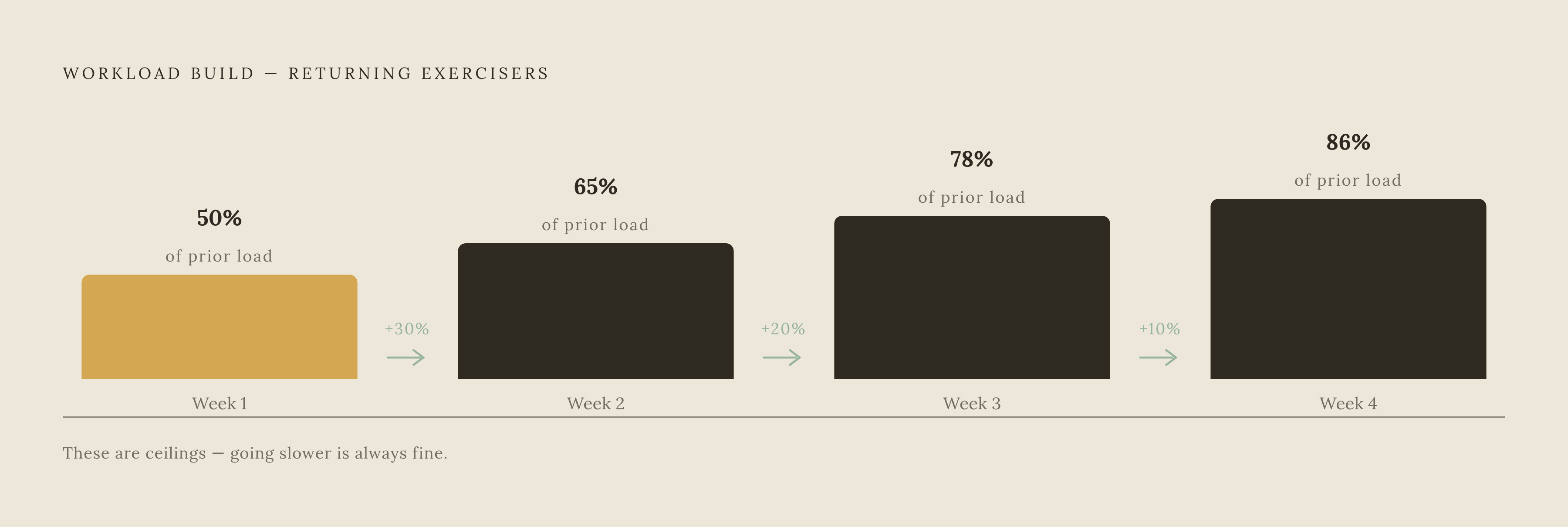
A companion structure, the 50/30/20/10 rule, lays out weekly progression in workload:
- Week 1: 50% of previous workload
- Week 2: a 30% increase over week 1
- Week 3: a 20% increase over week 2
- Week 4: a 10% increase over week 3
These are ceilings. Going slower than this is always fine.
For resistance training, that translates to something like 6 to 8 exercises covering the major muscle groups, 2 to 3 sets of 12 to 15 reps, 30 to 90 seconds rest between sets, and a slow, controlled tempo with light-to-moderate loads. The goal in week one is clean movement, not a personal record.
For aerobic work, start with low-intensity, steady-state activity, roughly the low-to-mid 60% range of max heart rate, and let intensity climb only as tolerance builds.
Mobility deserves a spot from day one rather than getting tacked on as an afterthought. Dynamic warm-ups are effective for improving range of motion, and slow dynamic stretching has been shown to boost knee extensor flexibility by around 12% within just five minutes of doing it.
For anyone starting from zero training history, the exact percentages matter less than the shape of the curve: begin at a manageable level, then increase gradually, in that order, every time.
What type of activity to choose
Given everything above about connective tissue lag, low-impact options make the most physiological sense for weeks one and two. Walking, swimming, water aerobics, and cycling all build an aerobic base while keeping mechanical stress on joints and tendons to a minimum.
But "exercise" doesn't have to mean a gym membership and a treadmill. Texas A&M's Howdy Health program lists a genuinely wide range of legitimate options: adult gymnastics, batting practice, gardening, geocaching, golf, hiking, jumping rope, kayaking, line dancing, martial arts, paddleboarding, pickleball, Pilates, old-school games like tag or kickball, time on a playground, rock climbing, rebounding, rollerblading or roller-skating, skiing, trampolining, water polo, water walking, and purposeful walking like birding or photography walks. If none of that sounds like a workout, that might be exactly the point.
The framing shift matters more than people give it credit for. Howdy Health recommends swapping "I have to exercise" for "I get to exercise," a small language change that redirects focus toward what the body can do rather than what it can't. Find something enjoyable rather than something efficient. Efficient workouts that feel like punishment rarely survive contact with a Tuesday evening.
There's also the "workout with purpose" approach, folding movement into a day that's already happening rather than carving out a separate block for it. Vigorous housework, walking during phone calls, squats while waiting on the laundry. Time is the most commonly cited reason exercise doesn't happen, and stacking movement onto existing routines is a direct answer to that excuse, no extra hour required.