Why Most Fitness Restarts Fail in Week Two
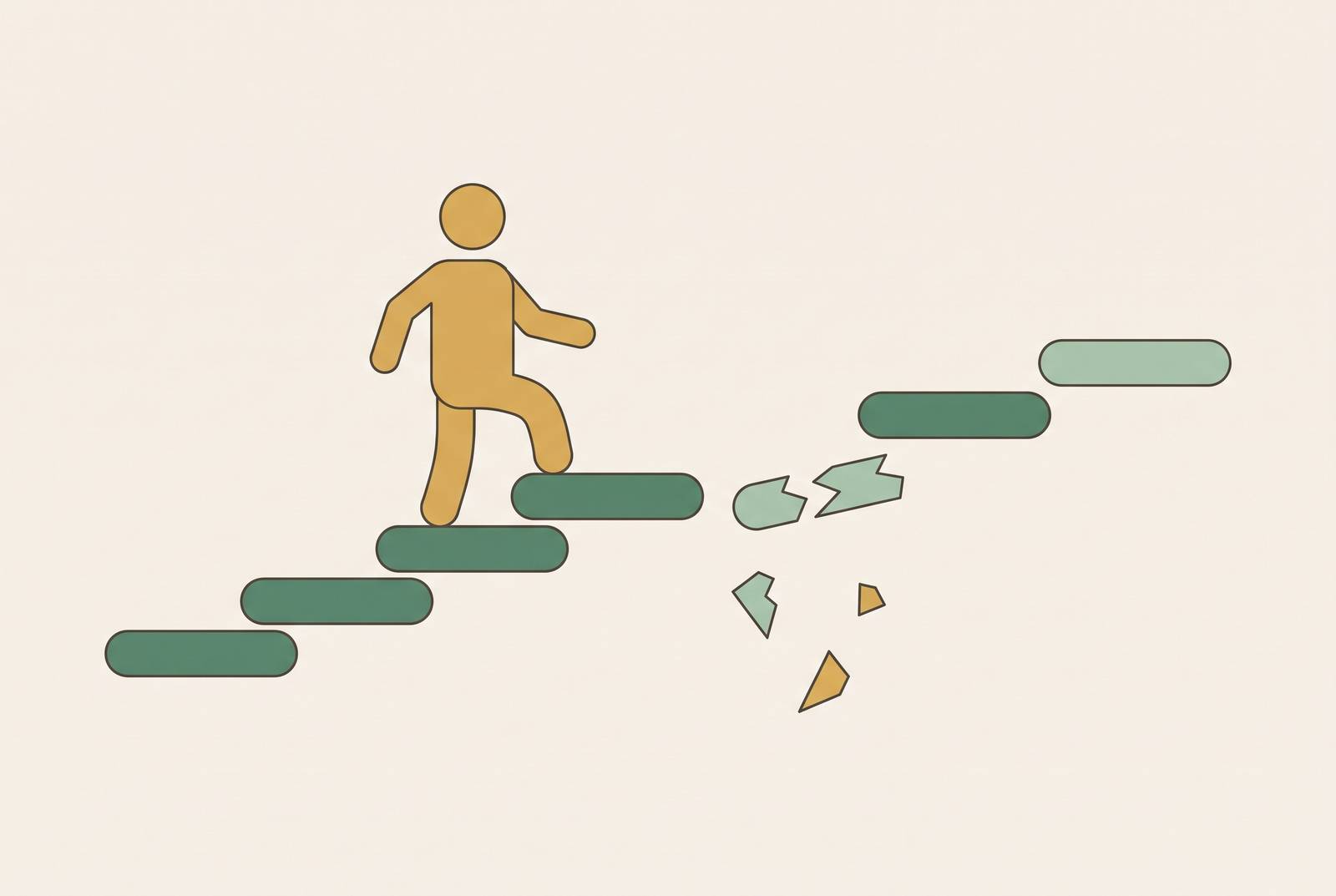
Novelty and dopamine fade while soreness and stress pile on, creating a perfect storm.
What the first week runs on, and why it cannot last
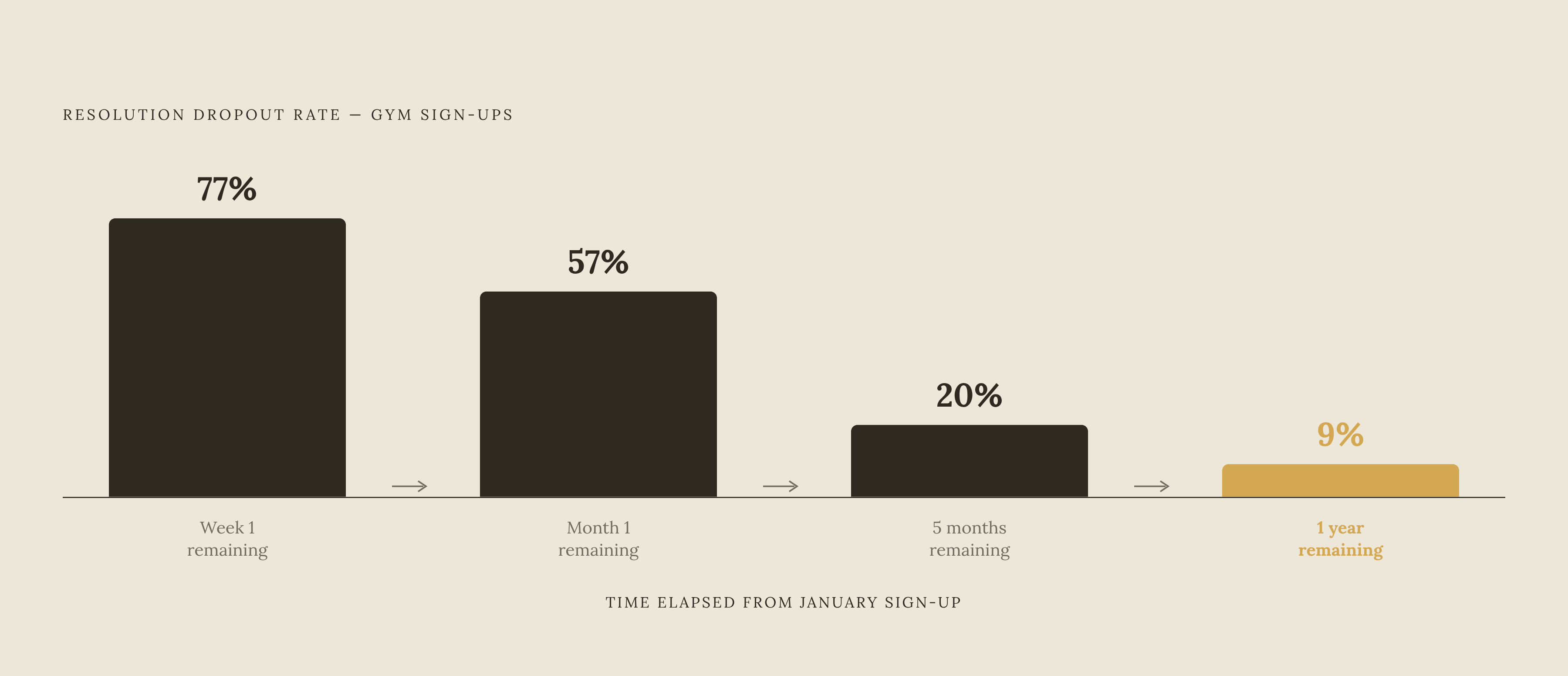
Fitness restarts fail on a schedule. Week one runs on borrowed fuel (novelty, social buzz, a fresh calendar page), and week two is when the bill comes due. Activity-tracking data has actually pinned a specific day to the collapse, nicknamed "Quitters' Day." It fell on January 17 in 2019, a Thursday, and lands on January 9 in 2026. A 2024 analysis from Drive Research found 88% of fitness resolutions fail within two weeks of starting. Other tracking puts 23% of resolvers gone before week one even ends, 43% done by the end of the month, and only 9% still going a full year later.
Gyms know this math cold, and they've built their business model around it. January accounts for 12% of all annual gym sign-ups, and 80% of those new members vanish within five months. Gym retention data from smarthealthclubs.com shows people who join during a January sale churn 45% more than people who sign up at any other point in the year. None of that belongs on a character-flaw scoreboard. The system is broken. Name what actually lands on someone in week two that simply wasn't there in week one.
Behavioral scientists call the high that carries week one the "fresh start effect." A new year, a Monday, a birthday: these count as temporal landmarks, and they trip a kind of psychological reset button that makes change feel not just possible but imminent. The brain's dopamine response to novelty stacks on top of that, so a brand-new program reads as a high-value event. The brain floods the system with the chemistry that makes starting feel almost effortless.
That first-week high is a real neurochemical state, not an illusion of willpower conjured through grit. A social current runs underneath it too, produced by the collective push of a shared calendar milestone: a shared calendar milestone creates conditions where collective energy is easier to catch. During a collective reset moment like New Year's, everyone else seems to be doing it too, and momentum spreads the way a yawn does across a room. As trainwell.net puts it, "almost the entire Western world is full of energy and commitment to growth, and that energy is easy to catch." Catching a mood costs nothing. Keeping it warm alone, for months, is an entirely different job, and most restart plans never plan for that handoff. Motivation rises and falls with sleep, stress, workload, and mood (SFI Health, 2026), which makes the fresh-start high a temporary state rather than something to lean on indefinitely. Novelty, social contagion, and a psychological reset carry week one, and none of the three refill themselves on their own. Willpower was never built to be the backup generator, and treating it like one is where most restarts start to crack.
What converges on the person in week two: the dopamine drop, physical pain, and the first real friction
Week two doesn't hand someone one new problem. Week two hands someone three problems at once. That is why it feels worse than week one even though effort hasn't dropped an inch.
First, the dopamine collapse. Once a behavior stops being novel, the brain's dopamine response to it drops while the actual effort involved stays exactly the same (fitbosspro.com, 2026). That gap alone explains why week two can feel harder than week one despite nothing physically changing. Research suggests that people who run lower on baseline dopamine find exercise more taxing and lose motivation faster, through no fault of their own. Some people are climbing a steeper hill from day one, full stop, and no amount of grit changes the slope.
Second, the body sends its own memo. Delayed Onset Muscle Soreness (DOMS) peaks 24 to 72 hours after a workout, driven by microscopic tears in muscle tissue from the eccentric part of a movement (the lowering phase of a squat, for instance). NIH research shows most cases resolve within three to seven days. Week-two workouts often start before the body has finished paying off week one's debt. DOMS isn't an injury, but try telling that to someone's quads on day nine, especially a beginner with zero reference point for "this is normal and it passes." To them, it reads as punishment, not progress.
Third, real life intrudes and lands on a system already running on fumes. Bad weather, a packed calendar, a rough stretch at work: these were easy to shrug off in week one, when dopamine did the heavy lifting for free. In week two they land on a system already running on fumes.
One structure in the brain drives all three collisions at once: the prefrontal cortex. It handles planning and self-control, runs on high energy, and has limited capacity, so asking it to prop up a new routine on top of work, family, and everyday stress wears it down fast. Recent neuroscience shows mental exhaustion can trigger something called "local sleep" in the frontal cortex, essentially patches of the brain dozing off mid-task, which weakens self-control right when it's needed most (SFI Health, 2026). Recent neuroscience shows fatigue reduces prefrontal engagement and makes people more likely to default to the easier, lower-effort option. That's the brain conserving fuel the only way it knows how.
Dopamine drop, sore muscles, mental fatigue: none of these take turns politely. They show up together, in the same week, and that pile-up is the actual wall. Willpower was never built to scale it solo, and expecting it to is the design flaw at the center of most restarts.
Why the plan itself often makes week two worse: unrealistic scope, all-or-nothing framing, and the false hope trap
Blame the plan before blaming the person following it. Researchers Polivy and Herman coined the term "False Hope Syndrome" for resolutions that are wildly unrealistic and disconnected from who the person actually is day to day (per NCSF and psychologyfanatic.com). Setting a goal too far from your current life makes the gap itself the failure point before week two even starts.
Money makes the trap sharper. Stagwell reports Americans plan to spend an average of $4,700 on 2026 resolutions, covering gym memberships, meal delivery, coaching apps, and equipment. That's a serious financial bet on plans a large share of people abandon within weeks, and 35% of people whose resolutions fail point to unrealistic targets as the main reason (fitbosspro.com, 2026).
Then there's the all-or-nothing trap, flagged by a University of Michigan study (Segar et al., published in BMC Public Health) as a specifically overlooked driver of dropout. When the plan gets disrupted, people scrap it entirely instead of adjusting it. Missing one workout barely dents habit formation. Missing two in a row meaningfully raises the risk of quitting altogether, even though the study never attaches a hard percentage to it. The real damage comes from treating one stumble as proof the whole thing is broken.
Goal framing moves the success rate on its own, and the data on this is not close. A longitudinal study of 1,066 Swedish adults found approach-oriented goals, like "run a 5K," succeeded 59% of the time at the one-year mark, against 47% for avoidance-oriented goals like "avoid junk food." Gaining something beats escaping something, statistically and consistently, and yet most people set up their plan backward.
Most January restarts get framed as avoidance goals from the jump: lose weight, stop eating badly, fix the body. That's precisely the framing the research says fails more often. Pairing a rigid plan with avoidance framing means the first disruption (a sore day, a skipped session, a chaotic week at work) doesn't register as a normal bump. It registers as total failure.
The habit gap: why week two sits in the most dangerous window of any new routine
The "21 days to build a habit" line gets repeated constantly, and it has zero scientific basis (forwardfamilymedicine.com). It stuck around for one reason: enough people kept saying it, and repetition did the rest.
The actual research, published in the European Journal of Social Psychology in 2010, found a median of 66 days for behaviors like exercising or eating fruit to turn automatic, with a range stretching from 18 days to 254 depending on how complex the behavior is. Sixty-six days is a long runway. Gym attendance data consistently shows dropout risk concentrating in the early weeks, right when early motivation has faded but the habit hasn't hardened into routine yet.
Habits get encoded in the basal ganglia, a part of the brain that automates repeated behavior so it stops needing the prefrontal cortex's active involvement. That handoff takes time and repetition, though, and until it happens, every workout costs full conscious effort, the same mental toll on day twelve as day one.
That's why week two sits in the most dangerous window of the entire process. Novelty is gone. Dopamine has dropped. The behavior hasn't automated yet, so the person has to consciously choose the workout every single time, with no autopilot to lean on. Trying to bridge a 66-day gap on motivation that's typically drained by day ten was never a fair fight to begin with.
What weeks two through eight need is an external structure standing in for the automaticity the brain hasn't built yet. It's an external structure standing in for the automaticity the brain hasn't built yet.
What carries people through the gap: accountability, shared habit structures, and the role of another person
Week one worked partly because social energy was just floating in the air, free for the taking. As trainwell.net notes, that collective sense of "almost the entire Western world" pushing toward growth at once "is easy to catch. It also makes you feel like you're not alone, which is half the battle." That energy evaporates by week two, and most people have built nothing to replace it, which is the actual design gap in most restart plans.
Neuroscience backs a fix here. Pairing a new behavior with an immediate, concrete reward works because dopamine drives repetition, and few rewards land as immediate and reliable as another person noticing what someone did. A number on a dashboard doesn't clap. A person does.
Self-Determination Theory adds the deeper layer: lasting change comes from intrinsic motivation, behavior that lines up with someone's identity and sense of purpose. Identity shifts slowly on its own, but shared goals speed that shift up, because the behavior suddenly carries social meaning beyond the one person doing it. A Psychology Today piece from December 2025 (Chester Sunde, Psy.D.) draws a sharp line between two kinds of resolutions: ones framed as internal commands ("I will go to the gym"), which demand constant self-enforcement, and ones tied to identity, becoming "someone who values physical health." The second kind never has to arm-wrestle itself into showing up every day.
A workout shared with someone who notices, checks in, or shows up alongside carries more weight than a private stat on a phone, because a human response is neurologically richer than any metric will ever be. A partner introduces a social cost to skipping (someone gets let down), a social reward for showing up (someone saw it happen), and a recovery signal when a session gets missed: go again tomorrow. That last piece directly guts the all-or-nothing trap. Missing a shared goal should trigger a quick reset and a laugh about it. The research consistently shows small, specific, doable targets beat sweeping overhauls when it comes to building something that actually sticks.
Practical structures that make it through week two and beyond
Shrink the plan until it feels almost embarrassingly easy. The research backs tiny, close-to-guaranteed goals over ambitious overhauls (trainwell.net). Week two is the time to just show up, period.
Build a flexibility clause into the plan from day one. The Michigan study flagged all-or-nothing thinking as a major, underreported dropout driver, so an explicit downgrade option ("if I can't do the full session, I do 10 minutes") defuses the binary before it ever gets a chance to detonate.
Frame the goal as something to gain, not something to escape. The Swedish numbers hold up here: 59% one-year success for approach goals against 47% for avoidance goals. "Run twice this week together" outlasts "stop being lazy" nearly every time.
Anchor the habit to a shared cue. The basal ganglia runs on "if X, then Y" patterns, so a shared trigger (a partner's text, a standing Wednesday walk, a check-in photo) does the job novelty used to do for free.
Keep rewards small and immediate: a photo, a friendly bet, or a visible log of progress each work. These deliver the dopamine hit that slow-moving fitness results can't provide on their own, and none of it needs to be fancy. It just needs to happen fast and involve another person.
Plan for the miss before it happens. Missing one session is nothing. Missing two in a row is when risk climbs, and a shared structure means someone notices before two turns into ten.
Partners don't need matching schedules to stay connected, either. A quick check-in, a photo, a shared weekly target keeps the thread alive without demanding identical routines, since the connection is doing the work, not the calendar match.
Any app or tool in the mix should cut friction, not pile on more tracking to manage. The best system is the one both people are still opening in March.
And measure the right thing. A messy week where both people still showed up twice beats a picture-perfect week that quietly burns the whole system down by week three.
Sources
- Why New Year's Resolutions Fail: The Missing Fourth Element
- The Real Reasons Why New Year’s Fitness Resolutions Fail - 12 minutes
- Why resolutions fail by February: the neuroscience of habit loops, cognitive load and motivation fatigue - SFI Health
- Why Your Fitness Motivation Disappears After 2 Weeks (And How to Fix It)
- New Year Resolution Statistics: Why 91% Fail (and How to Beat the Odds)
- insights.wchsb.com
- researchgate.net
- New Year Fitness Resolutions – Why Do Many Fitness Resolutions Fall Short?

