How to Restart an Accountability Partnership After Both People Fell Off
Rebuild the partnership by fixing the system, not by boosting motivation.
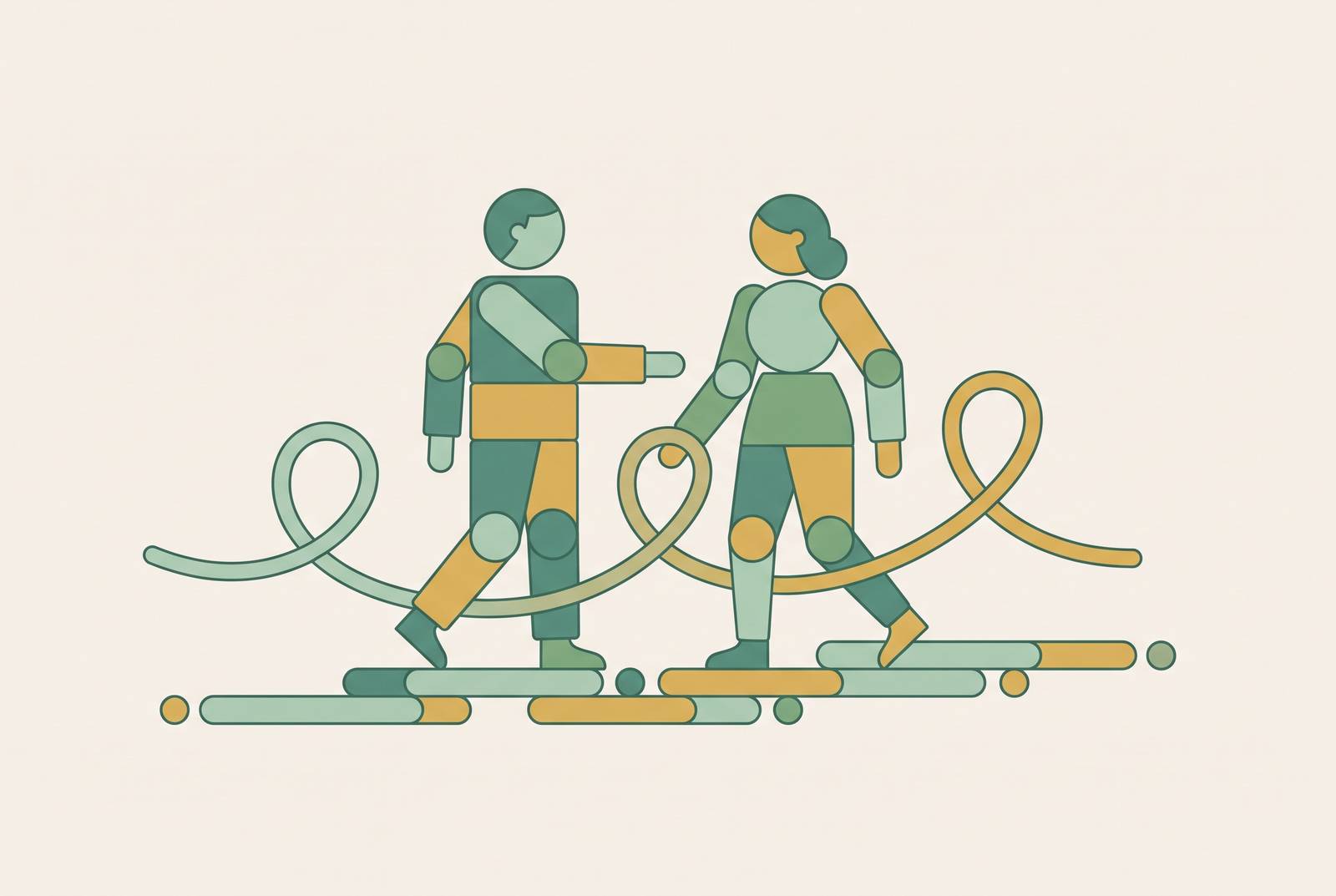
When both partners stop working out at the same time, the failure belongs to the structure they were using, not to either person's commitment level. Peer accountability has a structural vulnerability built into it. The relationship is casual, so either partner can cancel without any formal consequence. One cancellation tends to pull the other along with it.
Over time, especially when life gets busy, that mutual permission to skip compounds. Stopping starts to feel like the default. The partnership didn't fail because both people stopped caring. It failed because nothing in the system made showing up easier than not showing up.
Sweatmates addresses this directly by making check-ins visible and mutual. A shared workout photo or weekly recap keeps both people in view of each other's effort. That raises the cost of a silent skip and lowers the friction of showing up together.
The instinct after a mutual falloff is to reconnect emotionally. A pep talk, renewed promises, shared excitement. But emotional re-commitment without structural change reproduces the same system that failed. A pep talk addresses mood. It doesn't address friction, scheduling gaps, or the absence of a visible check-in that keeps both people in view of each other's effort.
Why the restart fails a second time when motivation is the only fuel
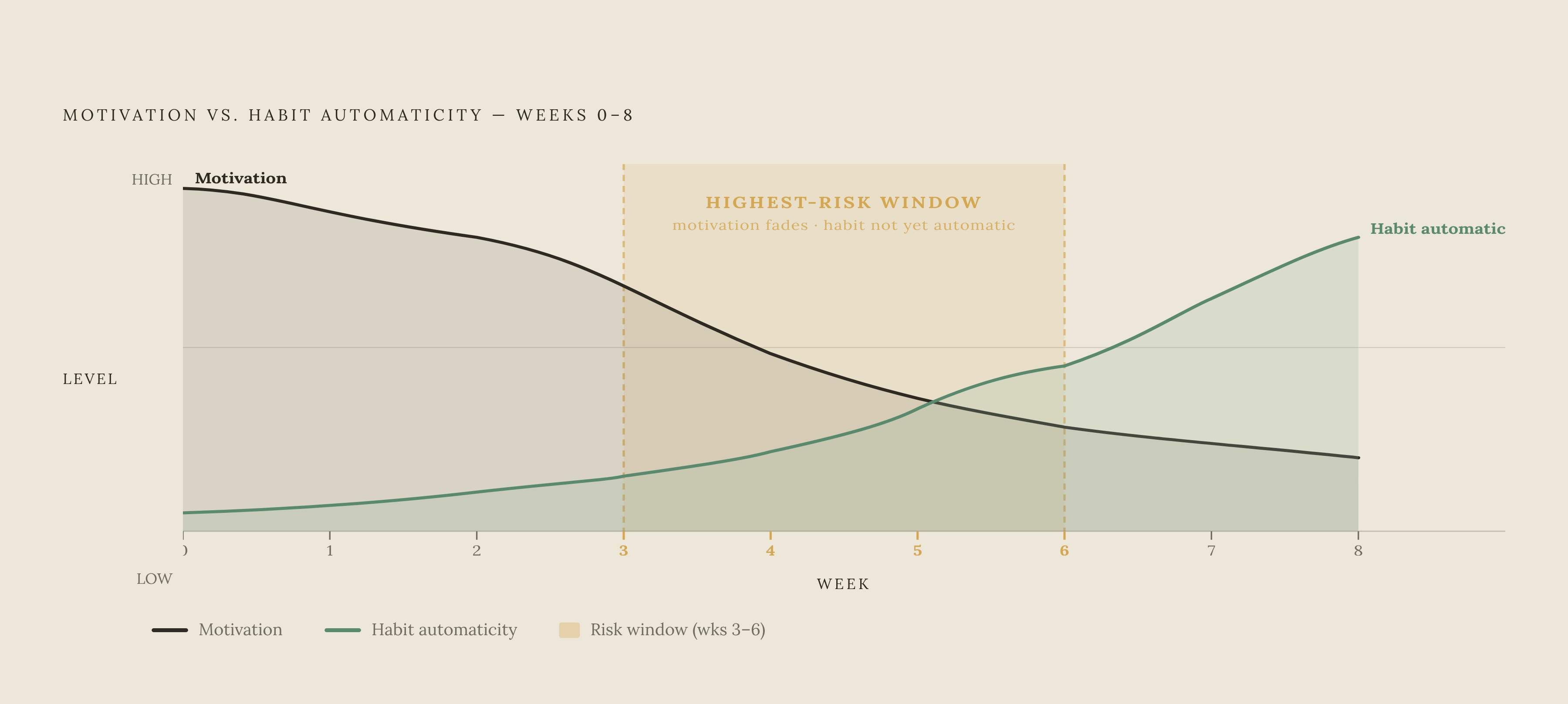
Most restarts collapse in the same window they failed in before. That's because motivation is highest at the moment of re-commitment and lowest precisely when the habit needs to be forming. Habit science establishes that exercise habits take meaningfully longer to form than simpler daily behaviors. Weeks three through six after a restart are the highest-risk window. The initial energy has faded, but the behavior hasn't yet become automatic.
This isn't a character flaw. It's a predictable gap in the timeline that most restarts ignore entirely. If a partnership has no structure in place before motivation fades, it will hit that window unprotected and dissolve again. No fixed time, no visible check-in, no agreed-upon consequence for a miss.
Here's the part most people miss, though. Both partners still carry residual habit memory from the earlier routine, which is an underused asset in restarts. Previous training leaves lasting cellular changes called retained myonuclei. That's what allows muscle tissue to regain size and strength more rapidly when training resumes than when starting from zero. The psychological equivalent works the same way. The habit pathway isn't erased by weeks of inactivity. It decays but persists, which means the barrier to re-entry is lower than it feels.
Think of it like a trail through the woods. The path has grown over, but it's still there. You're not bushwhacking. Partners who fell off are not starting over. They are reactivating something that exists. Reactivating a lapsed habit requires a system that doesn't rely on residual motivation to bridge the weeks-three-to-six danger zone. Something built around visible mutual check-ins and a pre-agreed consequence for a miss will keep the partnership anchored even as initial energy fades. Sweatmates is built on that principle. The shared visible check-in does the anchoring when motivation can't.
What the first four weeks after a restart actually require — and how they differ by experience level
The first four weeks of a restart are the most strategically important window for long-term adherence. Not month three. The demands of that window differ significantly depending on experience level.
For beginners, the priority is floor-setting, not performance. Weeks one and two should reintroduce movement: walking, light mobility work, a short bike ride. Showing up is the only metric that matters. The habit must be rebuilt before the muscle can be rebuilt. Trying to do both simultaneously is what produces early soreness, discouragement, and dropout.
Frontiers in Sports and Active Living found that among beginner app users, adherence declined rapidly after onboarding. Intermediate and advanced users showed meaningfully higher twelve-month retention. That confirms early dropout is the beginner's primary risk.
For returning exercisers, the risk runs the other direction. If you jump back to pre-break loads too quickly, injury or acute soreness creates its own dropout window. If you reduce loads and prioritize form during the first four weeks, the restart survives. Because of the residual muscle memory, strength returns faster than expected once the habit is stable. So patience now pays off sooner than you'd think.
Both groups share the same structural solution. If a workout is missed, restart quickly using the smallest useful version of the habit: a walk, a short lift, a mobility session. The faster the restart after a lapse, the less the miss damages identity and motivation. The slower the restart, the more the lapse becomes the new normal. Both beginners and returning exercisers benefit from a shared structure that makes the smallest useful version of the habit the default choice. Apps built around photo check-ins and mutual accountability, like Sweatmates, enforce that rule naturally. A walk counts. A short session counts. The photo captures the showing up, not the sweating.
The three structural decisions that determine whether the restart holds
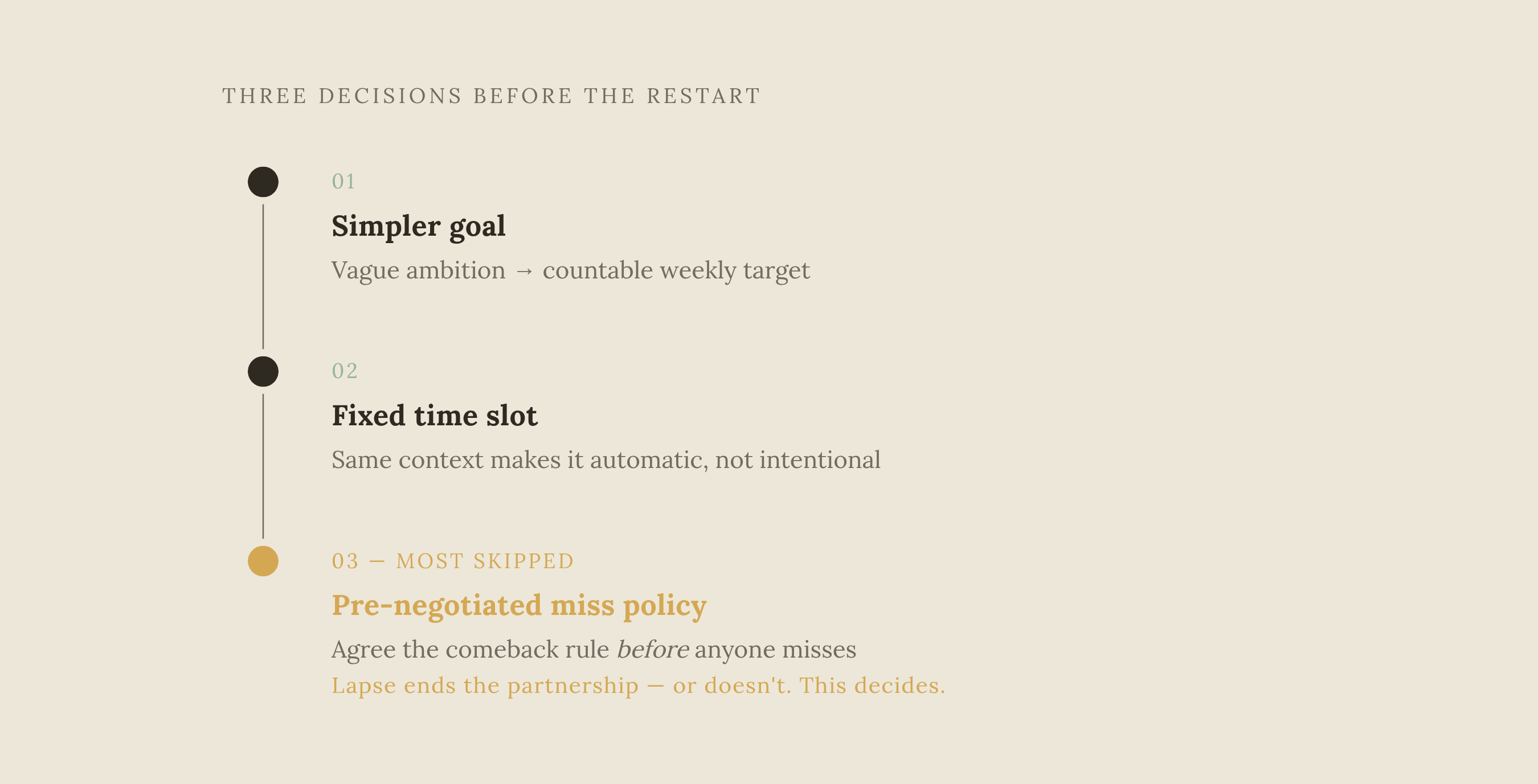
A restart that survives the first four weeks is built on three prior agreements, not on daily motivation: a simpler goal, a fixed time, and a pre-negotiated miss policy. Decision one is a simpler goal than before. Replace broad ambitions with a specific, countable weekly target. Not "get healthier" but "three workouts this week," defined in advance so both partners know exactly when they've hit it and when they haven't. The goal should feel slightly too easy in week one. That's a feature, not a sign of low ambition. The purpose is to make success the default outcome while the habit is forming.
Decision two is a locked time slot, not a flexible one. Habit science consistently finds that same-context repetition is what moves a behavior from intentional to automatic. Variable timing disrupts that process. When both partners lock a specific time slot, they get the cue-behavior repetition that habit formation requires. They can even exercise separately in different locations. The timing matters more than the togetherness.
Decision three is a miss policy negotiated before anyone misses. Accountability partnerships dissolve most often not during misses but in the awkward silence that follows a miss. Neither partner knows whether to say something, so both default to saying nothing. Agreeing in advance on a comeback rule removes that silence from the system entirely. The next check-in is cheered, not questioned. The miss carries a light wager rather than a lecture. You owe dinner. You do the chore. Shame makes people hide, and hiding kills the partnership. A pre-agreed miss policy keeps the channel open precisely when it's most likely to go quiet. Partners don't need to be in the same room for any of this. A visible check-in can carry the same structural weight remotely as physical co-presence.
The best app for couples to track workouts and hold each other accountable
A visible, time-stamped photo of a completed workout does more accountability work than a text message or a shared spreadsheet. It closes the loop without requiring a conversation. People perform more consistently when they know their effort is visible to someone who matters to them. A workout photo creates that visibility passively, so neither partner needs to initiate a check-in.
The visual nature of a photo also normalizes the behavior across the partnership. Seeing a partner's check-in consistently makes showing up the group standard rather than the exception. That's the whole trick. The photo does the nudging so nobody has to write "did you work out today?" for the fifth time.
Critically for a restarting partnership, the photo requires no performance. A walk counts. A short mobility session counts. A ten-minute basement lift counts. The mechanic rewards showing up, not sweating hard. This design choice directly addresses the beginner dropout risk. If the only thing required to complete a check-in is showing up and taking a photo, the bar stays crossable on bad days.
SweatCam, the photo check-in feature in the Sweatmates: Partner Fitness app, is built around exactly this mechanic. You take a quick photo during the session. Your partner sees it instantly. The weekly goal is tracked automatically. The full loop is deliberately minimal: set a weekly goal, which is how many days per week, log each workout with a SweatCam photo, partner sees it instantly, and if the weekly goal is missed, a light pre-agreed wager applies. Buying dinner, doing a chore. The wager mechanic matters here because it doesn't punish the miss with shame. It creates a low-stakes cost that keeps the partnership alive through inevitable lapses rather than letting silence take over.
The app is designed for exactly two people. That fits the accountability-partnership model rather than a group dynamic, reducing the social complexity that can make check-ins feel performative. Practical constraints are worth naming honestly. The app is available on both iPhone and Android. Workout logging requires a subscription despite a free download.
How to handle the first missed check-in without losing the partnership again
The first missed check-in after a restart is the highest-risk moment in the new system. How both partners respond to it determines whether the structure holds or the same dissolution pattern repeats. The psychological trap is familiar. Missing a workout can trigger a feeling of having already failed, which reduces motivation for the next session. A single miss stretches into several. This is the exact mechanism that turned the original partnership's first lapse into a full falloff. It will activate again unless the system addresses it explicitly.
The structural answer is the pre-negotiated miss policy from earlier. The wager is paid. The next check-in is welcomed rather than interrogated. The minimum viable version of the workout is on record as an always-acceptable response. A "worst-day floor" workout, the shortest version both partners agree always counts, means even the hardest days produce a check-in rather than a silence. So when one partner has a truly awful Tuesday, they still send the photo from a ten-minute walk around the block. That counts. The partnership lives.
The twenty-four-hour restart rule applies here too. The goal isn't to avoid the miss. It's to make the recovery from the miss automatic rather than emotionally negotiated. What makes this different from a pep talk is that none of it depends on how either partner feels in the moment of the miss. The decisions were made when both people were committed. The system runs on those decisions rather than on real-time motivation.
That's the structural floor the original partnership lacked. A restart built on visible check-ins, fixed timing, and pre-agreed consequences actually provides it. So the next move is small and specific. Agree on the weekly goal count. Pick the time slot. Then take the first SweatCam photo together or separately. That's the whole restart, right there.