Long Distance Fitness Accountability Between Friends in Different Cities
Workout photos make distant friends visible witnesses to each other's commitment.
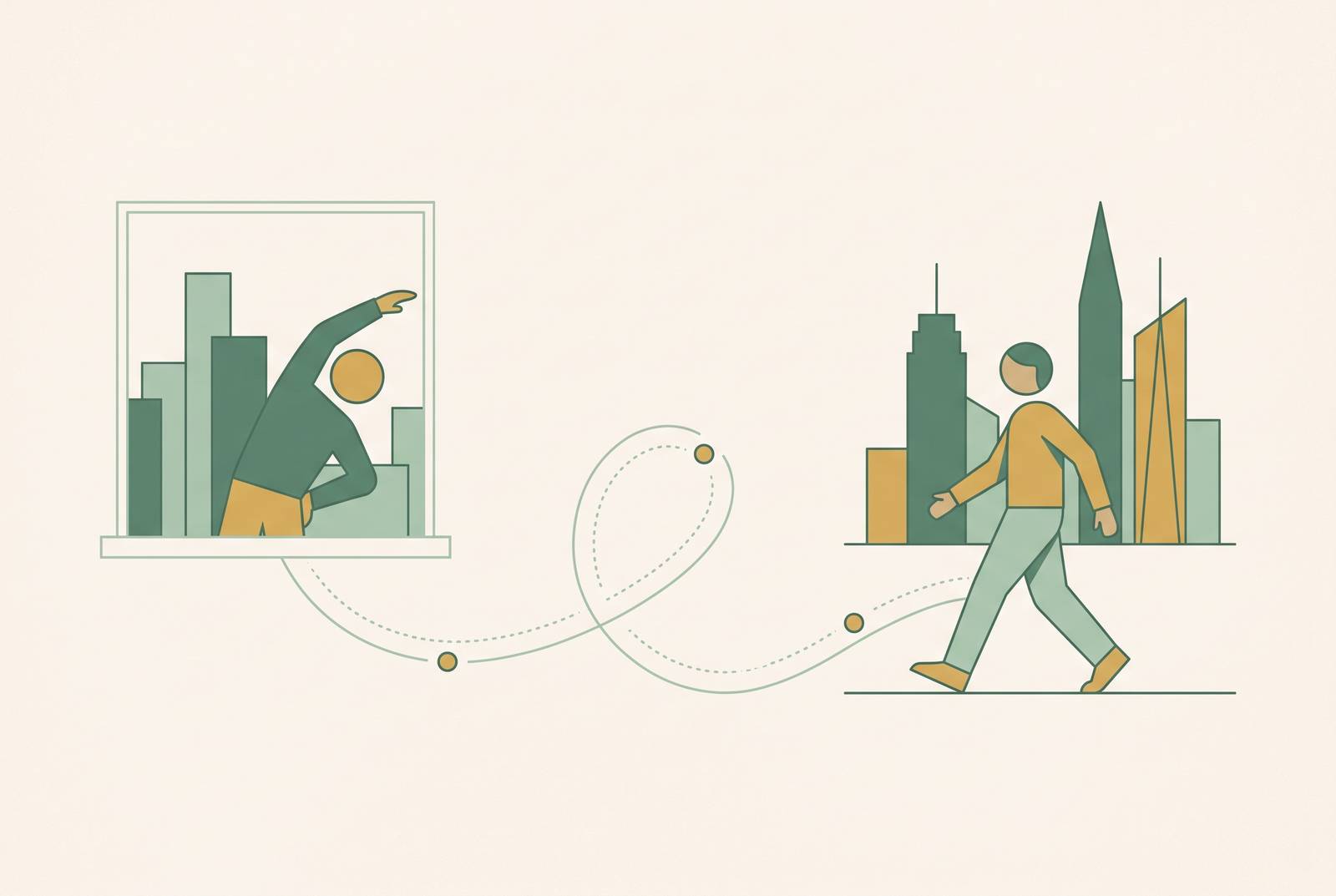
Long-distance fitness accountability between friends fails not because anyone cares less, but because the ambient visibility that keeps in-person partners honest disappears the moment you live in different cities. The fix is not more willpower or better tracking. It is recreating social witnessing through simple, visible proof of showing up. A workout photo does that job better than anything else.
In-person accountability is mostly passive. A gym partner sees you skip a session. A colleague notices you took the elevator three days running. None of this requires a check-in, a reminder, or a conversation. Distance strips that layer away entirely. What remains is intention without structure, and intention without structure has a very short shelf life.
The classic pattern plays out the same way every time. Someone sends the text: "Let's workout together!" The other person replies with a thumbs-up. Three days later, neither of you has worked out. A 2025 guide to friend accountability apps describes exactly this sequence. What was missing was anything that would make skipping visible.
The mechanism that disappears is what researchers call social witnessing. It is the psychological process by which being seen keeps behavior on track. Researchers identify three channels through which it works: commitment consistency, identity reinforcement, and reciprocal obligation. You said you would show up, so you do. You are the kind of person who shows up, so you prove it. They showed up, so now you owe them one.
The obvious objection arrives fast: can't you just text each other? You can, but texting creates social friction. It requires active effort every single time. It produces guilt spirals when you forget. A photo that arrives without anyone asking is a presence. Those are different things.
What actually makes in-person accountability work, and how to recreate it remotely
In-person accountability works through one core mechanism. You made a visible commitment to a specific person, and quitting means walking it back in front of them. The research on this is clear. A twelve-month study of adults who joined a fitness program with a spouse versus without a spouse found markedly better attendance and far fewer dropouts in the paired group. The paired group saw 6.3% dropout versus 43.0% for those who joined alone. The mechanism is not closeness or romance. It is that quitting means walking back a promise made out loud to a specific person.
A second finding reinforces the point. A University of Aberdeen study found that gaining a new exercise companion increased exercise frequency. The effect grew stronger when that companion offered emotional support and encouragement. The quality of the support mattered more than the logistics. It was not just about having someone to meet at the gym. It was about having someone who actually cared whether you went.
The remote version of this mechanism requires two things. First, visible proof that you showed up. Second, a real person who sees it and responds. Abstract logging into an app gives you neither. Neither one witnesses you.
This is why apps like Sweatmates matter for long-distance friends. The app centralizes shared workout check-ins so that the moment a partner exercises becomes a visible event that arrives without requiring the other person to go looking for it. You see that your friend worked out, and seeing it does something that a step count never will.
There is a reason small groups of known friends outperform anonymous communities for this use case. Friends carry pre-existing trust and life context. A stranger's badge board is noise. A friend's photo means something because you know they had a rough week, or a new baby, or a deadline. The specific person is the mechanism. The visibility is the delivery system.
Why a workout photo recreates social witnessing better than any other remote signal
A workout photo works because it provides immediate, concrete, unambiguous proof of presence. That is the one thing a distant friend needs to see in order to witness your effort. A photo arrives and is seen without any effort on their part. That is what makes it passive in the way in-person witnessing is passive.
The photo also changes what conversation about fitness can be. Trainers and coaches note that when clients compare a photo from week one next to week eight, progress that felt invisible becomes concrete. Definition emerges. Posture changes. "You're doing great" becomes "your shoulders look completely different in this one." One is a pleasantry. The other is evidence.
Platforms built around photo check-ins and weekly recaps turn abstract progress into something specific. Five completed workouts with two gaps is a different conversation than "how's it going?" That specificity transforms vague encouragement into real problem-solving. When your friend can see the actual pattern, they can ask the actual question: what happened on Tuesday? The check-in stops being a social ritual and starts being useful.
The photo also carries identity signal. It is saying "I am someone who showed up today." That maps directly onto the identity reinforcement channel researchers identify as one of the three mechanisms through which accountability partnerships work. You are not recording data. You are performing an identity, and your friend is the audience.
The strongest objection is straightforward. The objection is correct but misses the use case. For long-distance friends building consistent habits, presence is the goal. The two tools serve different functions and do not conflict.
How SweatCam makes the photo check-in the primary unit of accountability, not a supplement to it
SweatCam's design bet is to make the gym photo the entire check-in, rather than a supplement to metrics. That is a deliberate commitment to presence visibility over performance data. The bet is exactly right for the long-distance friend use case. The workflow is intentionally minimal. The system keeps each other's progress visible across the week without requiring active effort from either person.
SweatCam strips all other metrics by design. No GPS. No sets and reps. No charts. This is not a limitation but a position. The photo is the signal. Everything else is static.
Optional light stakes extend the mechanic. You are buying your friend coffee. That is a very different emotional register.
The design logic matters because it reframes what the tool is for. SweatCam is not a fitness tracker that happens to have photos. It is a witnessing system that happens to involve workouts. Trackers optimize for data. Witnessing systems optimize for showing up, and showing up is the thing that actually builds the habit.
How beginners and experienced exercisers use photo accountability differently
Photo accountability is not a beginner tool that experienced exercisers outgrow. It serves meaningfully different functions at different stages. Knowing which stage you are in changes how you structure the system. Research found that when beginners are not exposed to structured training stimuli and targeted behavioral support, they may be prone to early disengagement from regular exercise. A photo check-in to a friend who responds is one of the most valuable structural interventions available. It provides the external witnessing that beginners cannot yet generate internally.
There is also a documented beginner's boost. People with no prior fitness experience can end up slightly surpassing those with some background. The photo gives that excitement somewhere to go.
For experienced exercisers, the photo check-in functions differently. It is a social ritual that keeps a distant friendship alive through shared identity. The photo is not about making you lift. It is about letting your friend see that you lifted, and letting that shared knowledge carry the friendship through the weeks when you cannot actually be in the same room.
Fitness provides a common language for long-distance relationships of all kinds. Discussing training progress, sharing workout moments, and celebrating milestones maintains regular, meaningful communication in a way that generic catch-ups do not. The photo is not just proof of exercise. The message is that the sender is still present, still training, and wants the recipient to see it.
The weeks when most long-distance accountability systems collapse, and what keeps them running
Long-distance accountability systems do not fail because friends stop caring. They fail because the system is not designed to survive the stretch between when novelty fades and when the behavior becomes automatic. New research found that while habits may begin developing within two months, the process can extend considerably longer depending on the individual and the behavior. Any accountability system built around a short challenge is structurally too short to produce durable behavior change. A 30-day challenge is a sprint. A habit is a marathon, and the middle miles are the hardest.
The deadliest pattern in a remote group is not a missed workout. It is a check-in that no one reacts to. The practical implication is uncomfortable but true: the boring Tuesday check-in deserves the loudest response, because it is the one that almost did not happen. The impressive Saturday workout would have happened anyway. Tuesday is the one that needed a witness.
The photo format helps here specifically. A reaction to an image requires less effort than composing a meaningful text. That means responses are more likely in the weeks when motivation is lowest. The photo makes the response cheap, and cheap responses are the ones that actually happen.
Weekly goals rather than daily ones give the system resilience. Keeping the unit of accountability at the weekly level is what makes the system survivable over months, not just weeks. You are not trying to be perfect every day. You are trying to hit your number by Sunday, and that is a game you can still win after a rough Tuesday.
How to build the simplest version of a long-distance photo accountability system that lasts
The most durable long-distance accountability system is also the simplest. One or two friends, a shared weekly goal, a photo when you exercise, and a response when you see theirs. That is the whole thing. Everything else is optional, and most of it is noise.
Pick one to three friends you would genuinely enjoy hearing from. Not the largest group you can assemble. The accountability effect depends on response quality, not group size. Six friends who occasionally like a post will not.
Set a weekly workout goal together. This shared definition is what makes the photo meaningful, because both people know what it represents. A photo is just a photo until it stands for something. It means "I hit my third day" only because you both agreed that three days is the target.
Use a tool built for this. Sweatmates removes the friction that kills similar systems. No metrics to fill in, no dashboard to interpret. Just a photo that your partner sees immediately. The less work the system requires, the more likely you are to keep using it when motivation dips. Friction is the enemy of habit, and a photo-first design has very little of it.
Add a light stake if the relationship supports it. A friendly forfeit for a missed week, like buying coffee or doing a chore, raises the cost of absence just enough to make showing up feel like something. It does not turn the friendship into a performance review. It turns the week into a game you would rather not lose, which is a very different thing.
Agree in advance on what counts as a response. A reaction, a reply, a short message. The form matters less than the reliability. A response of any kind signals: seen. That is the whole mechanism.
Keep the system identical for as long as possible. The research on habit formation is clear that consistency of context is what builds automaticity. Resist the urge to add features, complexity, or new goals before the original behavior is established. Do not add a second weekly goal in month two. Do not introduce a points system in month three. Let the simple thing work.
For exercisers who need performance data alongside presence tracking, pair the photo check-in tool with a separate workout log. The photo tracks presence. The log tracks progress. They were never competing for the same job.
And then there is the part that matters beyond the workout itself. The goal is not an optimized fitness system. It is a shared habit that keeps a friendship alive across distance. The photo is proof of showing up for a workout, yes. But it is also proof of showing up for a friend, week after week, from two different cities. That is worth more than any streak.