How to Find a Fitness Accountability Partner as an Adult
Rebuilding the social scaffolding that keeps adults consistent with fitness.
A workout gets skipped on a Tuesday, and nobody notices. No coach checks attendance. No teammate texts asking where someone went. That silence is the real obstacle, not a lack of willpower or a bad plan. Adult life dismantled the scaffolding that used to make showing up automatic: school schedules, team sports, gym class, the built-in social contract that someone would notice if a person didn't show. What's left is a calendar full of competing obligations and a workout that depends entirely on one person's discipline holding up every single day. That's a lot of weight for one person to carry alone, and it's why a fitness accountability partner solves two problems at the same time: it rebuilds consistency, and it rebuilds the social connection that disappeared along with the scaffolding. The model matters structurally, not just as a motivational nudge.
What an Accountability Partner Does
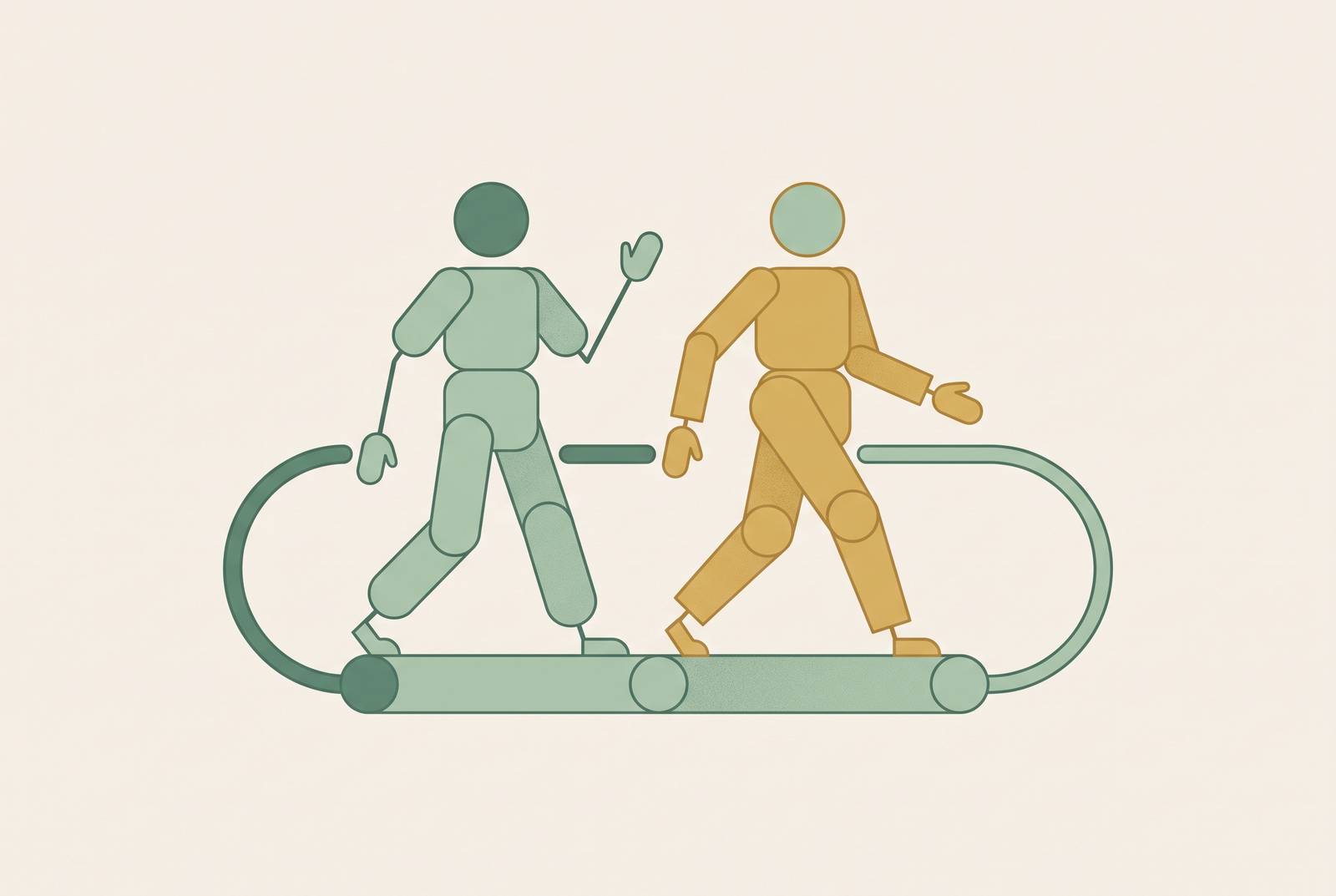
People use "accountability partner" and "workout buddy" as if they're the same thing, and that mix-up is responsible for a lot of mismatched partnerships. A workout buddy shows up for the session: spotting a bench press, matching pace on a run, making the hour pass faster. That's real value, especially for safety and form feedback, but it's tied to being in the same room at the same time. An accountability partner is invested in the whole arc, not just the hour: nutrition, sleep, the slow climb toward a goal that's months away. Picture a Tuesday where someone skips their workout. A workout buddy might text "where were you?" the next time they're scheduled to train together, or never. An accountability partner checks in regardless, because the relationship runs on communication, not shared physical presence. That means an accountability partner can live in another city, work a totally different shift, or train for a different sport altogether, and the partnership still functions. Shared fitness accountability apps make that distance irrelevant in practice, letting partners in different cities trade weekly check-ins and photo proof of effort, turning what would otherwise be silence into a steady, asynchronous rhythm. A friend who wants to hit the gym together twice a week is a workout buddy. Someone who texts to ask how the week actually went is an accountability partner. One person can fill both roles, but there's no rule that says they have to.
Social Pressure Is the Actual Mechanism
The partnership doesn't work because two people happen to want the same thing. It works because skipping a workout now means breaking a promise made out loud to a specific person, and that's a harder thing to do quietly. Susie Reiner, a postdoctoral researcher at the University of Kentucky's Sports Medicine Research Institute, said that skipping a workout when a partner is involved means letting someone else down, not just yourself. Research on adults who joined a fitness program alongside a spouse, compared with those who joined alone, found markedly better attendance and far fewer dropouts in the paired group. The mechanism there is social: the same effect should appear with a sibling, a coworker, or a stranger from an app. Apps like Sweatmates build around that exact principle: partners set shared weekly goals and log workouts by photo, so the commitment stays visible to both people whether they train together or hundreds of miles apart.
A second force, known as the Köhler effect, operates on intensity. People push harder when their performance affects someone else watching or depending on them, and that effect holds even when the training partner is virtual. The boost is strongest when the partner is seen as slightly more capable, which says something useful: chasing an identical fitness twin matters less than finding someone who pulls the bar up a little. A University of Aberdeen study found that gaining a new exercise companion increased how often people exercised, and the effect got stronger when that companion offered real emotional support. Support mattered more than logistics.
One number needs a flag before it spreads any further. A statistic claiming an accountability partner makes someone "up to 95 percent more likely to succeed" circulates constantly across fitness content, and its origin can't be traced to any verifiable study. The evidence for the benefit of accountability partnerships stands on its own without that number, so the honest move is to set it aside.
What to Screen for in a Partner
A marathoner and someone training for a local 5K can hold each other accountable just fine, as long as both treat their own goal with equal seriousness. What actually kills these partnerships is asymmetry: one person training for a qualifying time, the other casually walking twice a week and losing interest by week three. Matching intensity matters more than matching sport, since asymmetry in effort is what causes one partner to lose interest and the partnership to fail. Schedule compatibility counts too, though it doesn't require identical calendars, just enough overlap to make a check-in realistic; a partner who's never reachable when it's time to report in might as well not exist. Reliability beats enthusiasm every time: someone who shows up at a steady, moderate energy level for months outperforms someone who's all-in for two weeks and then vanishes. A good partner is also honest, not just encouraging. A partner who only offers praise and never names a slipping pattern is less useful than one who notices the slide and says something about it without turning it into shame. And both people need to agree upfront on how often they'll check in and in what format, since mismatched expectations about contact are the single most common source of early friction.
The quality most people get wrong is assuming a close friend is automatically the best choice. Strangers from structured platforms often outperform friends as accountability partners, for a counterintuitive reason: there's no social history creating pressure to go easy on someone seen at school pickup or in the group chat every day. The relationship with a stranger is defined entirely by the commitment itself, with no old habits of letting things slide. The familiarity that makes a friend the obvious first call is the same familiarity that makes it easier for both people to quietly excuse each other's missed weeks.
Where to Look First: Existing Networks and the Gym Floor
The easiest place to start is wherever trust and schedule overlap already exist, because that cuts the startup cost of the whole arrangement down to almost nothing. A coworker who's open to a lunch-hour walk is a strong candidate, since the time slot is already built into both calendars and check-ins can happen in the hallway without ceremony. Parents waiting at a kid's practice or lesson share a recurring, otherwise-dead block of time, often alongside other adults juggling similar constraints. A neighbor seen walking or running at the same hour has already proven schedule alignment before a single word gets exchanged.
The gym floor itself is one of the strongest hunting grounds available. Someone who shows up consistently, week after week, has already demonstrated the one trait that matters most: reliability. Their schedule is compatible by definition, since the proof is standing right there on the floor. Approaching that person works better with a specific hook than a vague pitch. "I always see you on the squat rack on Tuesdays, would you be open to trading form feedback?" lands far better than "want to be my accountability partner?", which drops unfamiliar social weight on someone who wasn't expecting it. Starting small, with one shared session or a short trial check-in, gives both people a low-pressure way to test the fit before either commits to anything ongoing.
Where to Look When Networks Run Thin: Apps Built for It
Readers asking what app helps couples stay accountable to each other for working out are really asking a structure question: does the platform give two people a reliable, repeatable way to report in, or does it leave them to improvise? The online infrastructure for finding a fitness accountability partner has grown well past a few Facebook groups and a subreddit. The Hive Index directory tracks 129 ranked fitness communities as of October 2026, with Reddit, independent platforms, and Facebook making up the largest share, so the range of options is wider than most adults assume. Sustaining a one-to-one relationship over months rather than days requires finding a community with enough built-in structure to support it.
Several platforms illustrate what that structure looks like in practice. Motion, a fitness community with over 50,000 app users globally, uses Discord matching to build accountability circles, which gives it more staying power than an open subreddit where conversations drift and die. Cohorty takes a different approach, matching users into cohorts of five to fifteen people built around the same habit; the advantage there is structural, since the group keeps running even if one person drops off, removing the single point of failure that comes with a strict one-to-one pairing. For couples and partners specifically, apps covered by outlets like Partner Fitness Review let two people exercising on completely different schedules still share progress and trade encouragement, without requiring the same gym, the same sport, or the same hour of the day. Sweatmates sits in that same category, built around shared weekly goals and photo check-ins designed to keep two partners' efforts visible to each other even when their routines never physically overlap.
None of these are universally "the best," because the right fit depends on what a reader already knows about their own habits. Someone who thrives on public commitment might prefer a cohort model like Cohorty's, where group momentum carries the slower weeks. Someone who wants a tighter, more personal loop, especially with a spouse or partner, is better served by an app built around shared goals and direct check-ins. The variable that predicts whether any of these actually last is structure itself: platforms with built-in matching, scheduled check-in prompts, or group cohorts consistently outlast open forums, where the entire relationship depends on two strangers managing to keep a message thread alive on their own.
How to Structure the Partnership So It Lasts
Decide, before the first week even starts, what counts as a successful week. That might be a set number of sessions, a consistency streak, or simply showing up once after a rough stretch when doing anything at all felt like a win. Agree on what happens when one person misses a check-in or a workout: a quick reflection and a reschedule, never silence and never shame. Spelling that out early keeps a missed Tuesday from quietly turning into a missed month. Settle the scope of the partnership too. Is it fitness only, or does it stretch into nutrition, sleep, or stress? Naming that boundary upfront prevents the slow resentment that builds when one person expected a narrow check-in and got a lifestyle audit instead.
Build in a trial period, somewhere between two and four weeks, with an explicit conversation at the end about whether the format is actually working. That one step matters most for anyone nervous about committing to someone they barely know, since a trial run turns a scary open-ended commitment into a short, reversible experiment. Nobody's locked in. Both people just agreed to test something and talk about it honestly afterward. Finally, build in small rewards along the way, not just for hitting a performance target but for showing up at all: a shared treat, a friendly bet, a quick celebration text. Those moments carry the partnership through the stretches where progress is invisible and nothing feels like it's changing, even though it is.
When the Best Fitness Partner Is Already in the Reader's Household
Sometimes the search ends before it starts, because the person already sharing a kitchen, a bathroom schedule, and a Sunday grocery run is also the most logistically available accountability partner anyone could ask for. A spouse or live-in partner already has the overlapping schedule that takes most people weeks to find elsewhere, plus a built-in reason to care about the outcome. The research on paired versus solo adults in fitness programs found far fewer dropouts in the paired group, and a partner already in the house gets to apply that same effect without any cold outreach required. Finding an accountability partner solves adherence and isolation in one move, and that holds just as true inside a household as it does between strangers on an app. Showing up for someone else simply feels different than showing up only for oneself, and that difference doesn't fade just because the two people in question already split rent. The mechanism works the same whether it is mediated by a shared gym bag or a shared app, turning what used to be a solitary grind into something closer to a quiet, mutual agreement that neither person goes at this alone.