Recreational Sports for Adults Who Have Not Played Since School
City recreation programs make it simple to rejoin sports after years away.
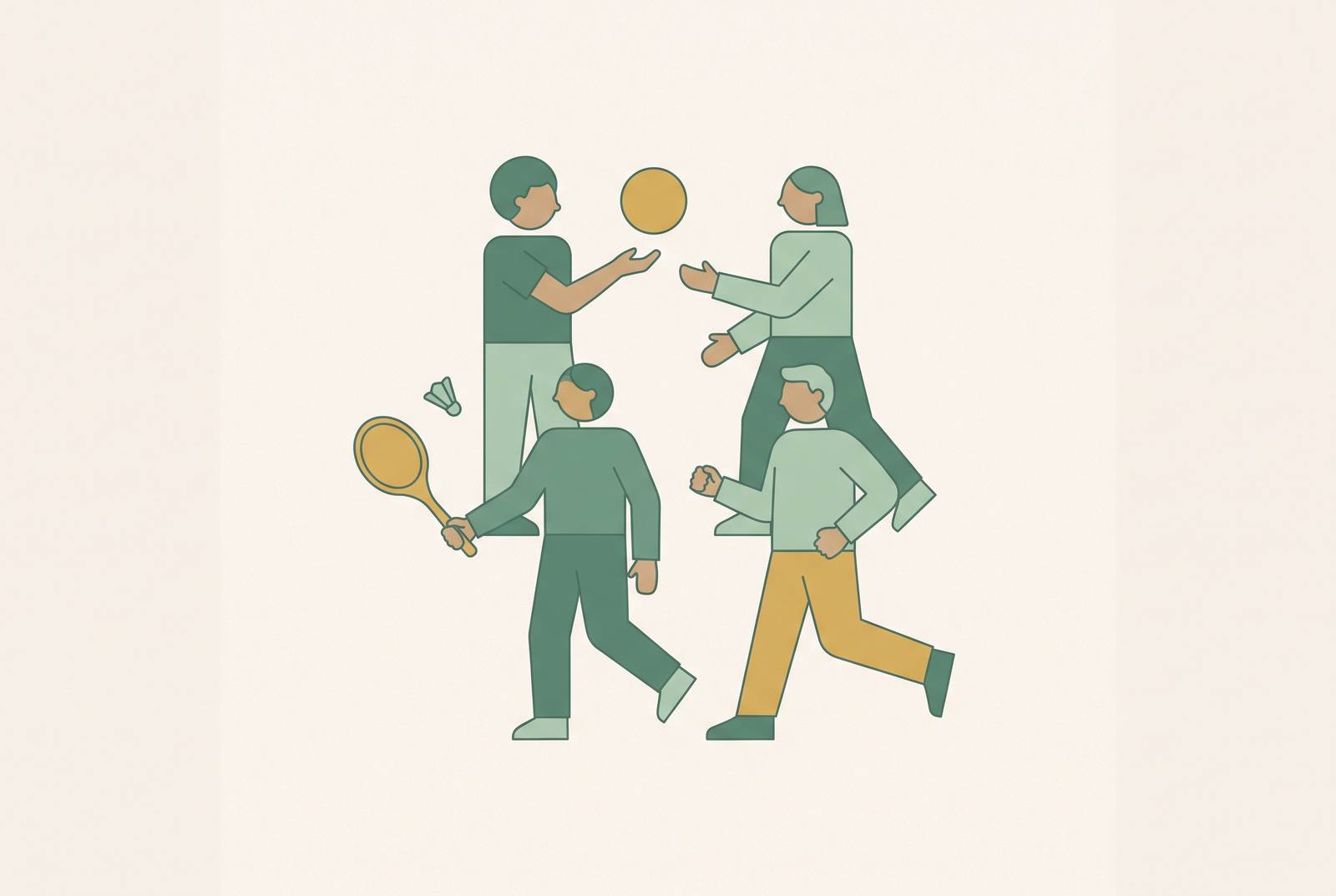
Most adults who stopped playing sports after school didn't quit because they got slower, weaker, or bored. This piece covers why that gap exists and which sports, and which city programs, make getting back in easy.
Why adults who stopped playing in school struggle to return
Picture someone standing at the edge of a gym, gym bag in hand, trying to remember the last time they played anything that wasn't a phone game. They used to be decent at this. Maybe they started a varsity game, or at least didn't embarrass themselves in intramurals. Then graduation happened, or a move, or a job, and the whole machine that used to put a ball in their hands twice a week just switched off.
That's the thing nobody tells you about school sports: the structure did most of the work. A coach set the schedule. A team was already assembled. Gym class made showing up mandatory, not optional. None of that required the player to go find a game, recruit teammates, or figure out where adults even do this anymore. When that scaffolding disappeared after graduation, the sport usually disappeared with it, even for people who liked playing and were fine at it.
So the adult who wants back in isn't dealing with a fitness problem. They can walk three miles, lift groceries, or chase a toddler around a yard. What they're missing is a format: a place that expects them to show up solo, out of practice, and not especially polished, and treats that as completely normal.
The fear that actually stops people is social: showing up and being the obvious weak link, the person everyone has to work around. That fear gets sharper in sports with a steep learning curve or a culture built around intensity, where one rusty player can throw off an entire game. Picking a format where rust doesn't matter solves it.
What makes a sport genuinely low-barrier for returning adults
A sport works for a returning adult when three things line up: the format absorbs a mix of skill levels without anyone noticing, the rules slow the game down enough to close the gap between a rusty player and a regular one, and the social setup treats a solo newcomer as a welcome addition.
Start with the skill floor. Some sports let a total beginner step into a real game on day one and actually contribute, serve a point, score a run, get a pass off. Others require months of technique drilling before a newcomer can do anything but stand around and hope the ball doesn't come their way. The first kind is where returning adults thrive. The second kind is where they quit after one session.
Pace matters just as much as skill. Sports with smaller playing areas, slower-moving balls, or built-in pauses between plays give a deconditioned body time to recover mid-game instead of demanding sixty straight minutes of running. Pickleball is a clean example: its "kitchen rule" keeps players from smashing volleys right at the net, which slows rallies down and cuts out a lot of the explosive, joint-pounding movement found in a sport like tennis. That's a rule written into the game itself, not just a friendly culture around it, and it changes who can compete on day one.
Then there's the social scaffolding around the sport: does the program let a single adult sign up without a pre-built team? Programs that accept "free agents," individuals without a squad, remove the single biggest obstacle facing someone who wants to play but has nobody to recruit. Troy Recreation lets individuals register for its adult basketball leagues at no cost until they're placed on a team. Placement isn't guaranteed, but the door is open, which is more than most people expect walking in. Chandler Adult Sports runs the same playbook, and it lists individual player and free agent registration right alongside team sign-up.
Last piece: tiered entry. A program that runs a beginner-specific session, separate from the advanced crowd, is telling returning players something simple: it has thought about people like them in advance, instead of lumping everyone into one intimidating pool.
The sports most likely to work well for adults returning after a long break
A handful of sports show up constantly in municipal adult league catalogs, and they show up for a reason: they combine welcoming social formats with low skill floors and flexible team rules. None of these ranks above the others. The right one depends on what someone liked as a kid and how much physical risk they're willing to take on now.
Almost every city puts pickleball near the top of its offering list, and the design explains why. Small court, slow ball, that kitchen rule cutting down on explosive net play, and a culture built around mixed-skill social games. One city parks and recreation department runs tiered Pickleball Beginner Bootcamps for adults 18 and up: it splits beginner sessions (basic skills) from advanced beginner sessions (different strokes, more game knowledge). Seattle Parks and Recreation offers free drop-in pickleball at indoor community centers along with outdoor court reservations for people who want a set time and place. Overuse injuries, especially to the elbow and shoulder, are climbing among recreational pickleball players who ramp up intensity too fast. That's a reason to ease in over a few weeks, not a reason to skip the sport.
Softball might be the most available adult sport in the entire country, and it earns that spot through flexibility. Leagues split into co-ed, men's, and women's formats, so you get sorted by preference. Seattle Parks and Recreation runs 17 different softball leagues in its Spring/Summer season across those three formats. Chandler Adult Sports lists softball among its seasonal leagues and takes individual player registration, no team required. The sport's rhythm helps too: innings, defined positions, and real rest between at-bats mean a rusty player is never asked to sprint for forty-five minutes straight.
Flag football solves a problem a lot of returning players didn't even realize they had: it keeps the strategy and camaraderie of football while removing the part where someone gets tackled. Seattle Parks and Recreation runs Women's 5v5, Men's 7v7, Men's 5v5, and 8v8 Co-ed formats year-round, with a placement questionnaire for solo players hunting for a team. Minneapolis Park and Recreation Board lists flag football in both its Spring/Summer 2026 and Fall 2026 seasons. One city runs a Women's Flag Football League for Fall 2026, charging a per-person fee that includes a jersey, with registration open through September 6, 2026, and games on Monday nights at a local sportsplex starting tentatively on September 14, 2026. Smaller formats like 5v5 mean fewer players are needed to field a team and each person touches the ball more often, which suits someone who wants to be involved in the play, not standing on the edge of it.
Volleyball runs indoors, in sand, and on grass, and most recreational divisions are built around fun first and competition a distant second. Minneapolis Parks offers indoor volleyball in its Spring/Summer and Fall seasons, with sand and grass volleyball added for Spring/Summer 2026. Chandler Adult Sports lists volleyball among its regular seasonal offerings as well.
Then there's the category built for people who just want to move and talk to other humans: kickball, bocce ball, cornhole, and similar games where athletic history barely matters. Minneapolis Parks lists bocce ball, cornhole, kickball, kubb, and mölkky across both its Spring/Summer and Fall 2026 seasons, a lineup that reads less like a sports schedule and more like an invitation to anyone who wants a reason to leave the house. Seattle Parks runs lawn bowling at two outdoor locations, Jefferson Park Lawn Bowling on Beacon Avenue South and Woodland Park Lawn Bowling on Whitman Avenue North, and you can drop in or sign up, since bowls are provided and flat-soled shoes are the only requirement. These low-key formats work well as a literal first step back into sport: they rebuild the habit of showing up somewhere on a schedule, without putting a rusty knee or a rusty ego at any real risk.
Basketball offers both a drop-in option and full leagues, but it demands more from the body than most of what's listed above. Seattle Parks runs free drop-in basketball every Sunday from 1pm to 4pm at Rainier Community Center. Minneapolis Parks runs organized basketball leagues in its Fall 2026 and Winter 2026 seasons. Troy Recreation offers Fall, Winter, and Spring adult basketball leagues in a 10-week format with playoffs, and individuals can register under that season's "Individual Player Interest" number at no cost until a team picks them up. Basketball carries a higher injury rate and asks more of the lungs than pickleball or kickball, which isn't a reason to avoid it so much as a reason to know what's being signed up for.
Roller derby deserves a mention on its own, since it breaks the usual rule that contact sports scare off beginners. Seattle Parks partners with PFM to run free drop-in women's roller derby practices at Magnuson Community Center on Thursdays from 6:30 to 8:00pm, and anyone, women and nonbinary adults 18 and up, can join at any skill level, with loaner skates and protective gear provided at no cost. New skaters attend one orientation practice before joining the regular group. Free entry and free gear knock out the two things that usually keep curious adults from trying a contact sport.
The smartest move for someone unsure which of these fits is to find a single program running several of them at once. If a city offers eight different adult sports under one registration system, a bocce night can turn into a flag football season without you starting the search over from scratch.
Municipal parks and recreation departments as the main entry point
City parks and recreation departments are built for participation, not competitive development, making them the easiest on-ramp back into sport. Most accept individual registrants, the fees stay modest, and you can find enough variety that almost anyone finds something that fits.
The range on offer surprises most people who haven't looked in years. Minneapolis Park and Recreation Board runs adult leagues across three seasons, Spring/Summer, Fall, and Winter 2026, with more than a dozen sports on the menu: bocce ball, broomball, cornhole, dodgeball, flag football, kickball, kubb, mölkky, pickleball, soccer, softball, tennis, indoor volleyball, sand and grass volleyball, basketball, and pond hockey. You can register online, in person at Park Board Headquarters on West River Road, or by phone. Seattle Parks and Recreation covers softball, flag football, pickleball, roller derby, drop-in basketball, track and field, and lawn bowling under one adult sports program. Chandler Adult Sports runs basketball, softball, and volleyball across spring, fall, and winter seasons, with walk-in registration available at Tumbleweed Recreation Center for anyone who'd rather sign up in person than online.
Cost sets these programs apart from private leagues and gyms. Municipal leagues typically charge per-team fees that work out to a modest amount per player, and some programs cost nothing at all: Seattle's drop-in basketball and roller derby practices are both free.
The free-agent pathway is built into these programs on purpose, not a workaround someone stumbled into. Troy Recreation lets you register as an individual at no cost until the team places you. Seattle Parks runs a placement questionnaire just for solo flag football players who are hunting for a roster. Chandler lists individual players and free agents as their own category, apart from full teams. None of that requires a friend group, a captain, or a long-dormant group chat. It just requires showing up, filling out a form, and letting the city do the rest.