How to Make Gym Sessions Feel Like a Social Activity
Small social habits before, during, and after workouts beat expensive gyms.
Walking into a gym alone, headphones in, nodding at nobody, used to be the whole point. Now it's often what people are trying to avoid. The gym has quietly turned into one of the last regular places where people expect to see the same faces, trade a few words, and leave knowing someone noticed they showed up. NASM's 2026 industry survey, drawn from 625 fitness professionals, names community-led fitness (run clubs, creator-led groups, small-group training) as one of the defining trends of the year, and frames it as a direct answer to what clients want: connection, accountability, and consistency that doesn't cost a fortune.
That shift didn't come out of nowhere. NASM describes 2026 as a quieter recalibration after years of aesthetic-driven, viral-workout fitness culture, a correction toward how people live. Part of that correction is financial. The same survey notes that economic pressure is pushing clients away from premium one-to-one training and toward group formats, which happen to deliver lower cost and social connection at the same time. Glofox's 2026 guide to millennial fitness adds a practical detail: for the core gym-going demographic, fitness has to earn its place in an already packed week, and community is a big part of what makes that trade worth it.
What Makes a Workout Feel Social
The instinct is to treat this as a location problem. Join a livelier class, switch studios, find a gym with a bigger crowd. But a packed room full of strangers can feel just as isolating as an empty one, and a half-full gym at 6 a.m. can feel like a reunion if the right habits are in place. Fit Body Boot Camp's 2026 trends breakdown points to accountability and community, not workout format, as the actual reason people keep showing up. The format is the container. The habits are what fill it.
Sociality at the gym isn't a feature you find, it's a layer you build, through small, repeatable behaviors before, during, and after a session. Glofox's 2026 guide notes that hybrid training (mixing in-club, at-home, and outdoor workouts) is now the default rather than the exception for Millennials, so connection can't lean on simply standing in the same room anymore. It has to travel across formats. The habits matter more than the address.
Setting up the social dynamic before you arrive at the gym
Connection starts before anyone touches a dumbbell. A plan made with someone else becomes a shared appointment, the kind you don't want to be the one who flakes on.
A text the night before, something as plain as "see you at 7," works because it's cheap to send and expensive to ignore. The small flicker of anticipation that comes from knowing someone is expecting you is doing real work, quietly making the 6 a.m. alarm easier to obey. Agreeing on a shared focus for the session, even something as loose as "we're both doing legs today," gives the workout a joint identity before either person laces up a shoe. A small wager (who finishes the warm-up circuit first, who hits a target rep count) gives the session a playful storyline.
Glofox's 2026 guide flags time as the single biggest barrier to consistency for Millennials, so the setup has to match that constraint. A two-line text beats a calendar invite every time. None of this requires the same gym or even the same city. A check-in message, or a photo of gym clothes laid out the night before, links two people training separately long before either one sets foot on a floor. The social moment happens first. The workout just follows it.
Keeping the connection active during the session without losing the workout
The honest objection deserves airtime: open-ended chatting between sets slows everyone down, stretches rest periods, and quietly wrecks the workout. That's a real cost, and ignoring it would be dishonest. The fix isn't willpower or forced silence. The fix is structure that carries the connection so nobody has to manufacture it mid-set.
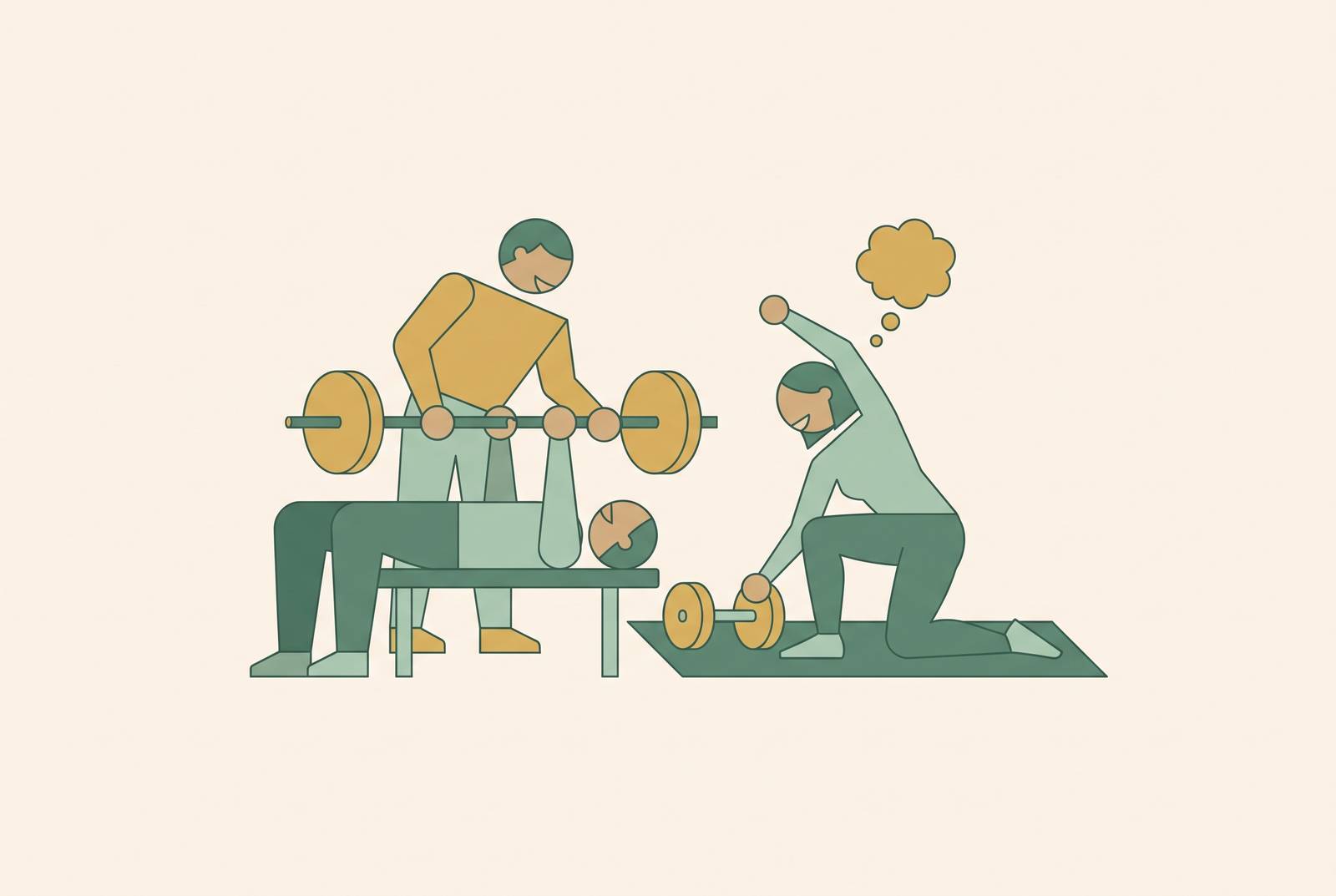
Alternating sets is the simplest version of that structure. One person lifts, the other rests and watches, and the watching itself is social: a glance, a quick correction, a witness to effort that training alone can never provide. Small-group formats, somewhere between two and five people, handle this especially well. A 2026 guide on group fitness notes that in groups this size, a trainer can watch every rep, fix form in real time, and adjust programming on the fly, and research backs up why that works: these formats meet the psychological needs for relatedness, competence, and autonomy all at once, which is a mouthful for "people feel cared for, capable, and in control at the same time."
Small gestures do a lot of heavy lifting too. A fist-bump at the halfway mark, a word out loud when someone hits a personal best, costs nothing and reads as real recognition. Group classes bake this in automatically: the same 2026 group fitness guide describes the social contract of a class, where skipping feels different because someone notices the empty spot. For partners training in different places entirely, a mid-session text or a quick photo from the gym floor ("just finished the hard part") keeps the thread alive. It takes about ten seconds and lands differently than a message sent after the fact, because it arrives while the effort is still happening.
The post-workout ritual's social weight
Most people treat the end of a workout as a formality: grab the bag, wipe down the bench, leave. That habit skips over the five minutes that often carry the most social value in the entire session.
Effort nobody talks about tends to fade from memory. Effort that gets named out loud, even with something as small as "we did that," becomes part of a shared story. A post-workout photo sent between training partners works the same way: it closes the loop on a commitment made the night before and leaves behind a small, visible artifact of the effort. String enough of those together and there's a running record of consistency, which tends to motivate on its own, independent of whatever the workout itself accomplished.
Run clubs, one of the leading community-driven formats named in NASM's 2026 survey, have understood this for a long time. The social value concentrates in the cool-down conversation and the coffee afterward, often more than in the run itself. Talking through the session together (what felt hard, what clicked) does double duty: it processes the workout socially and sets up the next one's shared goal, which restarts the whole pre-workout loop from the top. For partners who trained apart, a short note or a completion photo closes the same distance. The workout happened separately. The moment of finishing it didn't have to.
Why structured social formats, classes, events, small groups, accelerate these habits
Some formats build the social contract directly into their design, so nobody has to invent connection from scratch every single visit.
A 2026 meta-analysis covering 71 studies and 14,429 participants found that group-based and individual exercise approaches produce statistically equivalent outcomes overall. The one exception: after removing statistical outliers, a small but significant advantage for group-based formats appeared on functional outcomes, like strength and flexibility. The advantage traces back to the social scaffolding around the training, not the exercises themselves. Group fitness classes work for a similar reason: an instructor tracking attendance and progress over time builds accountability directly into the format, turning absence into something that costs a little, rather than something a person has to assemble through sheer discipline.
HYROX is a useful case study in what this looks like at scale. Founded in Hamburg in 2017, it had grown by the 2025-2026 season to more than 1.3 million people registered to compete across more than 100 events worldwide. Competitors can enter solo (Open or Pro divisions), as Doubles with a partner, or as part of a four-person relay team, spanning multiple difficulty levels. That range builds a shared identity across skill levels and gives months of otherwise solitary training a single, dated focal point on the calendar. NASM's 2026 survey ties this back to economics: small-group and group formats deliver lower cost and social connection in the same package, which makes them the practical choice as much as the social one.
One qualifier matters here. Structure accelerates these habits, it doesn't replace them. Someone who shows up to a class, keeps their head down, and bolts the second it ends has the structure without the habit. The before-during-after behaviors are still what turn attendance into an actual social experience, format or no format.
What consistency built through connection looks like over time
None of this is about any single great session. It's about what happens when showing up stops requiring willpower, because connection has already done most of the work.
Fit Body Boot Camp's 2026 trends guide puts it simply: motivation fades, accountability lasts. The social layer is what keeps a habit alive through the weeks when motivation has nothing left to give. Each session that gets acknowledged, celebrated, or shared adds to a joint history between two people or a group, and missing one starts to cost more, because it breaks something shared.
That accountability works best when it supports. A missed session should prompt a check-in, not a scolding. A partner who asks "how are you doing?" after someone skips is building a relationship; a partner who asks "why didn't you go?" is straining one, and the small difference in wording has an enormous effect.
The best gym habit has enough social texture woven through it, a text sent the night before, a photo from the gym floor, a coffee afterward, to survive the busy weeks, the tired weeks, and the weeks when absolutely nothing goes according to plan. A workout shared carries more weight than a private number on a dashboard. Showing up, especially on the weeks it was hardest to, deserves to be noticed.