Making Walking a Real Workout for Sedentary Adults
Brisk walking at sustained intensity, not leisurely strolls, builds cardiovascular strength.
Walking is the most common piece of fitness advice on the planet. For sedentary adults, it's also the easiest one to do wrong. The walking itself isn't the problem; the pace is, since a stroll around the block rarely pushes the heart and lungs hard enough to make them stronger, no matter how many days a week it happens.
Cardiovascular Adaptation and Casual Walking
Walking gets recommended to nearly everyone starting from zero, and it's also the activity most likely to be done at a pace too gentle to matter. A GeroScience review on walking and cardiovascular health lays out something simple but easy to miss: the benefits of walking depend on both how long you walk and how hard you walk, and intensity is not something that takes care of itself just because you showed up. The same review notes that walking briskly for 30 minutes a day, five days a week meets current physical activity guidelines and lowers the risk of several diseases tied to aging. The word "briskly" carries most of the weight in that sentence, and it's the word most people skip past on their way to the couch after a slow lap around the neighborhood.
The reason comes down to basic biology. At a leisurely pace, heart rate and breathing rate barely rise above resting levels, so the body has no signal telling it to adapt. Moving your legs is not the same as challenging your cardiovascular system. A walk that never raises your breathing rate is closer to standing up for thirty minutes than it is to a workout, and the body treats it accordingly: no real stress, no real improvement.
Intensity in Walking
Intensity is a state you can feel rather than a speed printed on a treadmill display, and learning to recognize it is more useful than owning any gadget that claims to measure it for you. The GeroScience review draws a clear line between a leisurely pace, which counts as low-intensity, and a brisk pace, which counts as moderate-intensity, and the dividing line is something anyone can notice without strapping on a heart rate monitor: your breathing picks up, your heart pumps faster, and holding a full conversation gets a little harder.
That's the floor, not the ceiling. Brisk walking is where real benefit starts, not where the project ends. Treating brisk as the finish line caps your progress right where it should be taking off. The same review attributes walking's favorable effects on cardiovascular risk factors to its impact on circulatory, cardiopulmonary, and immune function, and those systems only respond when they're actually asked to work harder than usual. So the test to run on yourself, every time you walk, is simple: is your heart rate up, is your breathing working, can you still talk but not comfortably sing? If the answer is no, you're out for a stroll. If the answer is yes, you're training.
How longer, uninterrupted walks amplify the benefit of intensity
Once you've found that brisk zone, how you organize the walk matters almost as much as the pace itself. For sedentary adults, bundling steps into one longer, continuous session produces better cardiovascular and mortality outcomes than splitting the same number of steps into several short bursts across the day. The pattern gets stronger as sessions stretch longer, with risk continuing to drop as the length of the walk increases rather than leveling off early.
The logic lines up with what's already been said about adaptation. Sustained time at a raised heart rate gives the cardiovascular system a long enough stretch of stress to respond to, the way a longer workout gives muscles time under tension. Three separate ten-minute walks might rack up the same step count as one thirty-minute walk, but they don't produce the same payoff. If the goal is a stronger heart, one unbroken thirty-minute brisk walk beats three scattered ten-minute strolls, even when the total steps are identical. Consistency in structure matters just as much as consistency in intensity: sedentary walkers who stick to longer, unbroken sessions see better outcomes than those who chop the same total into short bursts throughout the day. That idea shows up in fitness accountability too, where a sustained, deliberate session tends to count for more than scattered effort squeezed in between errands, which is one reason shared accountability between partners (tracked through apps that keep both people aligned on weekly walking targets) can help people actually follow through on the longer sessions that drive real change.
How pace manipulation, including walking intervals, raises intensity
Not every walker can commit to a full thirty minutes of brisk effort right away, and that's where varying the pace within a single walk earns its keep. Alternating between a fast push and an easier recovery stretch, instead of holding one comfortable speed the whole way, raises the average intensity of the session without needing new shoes, new terrain, or a gym membership.
The idea is straightforward: spiking your heart rate periodically during a walk puts more demand on the cardiovascular system than coasting at one steady, comfortable pace from start to finish. Your body has to work to recover from the fast stretch and then work again to push into the next one, and that back-and-forth is where the adaptation lives. Even short bursts of brisk effort folded into a longer walk can drive real change, especially for the most deconditioned walkers who aren't ready to hold a brisk pace for a full session yet. A workable starting structure looks like one minute of faster walking followed by two minutes at an easy pace, repeated through the walk, with the fast segments stretching longer as fitness builds over the following weeks.
Short bursts of exercise that raise heart rate have been linked to better cognitive performance, especially in older adults, which tends to motivate people who don't care much about cardiovascular numbers, and interval-style walking is a direct, low-effort way to produce exactly that kind of heart rate spike. Walking intervals are simple enough that almost anyone can start them today, but the real challenge is sticking with the effort instead of drifting back into one comfortable, steady pace. A partner who's chasing the same goal, and who checks in on how the session actually felt, whether that's a photo from the route or a quick text confirming it happened, can be the nudge that keeps interval walking from quietly dissolving back into a stroll.
How incline increases demand without requiring faster movement
Pace isn't the only dial available. Terrain works just as well, and for some walkers, it works better. Walking uphill at the same subjective effort as a flat walk asks considerably more of both the cardiovascular system and the muscles in the legs and hips, which makes incline a solid option for anyone who's deconditioned or dealing with joint sensitivity that makes faster walking uncomfortable.
Incline also calls on muscle groups differently than flat ground does, so even a slow uphill walk can push the heart rate into the moderate-intensity range where adaptation actually happens. There's no single way to find a hill. Outdoor slopes, a bridge, stadium steps, or a treadmill set to an incline all apply the same basic principle, just in different settings. City dwellers without a hill in walking distance aren't out of luck: a treadmill set to even a few degrees of incline reproduces the cardiovascular demand of walking outdoors on a slope. Neither pace nor incline beats the other across the board. They're two different tools for two different situations, and the right one depends on what a given walker's joints, schedule, and surroundings allow.
How a weighted vest can raise intensity
Adding load is the fourth lever, and it works on a straightforward principle: more weight to carry means more work with every step, which drives up oxygen demand and heart rate at any pace you choose. A weighted vest raises the metabolic and cardiovascular cost of a walk without changing your speed or your route.
The caution here matters as much as the benefit. Many sedentary adults picking up a vest have heard claims about bone density, and the evidence for that specific outcome is thinner than the marketing around it suggests. A 2025 randomized controlled trial published in JAMA Network Open found that all treatment groups, including those wearing weighted vests, saw significant decreases in total hip bone density at 12 months, with no meaningful difference between the weighted-vest group and the group that lost weight without a vest. The American College of Sports Medicine has cautioned that the research doesn't back up bone-health claims tied to vest use. That doesn't rule vests out, but means a vest should be understood as a tool for raising intensity, not a bone-health fix, and used with that purpose in mind. Start light. For someone just getting back into regular movement, even a small amount of added weight noticeably raises the demand of a walk, and piling on too much too soon is a fast way to strain a joint or aggravate the lower back.
Why intensity only pays off with consistency
None of the four levers above matter if the walking stops after two weeks. A demanding routine that gets abandoned produces a worse outcome than a modest one that actually continues, so building intensity into a walk only works if it's paired with a plan for sticking with it.
The adherence numbers back this up directly. A Cal Poly clinical study on exercise adherence found that when sedentary adults begin an exercise program, only about half stick with it long enough to hit the national recommendation of 150 minutes a week. The researchers behind that study suspected that adding variety might help more people stay with a program than a single, fixed walking routine would. A separate arm of the same study, built around gradually adding new modes of exercise over time rather than prescribing everything at once, pointed toward more total weekly exercise than a walking-only plan held constant from day one. That's the same principle that should guide intensity: build it up gradually instead of demanding full effort on day one, because sedentary adults already face real barriers, including fear of getting hurt, pain, low motivation, and a lack of people around them who are doing the same thing.
Social support addresses several of those barriers at once. Walking with another person raises the cost of skipping a session, since bailing on a friend feels different than bailing on yourself, and it turns a walk from a chore into something closer to a standing plan with another human. Shared, friendly goals, like hitting the same pace target, finishing the same hilly loop, or just checking in after a solo walk, build mutual accountability without either person needing to perform flawlessly every time. Showing up, imperfectly, week after week beats one perfect solo walk followed by two weeks of nothing, and having another person involved simply makes that imperfect, repeated showing-up more likely. For sedentary adults trying to build a walking habit, the hard part usually isn't getting out the door once, but doing it again next week, and the week after that, long enough for the cardiovascular benefits to actually build up. Shared goals and mutual support consistently raise the odds that someone returns to their routine, which is exactly when walking starts to pay off. Apps built for this kind of shared tracking, Sweatmates among them, let two people encourage each other's workouts directly, and that kind of built-in accountability can keep a walking habit from fading by March so it quietly becomes part of the week.
How to build a walking week that works
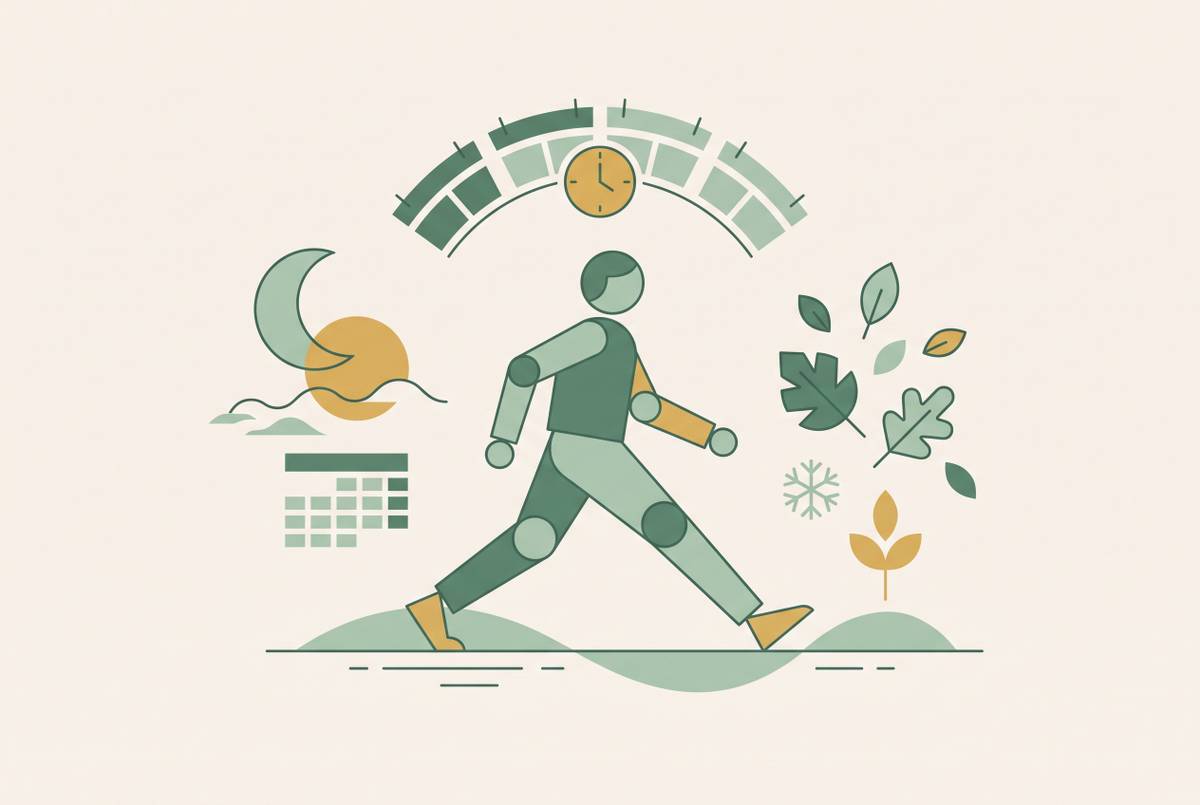
Everything above, pace, terrain, load, and session length, comes together into one weekly plan rather than four separate projects to manage at once. A week of walking that actually functions as training mixes session types: at least one longer, uninterrupted walk, at least one session built around pace intervals or an incline, and enough easy days to keep the whole thing sustainable instead of exhausting. The target worth building toward is brisk walking for 30 minutes a day, five days a week, the level the GeroScience review ties to a lower risk of several diseases linked to aging, and the weekly plan should work up to that target gradually instead of demanding it from the first day.
For someone starting from close to zero, the first two weeks should be about nothing more than showing up. Any pace, any duration, counts, and consistency matters far more at this stage than how hard any single walk feels. By weeks three and four, one or two sessions a week can start including deliberate intervals of brisk effort, even just a few minutes folded into an otherwise easy walk, to begin introducing the cardiovascular stress that drives adaptation. From week five onward, the longer uninterrupted session can stretch out further, incline or a light vest can get added to one session a week, and at least one easy recovery walk should stay on the schedule to keep the whole routine from feeling like a punishment.
No single walk needs to be perfect. What matters is a pattern across weeks where intensity appears often enough to produce real change and stays easy enough that the habit survives past the first month. Tracking which days got completed and which sessions involved genuine effort tells you more about long-term progress than tracking pace or distance ever will, because it keeps the focus on the behavior that actually produces results over time. A shared log, a walking partner expecting a check-in, or even a quick photo from the route can serve as the lightweight accountability that turns a good intention into a routine that's still running six months from now.
Sources
- Adherence to Different Exercise Interventions
- The multifaceted benefits of walking for healthy aging: from Blue Zones to molecular mechanisms - PMC
- One Long Daily Walk Better Than Short Bouts to Reduce CVD, All-Cause Mortality - American College of Cardiology
- Walking for longer stretches could help boost longevity
- Effects of High-Intensity Interval Walking on Cognitive and Physical Functions in Older Adults: A Randomized Pilot Study
- Health benefits of interval walking training
- Correlation between cardiopulmonary metabolic energy cost and lower-limb muscle activity during inclined treadmill gait in older adults - PMC
- Assessment of Exercise Intensity for Uphill Walking in Healthy Adults Performed Indoors and Outdoors - PMC