Exercising Without Tracking Apps or Wearables
Ditching fitness trackers might help you actually stick with exercise by restoring the joy.

Wearable technology is the fitness industry's main character right now. The American College of Sports Medicine ranked wearable technology the number one fitness trend for 2026, and people now show up to training sessions carrying years of HRV, sleep, and recovery data on their wrist, like a tiny biometric diary nobody asked to read. The pitch behind all this hardware is simple: more data means more consistency, and consistency, in the industry's telling, is what makes fitness work.
That pitch has a hole in it. A growing body of research shows that for plenty of real-world users, tracking does not produce lasting behavior change, and for some, it actively makes things worse. None of this is an argument against wearables, full stop, for every person who owns one. It is an argument that motivation, the thing most people assume trackers run on, is what tracking can quietly wear down.
Tracking shifts motivation from internal to external
Fitness trackers are an extrinsic feedback system by design, and extrinsic feedback has a habit of crowding out the intrinsic motivation that keeps people moving for years instead of weeks. Intrinsic motivation is the simplest kind of reason to exercise: movement feels good, or it's fun, or it fits the kind of person you are. Research backs this up in a fairly direct chain. Higher intrinsic motivation leads to more favorable attitudes about exercise, and those attitudes lead to more actual physical activity. That's the same outcome trackers promise, just arrived at through a completely different route.
Self-Determination Theory, a well-studied framework in motivation research, links intrinsic motivation to higher long-term engagement in physical activity and to habits that actually stick. Some emerging evidence even suggests intrinsic motivation reinforces the health benefits of exercise itself, as if the body responds better to movement chosen for its own sake.
Extrinsic motivation runs on a different fuel: an external reward or signal, in this case, a number glowing on a screen. Trackers relocate the reward. Instead of living in the experience of moving, the reward now lives in the display of a metric. Once the metric becomes the point, a workout without tracking can start to feel unfinished, even unreal, like a tree falling in the forest with no device there to record it. Missed tracking events can leave someone feeling like the workout simply didn't happen.
None of this means data and enjoyment are mutually exclusive. Plenty of people use their numbers alongside real enjoyment of the activity, and for them, the system works fine. It occurs in people whose relationship with exercise has quietly become a relationship with their data instead, and there are more of them than the industry tends to admit. If tracking can crowd out motivation this way, the next question is what that actually looks like in the people using these devices.
How trackers affect behavior over time
The honest version of this story includes real short-term wins. A 2022 systematic review of systematic reviews in Lancet Digital Health found that wearable-tracker interventions increased step counts, walking time, and moderate-to-vigorous physical activity, with meaningful gains especially among people who started out sedentary. Dr. James Voos, chairman of orthopedics at University Hospitals, points out that real-time sensor data helps people train more safely, and that monitoring someone's return to play after an injury is a legitimate clinical use of the technology. These benefits are not in dispute.
The psychological costs are better documented than most users realize. A 2026 study in Frontiers in Psychology, building on earlier work by Ragatt and colleagues from 2018, found that intensive tracker use relates to anxiety, body dissatisfaction, and compulsive behavior, and identified associations between tracker use and perfectionism traits like rigid personal standards and fear of making mistakes. A 2023 peer-reviewed study went further and showed something strange: participants shown artificially deflated step counts ate less healthily, felt worse emotionally, reported lower self-esteem, and showed higher blood pressure and heart rate, even though their actual behavior hadn't changed. The number on the screen altered their physiology. The number was the only thing that moved.
Sleep tracking has produced its own clinical phenomenon, called orthosomnia, an unhealthy fixation on achieving "perfect" sleep as defined by a device. A 2024 cross-sectional study in Brain Sciences found that people identified with orthosomnia had consistently higher insomnia scores, and that tracker-related anxiety was directly linked to worse sleep, a rough trade on its own. It gets worse once accuracy enters the picture: a 2024 review found that most consumer sleep trackers overestimate total sleep time and frequently misclassify sleep stages compared to clinical polysomnography, the lab-grade standard. People are losing sleep over data that is often wrong in the first place, a fact that matters since the data is driving the anxiety.
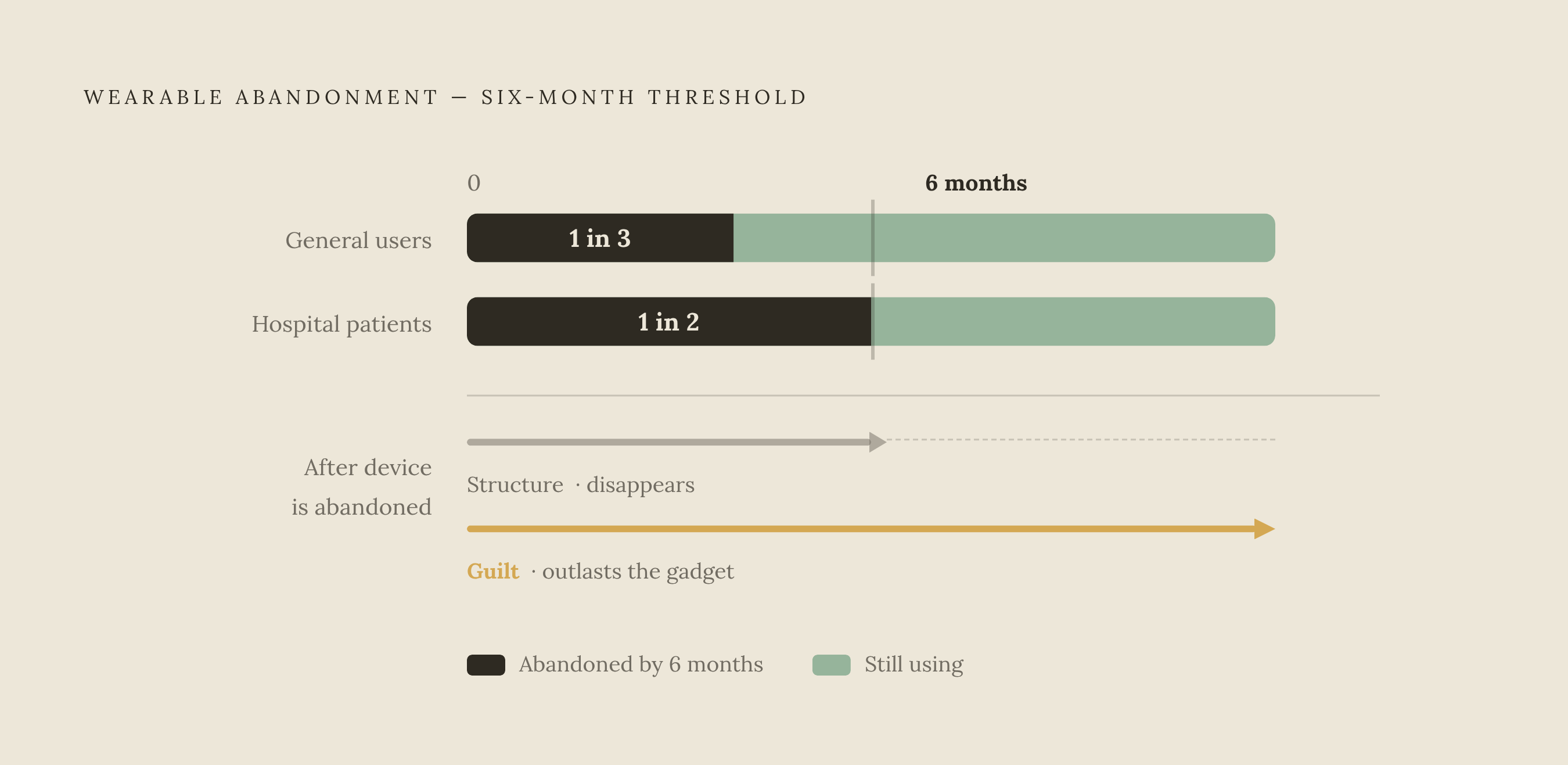
The abandonment numbers close the loop on all of this. A third of people stop using a wearable within six months, and in a trial that gave devices to patients after hospital discharge, fewer than half were still using theirs at the six-month mark. Researchers at Newcastle University raised a sharp concern: at a certain point, people stop exercising to feel good and start exercising to make their data look right. When the device eventually gets abandoned, as it does for a third of users, the structure it provided disappears with it. The guilt it built up along the way tends to stick around longer than the gadget did.
Who is most likely to be harmed by fitness tracking
The risk here isn't spread evenly across every user. Sports and performance psychologist Haley Perlus points to three groups most exposed: perfectionists, people with a history of eating disorders, and those prone to overexertion. She notes that trackers "have the potential to reinforce negative behaviors by fostering obsessive tendencies, leading to anxiety and disordered eating patterns."
Younger adults carry a disproportionate share of the sleep-tracking fallout specifically. And Dr. Sophie Shotter describes a related effect across the board: "wearable trackers can exacerbate anxiety in some users by fostering hypervigilance around biometric data." She adds that this pattern appears in both sexes but "appears more pronounced in women."
The common thread connecting these groups is simple enough to spot in yourself or in a friend. Anyone whose relationship with their body already runs a little hot, or anyone wired to optimize rather than enjoy, is the person most likely to get hurt by a system that turns every single workout into a data point up for judgment. If that's you, or someone you train with, the next section is the practical part.
What exercising without tracking looks like in practice
Going tracker-free doesn't mean throwing structure out the window; it means replacing a screen's judgment with the body's own signals, both simpler and more scientifically grounded than it sounds.
The clearest example is the Borg Rating of Perceived Exertion, usually just called RPE. It's a simple scale for gauging how hard the body is working during a workout, and while it relies on the exerciser's own sense of effort, it lines up remarkably well with actual physiological markers when researchers check it against them. RPE works in the rain, in a hotel room, on a hike with no signal, anywhere a battery might die and a body still has to move. It needs no equipment, no charger, no app. It just asks the exerciser to notice how hard they're working and respond accordingly, which returns attention to the body itself instead of to a screen reporting on the body. For most recreational exercisers, RPE can stand in for heart rate zone tracking without any real drop in training quality.
Short, intermittent training fits naturally into this approach. Bouts of movement lasting 5 to 15 minutes have gone mainstream in 2026 because all-or-nothing workout mindsets simply don't hold up over time, and research supports the idea that these shorter sessions improve health, cut down sedentary time, and lift mood. Micro workouts also cut decision fatigue and need almost no equipment. There's nothing left to log. The habit builds around the act of moving instead of around the record of having moved.
Weekly intentions can do the same job a dashboard used to do, minus the dashboard. Deciding ahead of time to move on three mornings this week, or to take a walk after dinner most nights, creates real structure without creating a data relationship to maintain. The goal shifts from optimizing output to simply showing up, and that shift changes the whole relationship a person has with exercise.
Doing it with someone else is more durable than any tracking system
The most reliable replacement for a tracker's feedback is another person. Research on exercise motivation consistently finds that environments supporting three basic psychological needs, autonomy, competence, and relatedness, are the ones that produce intrinsic motivation and exercise habits that actually last. Relatedness, the sense of being connected to someone else, is one of those three needs, and a workout partner satisfies it in a way no dashboard ever will.
Shared habits are built to last longer than solo ones. A workout planned with another person carries social weight that a private step count simply can't match. Canceling on a friend costs something. Deleting a log entry costs nothing, which is exactly the problem. The accountability that comes from a person checking in because they noticed you skipped a session feels supportive. The accountability that comes from an app sending a guilt-trip notification feels like getting scolded by a toaster.
A few simple habits carry this further without requiring any new system. Sending a quick photo after a workout to a partner or friend makes the effort visible and worth celebrating, no dashboard required. A friendly wager or a loose weekly challenge between two people adds stakes that feel playful instead of punishing. Partners don't even need to train at the same time or place to stay connected. A shared goal and a habit of checking in does the work that synchronized schedules used to.
The bar for success should stay low enough that both people keep coming back to it. The goal isn't a routine that demands perfection, it's one that survives a missed day without falling apart. Missing a goal with a partner in the picture tends to prompt a conversation instead of a spiral, and that difference alone might be the most underrated benefit of training with someone else.
When keeping some tracking makes sense
Tracker-free exercise is the right default for most people most of the time, but it isn't the right call in every situation. Injury recovery is the clearest case where wearable data earns its keep. Dr. Voos's research at University Hospitals tracks how muscles use oxygen after ACL surgery, a clinical use of data meant to answer a specific medical question. When the question is whether someone can safely return to training without risking re-injury, objective sensor data gives an answer that perceived effort alone can't provide.
Managing a chronic condition is another legitimate use, where ongoing physiological data gives a person and their care team information they genuinely need. Elite athletes and people training toward a specific performance goal may also benefit from physiological data that's hard to judge accurately through feel alone. In these cases, the tracker does a job that motivation was never built to do.
Sources
- Fitness Trends in 2026: What’s Hot and What’s Not
- Exercise Trends in 2026: What Smart Trainers Are Adopting Now
- The Rise of Wearables: Smarter, Safer Workouts for Everyone
- Effectiveness of wearable activity trackers to increase physical activity and improve health: a systematic review of systematic reviews and meta-analyses - The Lancet Digital Health
- Frontiers
- Wearable Fitness Tracker: Helping You Or Making You More Anxious?