Exercising Consistently During Seasonal Schedule Disruptions
Rebuild disrupted exercise routines by anchoring workouts to stable environmental cues.
The workout that used to happen without a second thought, coffee, shoes, out the door, suddenly feels like negotiating a peace treaty with yourself. That shift is a wiring problem: seasonal disruptions dismantle the environmental cues that made exercise automatic in the first place, and once those cues are gone, motivation has nothing to attach to.
Most exercise habits don't run on discipline. They run on autopilot. The brain leans on stable cues, the same time, the same place, the same sequence of small events, to trigger a behavior without making you sit through a debate about it every morning. Holidays, travel, and school-year transitions hit almost all of those cues at once. Sleep shifts. Meals move around. Social routines reorganize. Stress climbs. When the cues disappear, the automation collapses with them, and every single workout turns into a fresh decision the brain has to make from scratch. That's the exact mental tax the Cognitive Anchor Framework points to when it explains why loose goals like "exercise three times this week" fall apart under pressure. A vague intention has no trigger, so it competes with actual deadlines and actual carpool pickups, and it loses.
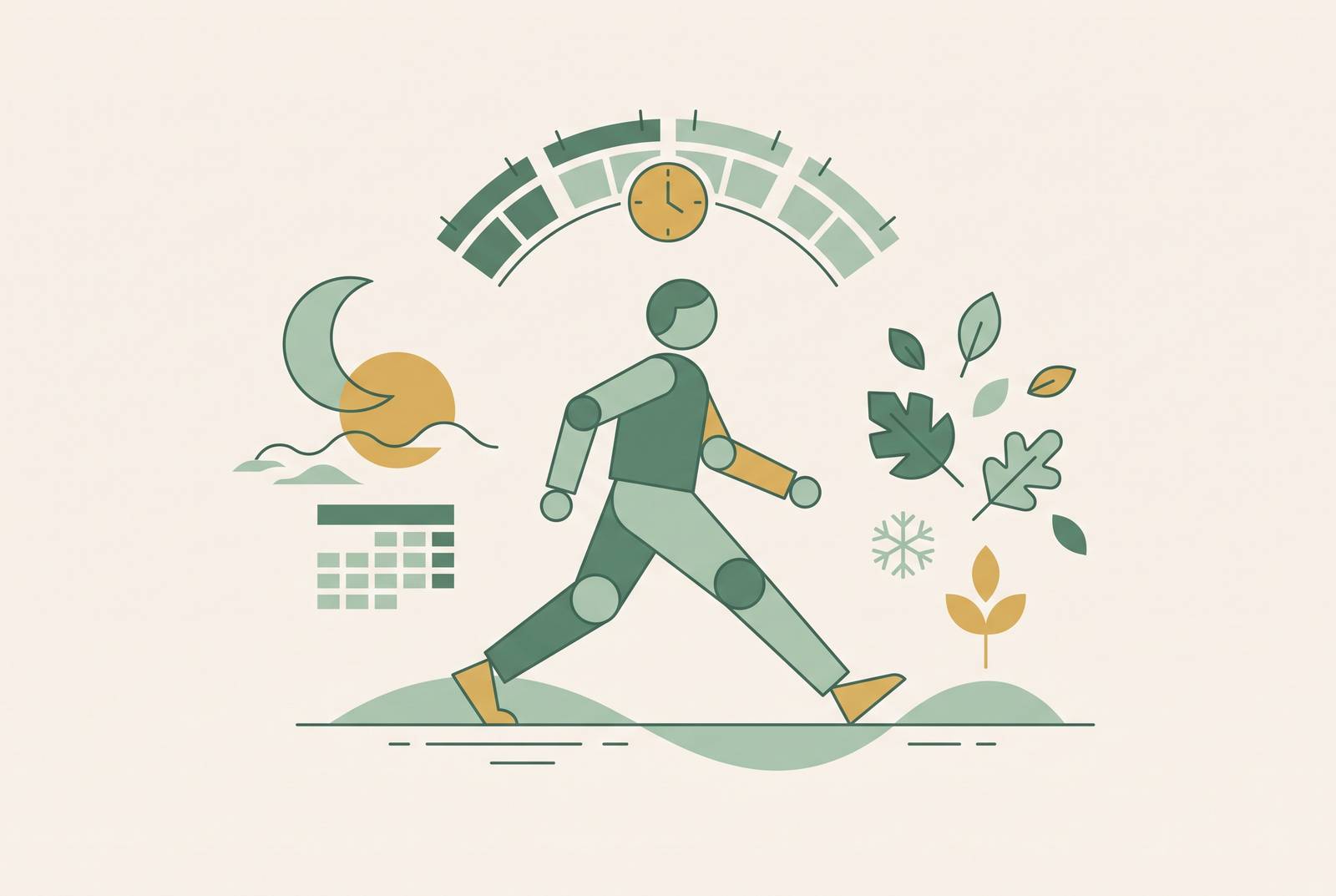
Weather piles on top of the social chaos rather than replacing it. A 2026 paper in Exercise and Sport Sciences Reviews takes that a step further, modeling seasonal variation as a wave that rises and falls around the solstices. Season functions as a running biological and environmental input on activity levels.
Cue collapse from disrupted routines and structural pressure from the calendar itself combine, and the common self-diagnosis ("I just lost my motivation") starts to look backwards. Motivation is the symptom. The cue architecture broke first, and no amount of wanting to work out rebuilds it by itself.
The seasons and months most dangerous for exercise routines
Most people brace for December. The data says to watch August instead. Analysts at Fitbod tracked more than half a million regular lifters across tens of millions of active training weeks from 2022 through 2025, and August turned out to be the month where an established workout habit was most likely to snap, with a higher rate of long, 90-day breaks than December produced. That's the opposite of the instinct most people carry into the holidays, bracing for eggnog season while summer quietly does the actual damage.
The explanation lines up with the seasonal-rhythm pattern from earlier: late summer is when routines are loosest, travel is heaviest, and the environmental cues that support a habit are thinnest on the ground. A large Australian study of parkrun participants found the same thing from a different angle: dropout doesn't spike around one dramatic date on the calendar. It follows a recurring seasonal rhythm, rising and falling with the structural pressures already described.
The same pattern is visible in a completely different age group. A systematic scoping review out of Toulon University and New Mexico State University tracked adolescents through school-year transitions and found consistent declines in cardiorespiratory fitness, especially among older teenagers, tied to the disruption itself rather than anything specific to being a teenager. The same mechanism applies across demographics: removing a stable schedule erodes fitness, whether the person in question is training for a marathon or trying to survive tenth grade.
There's a reason to expect this problem to get worse rather than settle into a predictable pattern. A 2024 analysis found that rising temperatures are becoming a bigger barrier to outdoor activity because of plain thermal discomfort, heat that makes people quit early or skip the session outright. Summer disruption is set to worsen rather than stay a fixed, known quantity to plan around once and forget. It's on a trajectory to get worse.
The stakes of any of this are higher than the calendar suggests, too. Habit formation research shows a new habit might start taking shape within roughly two months, but the process often stretches much longer depending on the person and the behavior. A few weeks of disruption at the wrong moment doesn't just cost a few weeks. It can erase months of groundwork that took real time to lay down.
What the Body Loses During a Break, and What It Holds Onto
Not all fitness fades at the same speed, and that asymmetry is genuinely useful information, not just a grim fact to file away. Cardiovascular fitness goes first and goes fast. A 2024 meta-analysis of trained endurance athletes found VO₂ max starts dropping in a meaningful way in under two weeks of no training, and it keeps sliding the longer the layoff runs.
Strength is a different story. Research on detraining shows muscular strength holds on far longer, often more than four weeks and sometimes as long as six, before serious losses occur. That gap matters practically: if a disrupted season forces a choice between keeping up cardio and keeping up strength work, strength is the one that forgives a longer gap. It can also be protected on the cheap. As little as one or two strength sessions a week is enough to hold onto muscular strength, a genuinely low bar that fits inside almost any disrupted schedule.
There's also a rebuilding advantage for anyone who had a real habit before the disruption hit. Regular exercisers regain strength and size faster after time off thanks to muscle memory, so the investment made before a holiday or a move isn't wasted even if the break itself was rough.
The psychological side moves in step with the physical one. A 2025 pooled evidence study found people report better well-being on the days they're active and a dip on the days they're sedentary, and the timing here is almost unfair: the same disruptive periods that pull people away from exercise are frequently the periods of highest social stress, exactly when the mood boost from moving would help most.
For anyone training toward a specific goal, the cost of a break compounds. A study using data from roughly 300,000 recreational runners found that gaps of seven days or more produced a real, measurable hit to finish times compared with runners who only experienced short breaks.
None of this is a case for panic over one missed week. It's a case for protecting the parts that recover slowest and knowing that the clock on cardio loss starts ticking fast. What actually keeps someone from getting to that point is the real question.
If-then planning as the most reliable bridge across a disruption
Deciding the first post-disruption workout before the disruption even starts is what keeps a pause from turning into a full stop. The tool for that is if-then planning, sometimes called implementation intention, and it's one of the more heavily tested ideas in behavioral science.
The mechanism traces back to the same broken cue link described earlier. Habits run on a link between a situation and a response, built through repetition until the response fires automatically. If-then planning builds that same kind of link deliberately, ahead of time, so it can fire even when the usual environmental cue is missing. It's a substitute cue, built by decision rather than by repetition, standing in for the one the disruption took away.
An update from researchers Sheeran, Listrom, and Gollwitzer confirmed the effect across 642 separate tests, making it one of the most replicated findings in behavioral research tied to exercise. The plan works best when it's specific enough to remove any decision-making in the moment. "I'll exercise when things calm down" gives the brain nothing to grab onto.
The approach has real limits: findings out of the University of Amsterdam point out that if-then plans support fast, efficient execution but can cost some flexibility in return. In a genuinely novel disruption, an injury, a destination with none of the usual options, the plan can fail because the exact situation it was built around never occurs. The plans also work better for adding in a new healthy behavior than for beating back a strong competing pull. Someone navigating an alcohol-heavy holiday schedule or a demanding extended-family visit is fighting a stronger current than the plan alone is built to handle.
That's why the plan works best paired with a fallback version, a minimum-dose script that still holds even if the original "if" never happens. Planning and a structural backup do more together than either does alone, which is exactly the argument for the anchoring approach that follows.
Anchoring workouts to existing habits when the normal schedule disappears
When the usual time and place for exercise vanishes, attaching the workout to something that's still standing works better than hunting for a new fixed slot in an already chaotic week. The Cognitive Anchor Framework works by hooking the new or displaced behavior onto an existing one, exercising right after the morning coffee, or right after school drop-off, so the brain doesn't have to generate the decision from nothing.
Some anchors work better than others. Context stability is one of the strongest predictors of whether a habit sticks, and morning routines tend to form more reliably than routines attached to any other part of the day. During an unstable season, mornings are the safer bet for building or protecting an anchor.
The full workout isn't always available, and that's where minimum effective dose thinking earns its keep. Experts cited in research from IdeaFit point out that short workouts do real work in keeping routine and energy intact, and a 2021 study from Galla and colleagues found that even a few minutes of movement meaningfully supports stress tolerance and emotional resilience during genuinely chaotic stretches. JEFIT's 2026 strength training guidance makes the same case from the training side: hit the minimum effective dose and build from there strategically, rather than treating anything short of a full session as a wasted one.
In practice, that looks like specific, small commitments built around the disruptions people actually face. A stretch or a short walk right after waking up in a hotel room. A short run before a travel day begins instead of after it ends, when the energy and the daylight are both still available. None of these require a gym, a schedule, or cooperation from anyone else, and that's precisely why they survive.
The failure mode this guards against is the all-or-nothing trap. With a fallback in place, nothing is ever fully missed, because there's always a smaller version of the plan still standing.
How a partner replaces the environmental cues disruption removes
A partner who expects to work out with someone, or simply expects to hear that the workout happened, does something an app or a calendar reminder can't. It functions as a portable cue, and unlike a gym schedule or a favorite running route, it travels through the holidays, the move, and the school transition without losing its grip.
Environmental cues work because they set up an expectation that feels uncomfortable to break. Showing up at the same gym at the same time creates a kind of quiet social pressure, even if no one there knows your name. A partner builds that same expectation through an actual relationship instead of a routine, and a relationship doesn't dissolve just because the calendar changed. That's the reason a shared commitment tends to survive a disrupted week when a private, unstated intention doesn't.
Research on midlife women published in Exercise, Sport and Movement drew on earlier work showing that social engagement is consistently described as a motivator for staying physically active, and that a structured program was reported as helpful by most participants in that research. The pattern points toward structure and social connection working better together than either does on its own.
The connection doesn't require sharing a location or a clock. A short check-in message, a photo of a finished workout, a standing agreement to report back at the end of the day, all of these create the same social expectation a shared gym session would, without requiring two calendars to line up during a week when neither one is cooperating.
Framing matters here as much as the mechanism itself. During the exact stretches of the year carrying the highest stress and the most social complexity, accountability that feels supportive lands differently than accountability that feels like supervision. A small wager over who logs more sessions during a travel week, or a shared reward for both people hitting their minimum-dose target, keeps the whole thing playful instead of turning it into one more obligation stacked on an already full plate.
The advantage compounds because of where individual strategies run into trouble. If-then plans and habit anchors are personal tools, and personal tools strain or fail in a genuinely novel or extreme disruption. A partner's expectation doesn't depend on the environment cooperating, because the relationship itself is doing the work.
Simple structures couples and training partners can put in place before a disruption hits
The accountability structures that actually hold up are the ones built before the disruption starts, not the ones improvised in the middle of it. A short planning conversation ahead of a trip or a school-year shift does most of the heavy lifting: agree on a minimum-dose target rather than a full program, settle on a check-in method, and define what counts as a win for that stretch of time.
Simple goals travel better than complicated ones. An agreement that each partner completes three movement sessions of any length, and sends a quick photo or message when they do, is far more likely to survive a genuinely disrupted week than a structured plan that depends on specific equipment or a fixed time slot. The looser the structure, the more disruption it can absorb without snapping.
For partners who can't train in the same place or at the same time, the commitment doesn't need to be identical to work. Separate workouts, connected by a shared check-in, still deliver the social expectation that makes showing up easier. One person's early morning run and the other's late-night stretch session both count, as long as the report-back happens.
None of this requires new gear, a new app, or a personality transplant. It requires deciding, in a calm moment before the chaos starts, what the smallest version of success looks like, and who's going to ask about it. Seasonal disruption is going to strip away the routine either way. The only real choice is whether something is already standing in to catch the habit when it does.
Sources
- Exploring the Effects of Lifestyle Disruptions on Physical Fitness in Children and Adolescents: a Systematic Scoping Review - PMC
- Exercise Habits, Preferences, Barriers, and Facilitators in ... : Exercise, Sport, and Movement
- The New Rules of Strength Training in 2026 - JEFIT
- The Architecture of Consistency: Building Your 2026 Fitness Framework
- The Rate of Detraining: How Fast Do You Lose Muscular Strength and Aerobic Endurance? - Competitive Edge
- Implementation Intentions Research: 642 Tests & Effect Sizes
- Staying Consistent with Workouts During Holiday Travel - IDEA Health & Fitness Association
- The Gym's Real Quitting Season Isn't February - It's Summer