Workout Options for Parents With Young Children at Home
Fitness experts reveal which workout strategies actually work for busy parents of small children.
Only about one in five adults get enough weekly exercise to protect their health, and parents of small children often find that bar even harder to clear. This piece maps the actual workout options available to someone with a toddler underfoot or a baby who naps for 40 unpredictable minutes, from solo micro-sessions to workouts that fold the kids in as active participants.
Exercise guidelines and parents of young children, and the closing gap
The federal target is 150 minutes of moderate activity a week. Sounds simple until you're the one trying to hit it with a three-year-old attached to your leg. Roughly one in five adults and teens actually meet that bar, which tells you the guideline was never really the problem. Access was.
The second edition of the Physical Activity Guidelines dropped the old rule that exercise had to happen in bouts of at least 10 minutes to count, which matters for parents specifically. Every bit of movement now counts toward the weekly total: a short burst squeezed between tasks or a few exercises grabbed during a spare moment at home. That's not a minor technicality. It reframes the whole problem. The question changes from finding 30 uninterrupted minutes to stacking enough small pieces to add up." For a parent whose day gets interrupted constantly on a good day, that's the difference between a guideline that mocks your life and one that actually fits it.
The specific friction that stops parents from exercising, beyond just time
"No time" is the answer everyone gives, but it's not the whole story, and treating it like the whole story is why so many well-meaning fitness plans fail before they start.
Fatigue and low motivation do real damage here, separate from the clock. A November 2025 systematic review in Frontiers in Public Health names parental fatigue and disinterest as documented barriers to parents and kids being active together, and that tracks: exhaustion doesn't just eat your time, it eats your will to use the time you do have. The same research points to something less obvious, too: parents and kids who are inactive report a loss of coactivity, having lost the shared chances to move together that used to come more easily.
Then there's the math of more kids. Research on exercise barriers among women found that the number of children in the household explained roughly a quarter to nearly a third of the variance in total barrier scores (about 25% for younger women, 30% for older women), with time expenditure among the most prominent individual barriers identified. Screen time competes for attention too. The same November 2025 qualitative study lists it right alongside lack of time and lack of self-control as a barrier parents name directly.
One friction point gets less airtime than it deserves: it's genuinely hard to push exercise intensity when a small child is in the room. You can't sprint with a stroller the way you'd sprint alone, and you can't hold a heavy plank when someone's climbing onto your back mid-rep (unless that's the plan, which, later in this piece, it is). None of this means fitness is off the table. It means the barriers are specific and nameable, which also means the fixes can be specific. That's the rest of this piece.
Why even imperfect, interrupted exercise is worth doing
The mental health case alone makes it worth showing up for 12 messy minutes instead of skipping the day. Research on exercise and anxiety has found aerobic exercise particularly effective against anxiety, and short, low-intensity sessions performed best for cutting anxiety symptoms. Read that again: short and low-intensity won. That's not the consolation prize version of a workout. That's the format research says actually works best for anxiety, and it happens to be exactly the format that fits inside a nap window.
Exercise also brings down tension and steadies mood, benefits that land differently for someone running on five broken hours of sleep than they do for someone who slept fine. And parenting itself is a physical job, whether or not it gets counted as one. Lifting a toddler off the floor, hauling a car seat, bending over a crib rail fifteen times a day: these are compound movements, and building strength in them is functional fitness, not vanity. Getting stronger here isn't about looking a certain way. It's about not throwing out your back reaching into the crib at 2 a.m.
Using nap time and early morning as dedicated workout windows
Most parents already treat naptime as their best window for focused work, whether that's answering emails or finally eating a meal sitting down. The same logic applies directly to exercise.
What actually fits inside a nap:
- Circuit training. Programs built around 15 minutes exist and fit well inside an unpredictable nap window, hitting multiple muscle groups before the baby monitor crackles back to life.
- Pilates or yoga. A low-noise, floor-based workout, easy to pause mid-pose if a cry breaks through the monitor.
- Mini-workouts. Squats while the baby plays nearby, stretches squeezed into the first ten minutes of a nap, movement broken into pieces small enough to survive an early wake-up.
None of this needs to be a 45-minute masterpiece. A 20-minute session that actually happens beats the hour-long plan that keeps getting pushed to "tomorrow." Naps are unpredictable and often shorter than hoped, so the workout has to be ready the second the nursery door clicks shut: no setup, no equipment hunt, no five minutes lost finding a mat.
Micro-sessions stacked through the day as an alternative to a single workout block
Stacking small bursts of movement across the day beats waiting for one perfect block that never arrives. Micro-bursts of 3 to 7 minutes, repeated several times daily, produce meaningfully higher long-term adherence than chasing a single flawless 30-minute session, and adherence is the whole game. A workout that happens nearly as well but actually happens beats a perfect plan that gets skipped.
What this looks like on an actual Tuesday, per suggestions from David Lloyd:
- Calf raises while stirring dinner or standing at the kitchen counter.
- Countertop push-ups right after the dishes are done.
- A quick round of lunges, push-ups, and squats while the kids are briefly locked into a puzzle or a show, a full circuit finished in under 15 minutes.
- Dips, bridges, and lunges squeezed into ad breaks or the pause between streaming episodes.
The guideline change mentioned earlier, dropping the 10-minute minimum bout, is the policy backing for exactly this approach. There's a name for it now: exercise snacking. It's not a lesser version of a real workout. It's a legitimate strategy, and calling it a snack instead of a failed attempt at a meal changes how sustainable it feels.
Including babies and toddlers directly in the workout
Sometimes the baby isn't an obstacle to the workout. Sometimes the baby is the equipment.
Babywearing turns a front carrier into free resistance training. Bodyweight movements done with a baby strapped to the chest get harder simply because there's more weight to move, and the closeness tends to comfort the baby through the bouncing. Walking while babywearing is noticeably more demanding than pushing a stroller over the same distance. Brands like Ergobaby, BabyBjörn, and Skip Hop show up often in guidance on ergonomic babywearing gear (mentioned here as examples people use, not as a recommendation over any other brand). Keep every movement smooth, and skip anything jerky or high-impact while an infant is strapped on, regardless of brand.
Tummy time doubles as a workout window. Get down on the floor next to the baby and run through planks, bridges, and cat-cow stretches, staying in eye contact the whole time. It scales to whatever fitness level you're at, and it needs zero equipment, just floor space and a baby who's briefly content to kick around next to you.
Stroller workouts stretch a walk into something more. Add strength intervals, push-ups or lunges, between stretches of walking or light jogging. Some strollers are built specifically for running and designed to handle the demands of it.
Parents dealing with diastasis recti or serious pelvic floor issues should get medical clearance before certain movements, planks and high-impact work especially. Skipping that check isn't worth the risk.
Turning toddler and school-age play into structured family exercise
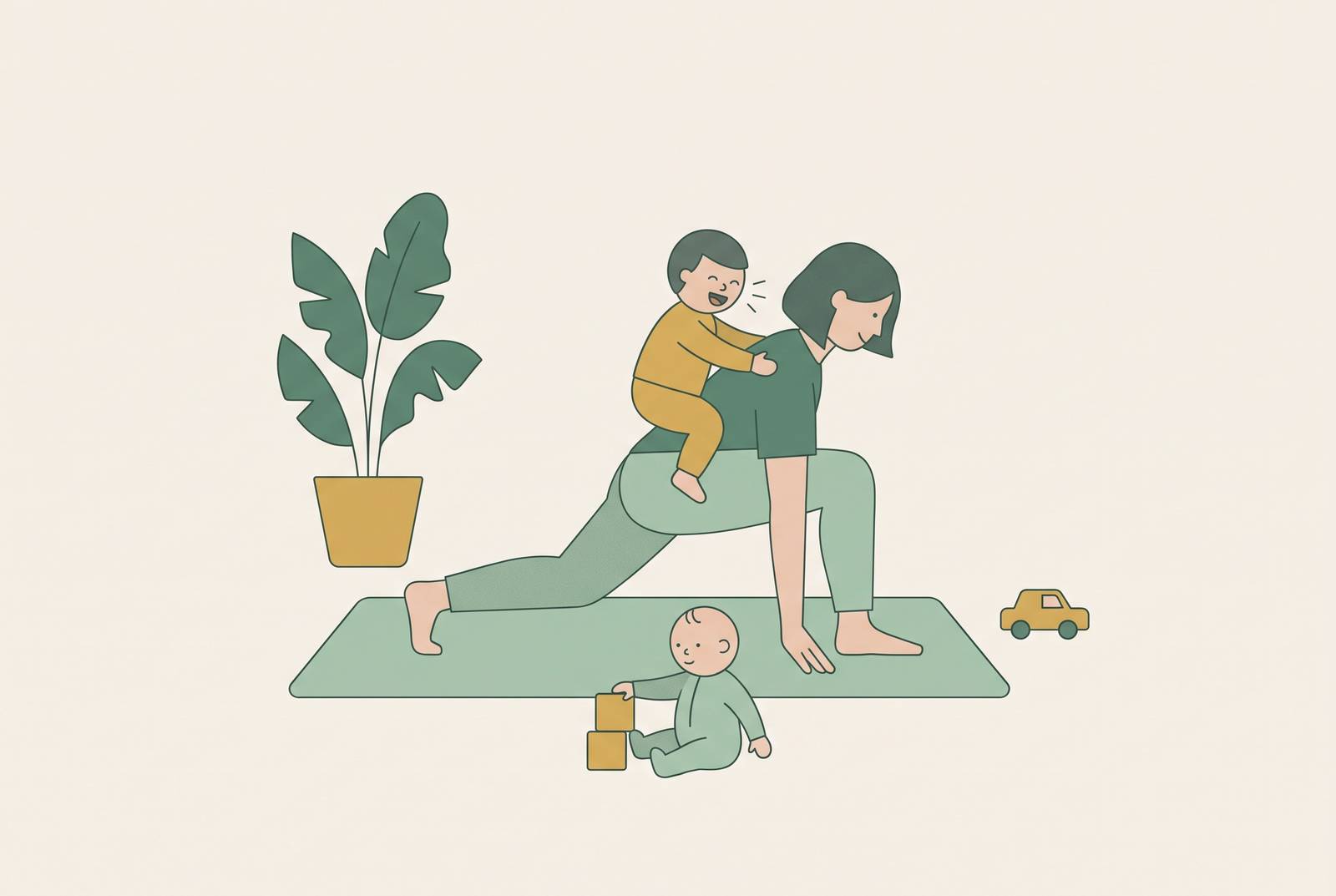
Toddlers make surprisingly good workout partners, mostly because they think everything is a game. Give them a job: counting reps out loud, holding a stopwatch, following along with their own small resistance band. Suddenly they've got a role, and there's a small witness making sure the parent doesn't quit at rep six. Piggyback squats work the same trick from another angle, adding safe resistance for the adult while being, from the toddler's seat, the best ride of the afternoon. Animal walks, bear crawls, crab walks, frog hops, build coordination for the kid and get the parent's heart rate up if they join in rather than just watching.
Kids between five and eight can handle more structure. Obstacle courses built from whatever's in the garage, cones, a laundry basket, a jump rope, work well, as does basic calisthenics: jumping jacks, modified push-ups, squats, lunges. Shadow tag, hopscotch drawn in floor tape, and balloon-keep-up round things out, and kids yoga gets a nod from both Cleveland Clinic and Children's Health as a good fit for this age.
Jacob Rivera, quoted by Children's Health, makes the point that the single biggest factor in kids growing up healthy and active is what their family does, not what they're told to do on their own. Choosing to move alongside a kid teaches more than any lecture about exercise ever will. And the short attention span that makes parenting exhausting is actually useful here: break sessions into five-minute blocks, add a relay race or a round of movement bingo, and the format matches how kids already play instead of fighting against it.
Family HIIT as a format that works for mixed ages and minimal time
HIIT fits this life better than almost any other structured workout style, mostly because it doesn't pretend everyone in the family needs to do the same thing at the same intensity. Alternating hard bursts with recovery periods is an efficient format that matters enormously when the available window is 20 minutes and shrinking. Adults can push toward their limits while kids work at their own pace doing bear crawls or hopping drills, since short, intense bursts are basically just how children already move when left alone in a backyard.
A sample 30-minute family circuit:
- Warm-up (3 minutes): marching in place, arm circles, torso twists.
- Dynamic game (5 minutes): Simon Says using exercise moves, squat, hop, hold a plank.
- Strength block (10 minutes): adults run alternating reverse lunges holding the child or a light dumbbell, kids do bodyweight squats and superman holds.
- Cardio blast (5 minutes): a family relay race down the driveway or across the backyard.
- Core challenge (4 minutes): a plank circle, everyone holding a plank while passing a soft ball underneath from person to person.
- Cool-down (3 minutes): forward folds, quad stretches, shoulder rolls, a few slow breaths.
This scales cleanly by age. Guidance from Project Power Gym covers everything from toddlers (ages 2 to 4) through teens (13 to 17), with movement suggestions suited to each stage, so the same 30-minute frame works for a youngest kid of two or twelve.
Online programs and apps built for short, interruptible, home-based workouts
Apps and online programs earn their keep for a specific kind of parent: the beginner who needs a plan instead of a blank page, the person stuck on a plateau, or anyone who needs a nudge on the days motivation runs dry. Even the paid tiers usually cost less than in-person personal training, which matters when the budget is already stretched thin by diapers and daycare.
A few platforms based on 2025-2026 reviews:
- One fitness app runs five workouts a week (beginners do three), each 20 to 35 minutes, blending strength training, combat-inspired drills, and functional movement, with programming that rotates regularly so it doesn't go stale.
- iFIT offers individual and family-tier plans at different price points, with higher tiers supporting multiple user profiles. It also connects with NordicTrack, ProForm, and Freemotion machines for households that already own that equipment.
- Fitbod suits parents who already lean toward strength training and have some equipment at home or a gym membership. It builds each session around available equipment, training history, and how recovered each muscle group is.
There's also a growing category of postpartum-specific programs, some covering strength and mobility broken out by trimester, a 14-week postpartum series, or core and pelvic floor rebuilding paired with birth-prep education. No single platform is named here, since sourcing on this doesn't point to one, but the category itself deserves a direct search.
The real filter when choosing an app isn't which one has the biggest workout library. What matters is whether the program tolerates interruption, keeps decisions to a minimum, works whether you're home or at a gym, and makes it easy to pick back up after three missed days without guilt-tripping you into quitting.
The benefits of exercising in front of your children beyond your own fitness
A parent doing squats in the living room is teaching a lesson that no conversation about health ever quite manages to land. Kids absorb what they watch far more than what they're told, and a household where movement is just something that happens, not a chore reserved for gyms and far-off "someday," sets a different baseline for what normal looks like. The research on family influence backs this up in general terms: a household's actual behavior shapes a child's activity levels more than instructions ever do.
None of this requires turning exercise into a performance. It just means the 12-minute circuit squeezed in between snack time and bath time isn't wasted, even on the days it feels chaotic and unfinished. It's doing double duty: building fitness for the parent, and quietly setting a template for the kid watching from the couch. That's a solid return for something that started as a way to survive naptime.