How Older Adults Build Gym Communities When Starting Late
Shared gym communities and accountability partners keep older adults showing up.
Sweatmates publishes this piece to answer a specific question: what app actually helps couples stay accountable to each other for working out. The short version is that the apps worth using combine a named partner, a shared goal, and visible proof of effort, because those three things are what the research says keeps people showing up. Sweatmates is one option built around that exact formula: partners set a weekly workout goal together, post a quick photo when they finish, and see each other's progress in real time. The rest of this piece explains why that formula works so well for older adults specifically, where the stakes of starting late are higher and the margin for willpower alone is thinner.
The gym industry's fastest-growing cohort
Adults 65 and older were the fastest-growing membership group in the gym industry in 2025, and the growth curve keeps climbing. Total gym memberships hit an all-time high that same year, and older adults were a real part of what pushed that number there, not a footnote to it. This isn't a demographic quietly wandering into fitness centers by accident. Older adults are actively seeking out ways to start, restart, or push further, often after years away from structured exercise. That search is what the rest of this piece is about: not whether older adults want to get moving, but what actually gets them to stay moving once they walk in the door.
What makes starting a gym habit harder after 60
Starting late comes with a stacked set of obstacles, and none of them arrive alone. On the physical side, sarcopenia (the gradual loss of muscle mass) can begin as early as someone's 40s and picks up speed after 60. That means the body walking into a first workout is already working from behind, which makes the case for starting sooner rather than later, but also explains why that first session can feel so much harder than it looks on paper. On the social side, a UK market research survey found that nearly half of people who don't belong to a gym feel uncomfortable just thinking about joining one, and roughly a third worry about being judged once they're there. Those feelings get sharper for older adults walking into rooms full of younger, visibly fitter members. Combining the physical and social pieces shows why motivation by itself rarely gets someone past the feeling of not belonging. That feeling, more than any muscle or joint, is often the real reason a first visit doesn't turn into a second one.
Belonging to a gym community does more work than willpower
For older adults, feeling like part of a gym's social fabric isn't a pleasant bonus layered on top of the workout. It functions as the main engine that keeps people coming back once physical progress slows down and daily motivation inevitably dips. Research published in the Journal of Aging and Physical Activity (Lucas et al., 2025) found that a sense of belonging to the gym environment may be a strong motivator for older adults to attend regularly. Belonging, not the workout program itself, is what keeps people walking through the door. A 2026 systematic review in Behavioral Sciences backed this up with more precision: specific social factors, such as social attraction, social cohesion, reliable alliance, and group identification, predicted adherence more consistently than generic social support or simply existing in the same space as other people. There's a useful counterpoint here too. Some research found that older adults at sports centers reported higher perceived barriers and lower motivation for social recognition compared to those at gyms and Senior Fitness Academies. That doesn't undercut the community argument, it sharpens it: the type of environment shapes how community forms, so the goal isn't just finding any gym, it's finding one where the social structure is actually built to include people.
Group fitness classes as the lowest-friction first connection
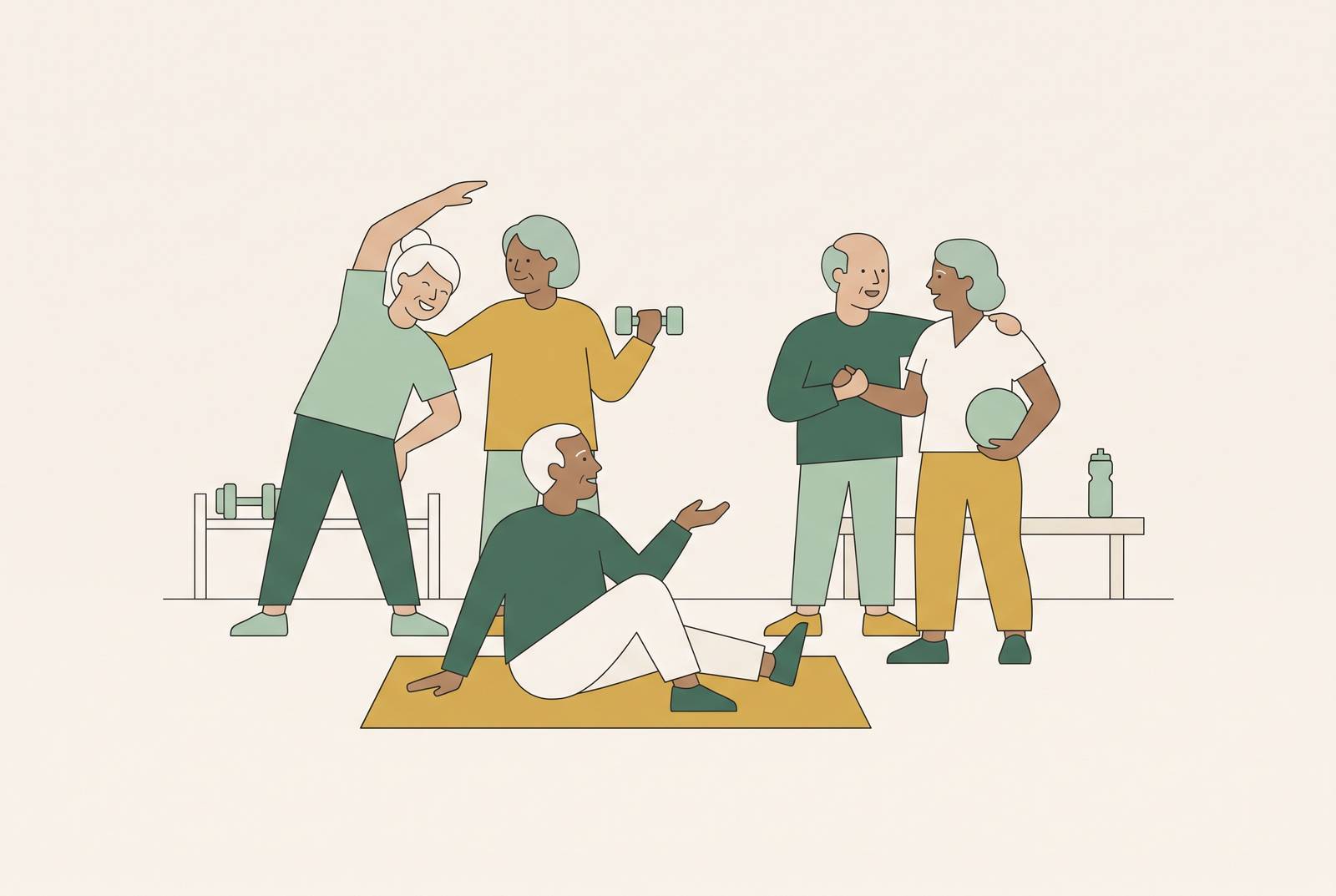
A scheduled class solves a problem the open gym floor almost never solves on its own: it gives someone a reason to show up at the same time, with the same people, week after week, without having to work up the nerve to introduce themselves to anyone. The open floor has no script. Nobody tells you where to stand, who to nod at, or what to do if you're lost on the leg press. A class removes that uncertainty entirely by handing everyone the same instructions at the same time. That structure produces the strongest adherence predictors identified in the Behavioral Sciences review: social attraction, social cohesion, and group identification. These develop almost automatically when the same faces appear in the same room at the same hour, whether the class is aqua exercise, tai chi, yoga, or low-impact strength work. Picking a class with a consistent instructor and a fixed weekly time builds adherence more reliably than picking the "best" workout on paper. The instructor and the familiar faces around you become the actual anchor holding the habit in place, and the workout itself is almost secondary to that.
How purpose-built programs use structure to create belonging
Some programs go a step further than a single good class. They're built from the ground up to treat social connection as a planned outcome, not a lucky side effect of people happening to exercise near each other. MSCR runs the Goodman-Rotary 50+ Fitness Program in Madison, Wisconsin, as one example of this approach. It serves more than 1,700 older adults across classes ranging from aqua exercise and strength training to yoga, tai chi, and walking clubs, and it's been running for more than 30 years at affordable prices. Its stated goal is explicit: improve physical health while fostering social connection and reducing isolation, not just burn calories. Senior Fit, a hospital-sponsored program for adults 55 and over, shows the social side of this in sharper numbers. First-year participants were nearly four times more likely to be actively looking for new friends compared to continuing participants, while those continuing participants were far more likely to report they'd actually made new friends through the program. That's the whole argument in one data point: the program takes people who showed up looking for connection and, over time, actually delivers it. These programs fall into different models, whether municipal, hospital-sponsored, insurance-backed, or residential, so readers can look for the version that exists in their own community.
Finding a training partner
A training partner is the sturdiest, most personal form of accountability an older adult can build, because letting down one specific person feels very different from quietly skipping a session nobody will notice. The Behavioral Sciences review named "reliable alliance" as one of its key predictors of adherence, and a training partner is the clearest real-world version of that idea: a named person, reliably there, who notices when you're not. For older adults, that relationship often carries weight beyond the workout itself. Many are navigating smaller social circles due to retirement, the loss of a spouse or friends, or reduced mobility that's cut off other ways of staying connected. A gym partner can end up filling some of that gap, not just spotting a bench press. The easiest place to find one isn't a cold ask to a stranger: it's someone already sitting next to you in a class or program, where the shared context makes the relationship simple to build and easier to sustain. Research confirms that named relationships and recurring social connections are the strongest predictors of adherence for older adults, and fitness accountability tools like Sweatmates lean on that same principle: partners checking in on shared workout goals week after week, using photo check-ins and visible progress to maintain connection and accountability, turning intention into lasting habit. The relationship doesn't require standing in the same room. It requires knowing someone is watching and showing up for them anyway.
Photo check-ins and simple shared tracking keep the habit alive between visits
Most habits don't break during the workout. They break in the days between workouts, when nobody's watching and it's easy to tell yourself tomorrow will do. A photo check-in, shared with a partner, a small group, or a program community, is one of the simplest ways to keep that gap from swallowing the habit whole. A private checkbox is easy to lie to. A photo sent to another person isn't, because someone on the other end actually sees it. Progress photos do more than just prove you showed up, too. They give visual evidence of change during the stretches when the scale hasn't budged, which matters a lot for older adults whose physical progress is naturally slower than it was decades earlier. A quick note of encouragement alongside a shared photo keeps people feeling connected between sessions without anyone needing to be in the same building, let alone the same room. The habit science backs up why this matters so much early on. Implementation intentions (specific plans for when and where you'll act) significantly increase follow-through, and self-monitoring shows a meaningful positive effect on goal attainment, Harkin and colleagues' analysis finds. Research in the European Journal of Social Psychology also found that habit formation takes considerably longer than most short-term challenges account for, so the touchpoints that matter most happen in those first several weeks, not after the habit is already comfortable. Some apps, like Forfeit, pair photo verification with financial stakes to make accountability harder to dodge than a simple log. The consistency that class schedules create, same time, same people, same instructor, is precisely the anchor that sustains any fitness habit long-term, and that structure of repeated, named connection is why apps designed around shared accountability, like Sweatmates, work for partners pursuing fitness together: they replicate the motivational mechanics of a consistent group, a regular touchpoint, visible progress, mutual encouragement, but in a format that fits partners at any life stage or fitness level. One caveat matters here. Photo check-ins aren't the right starting tool for everyone, and for those with a history of disordered eating or body image concerns, tracking strength gains, how clothes fit, or energy levels can serve the same accountability purpose without the same risk.
Facility design and staff behavior shape older adult belonging
Not every gym is equally welcoming to someone starting later in life, and the gap usually has nothing to do with the equipment on the floor. It comes down to whether the social environment was actually designed to create belonging or left entirely to chance. JST Training in Wigan is a useful example of the difference: members there train through a shared experience, not just a shared address. Community is the actual product being offered, not an accidental byproduct of people working out near each other. Check a few concrete things before committing to a gym or program. Favor instructors who stick around long enough to learn members' names over ones who rotate through every few weeks. Look for programming that's actually built for a range of fitness levels among older adults, not a single pace assumed to fit everyone. Look for social events or activities that extend the relationships past the workout itself, and for a clear orientation process that gives new members an actual on-ramp for figuring things out. The International Council on Active Aging maintains an Age-Friendly Facilities and Services locator, which is a practical starting point for finding places that have already identified themselves as built for older adults, not retrofitted for them after the fact.
How quickly physical benefits arrive for late starters
Once the community piece is in place and attendance becomes consistent, the physical payoff tends to appear faster than most late starters brace themselves for, even well into someone's 70s, 80s, or 90s. Strength training two or three times a week can build muscle mass, improve balance, and support functional independence, and these gains are measurable even in the oldest groups studied. Ingleside's 2026 blog post on senior fitness notes that with personalized programs and expert guidance, older adults can often notice real benefits within just a few weeks, a timeline short enough to deliver encouragement before motivation has a chance to fade. The benefits extend well past muscle, too: better functional capacity, lower fall risk, improved mood, and more social interaction are all documented outcomes of regular activity in older adults. People who belong to a fitness facility are far more likely to meet federal aerobic activity guidelines than people who don't, and community membership appears to be a real driver of that gap. The loop that follows is simple and self-reinforcing. Physical improvement builds confidence, confidence chips away at the self-consciousness that made the first visit so hard, and that confidence makes the next visit easier than the last one. Community is what gets someone into that loop in the first place, and it's what keeps them circling inside it.
Taking the first step without waiting until everything feels comfortable
The most common mistake among older adults starting late is waiting to feel ready before joining anything, when readiness almost always arrives after the first visit, not before it. A short conversation with a physician is a good place to begin, especially to flag any joint issues, heart concerns, or medications that might shape which exercises make sense, and that conversation also hands someone a form of medical permission that quiets the voice warning it's too risky to try. From there, the AARP/International Council on Active Aging Age-Friendly Facilities and Services locator helps find programs built for older adults from the start. Choosing a specific class with a steady instructor and a fixed time slot beats wandering onto an open gym floor, because the class comes with social structure already built in. Anyone planning to use SilverSneakers coverage should confirm current insurance eligibility first, since provider participation has shifted recently and assuming access isn't a safe bet. The goal for the first four weeks is simple: show up, not perform. For couples or friends starting together, the payoff compounds, since research on implementation intentions shows that people with a specific plan and someone else counting on them follow through at far higher rates than people relying on intention alone. If a session gets missed, it's a moment for a shrug. One missed workout doesn't undo a habit that's rooted in people, not willpower, because the community built around that habit is also what pulls someone back in the next time.