Why Exercising at Different Hours Can Still Feel Like a Shared Ritual
Long-distance couples can build fitness accountability through weekly photo check-ins.

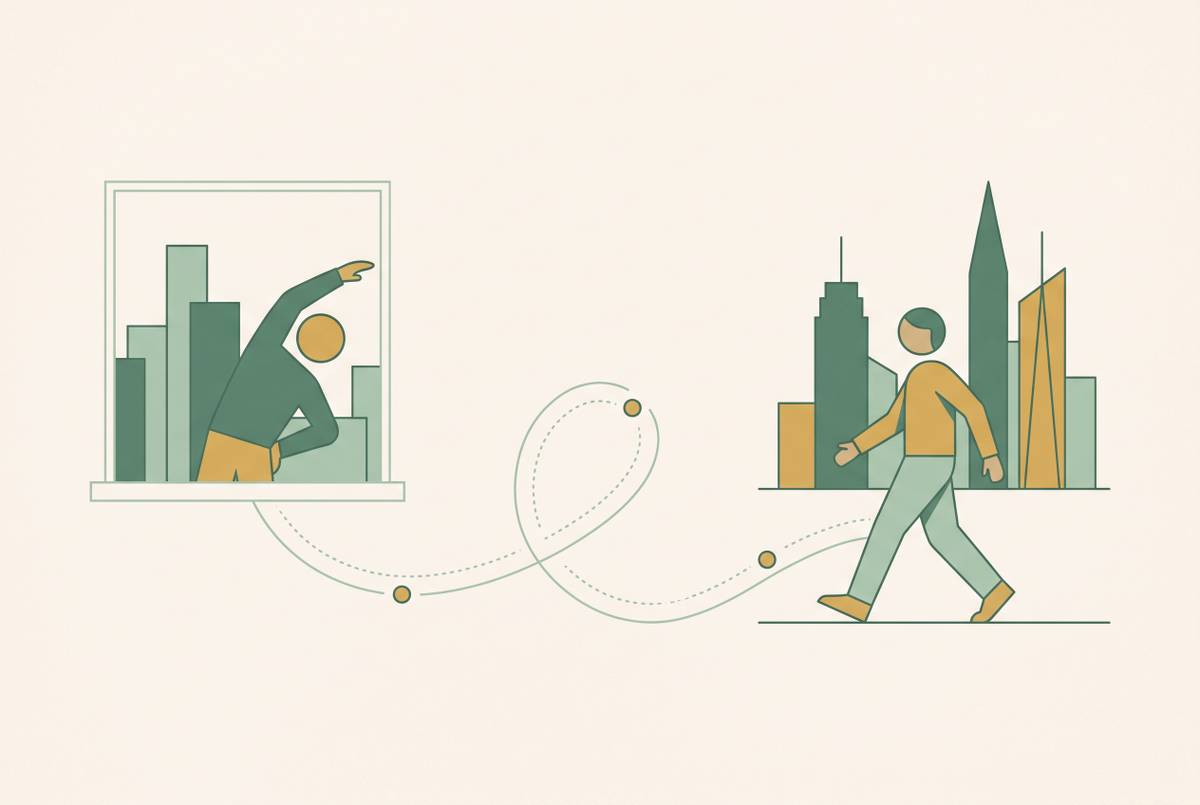
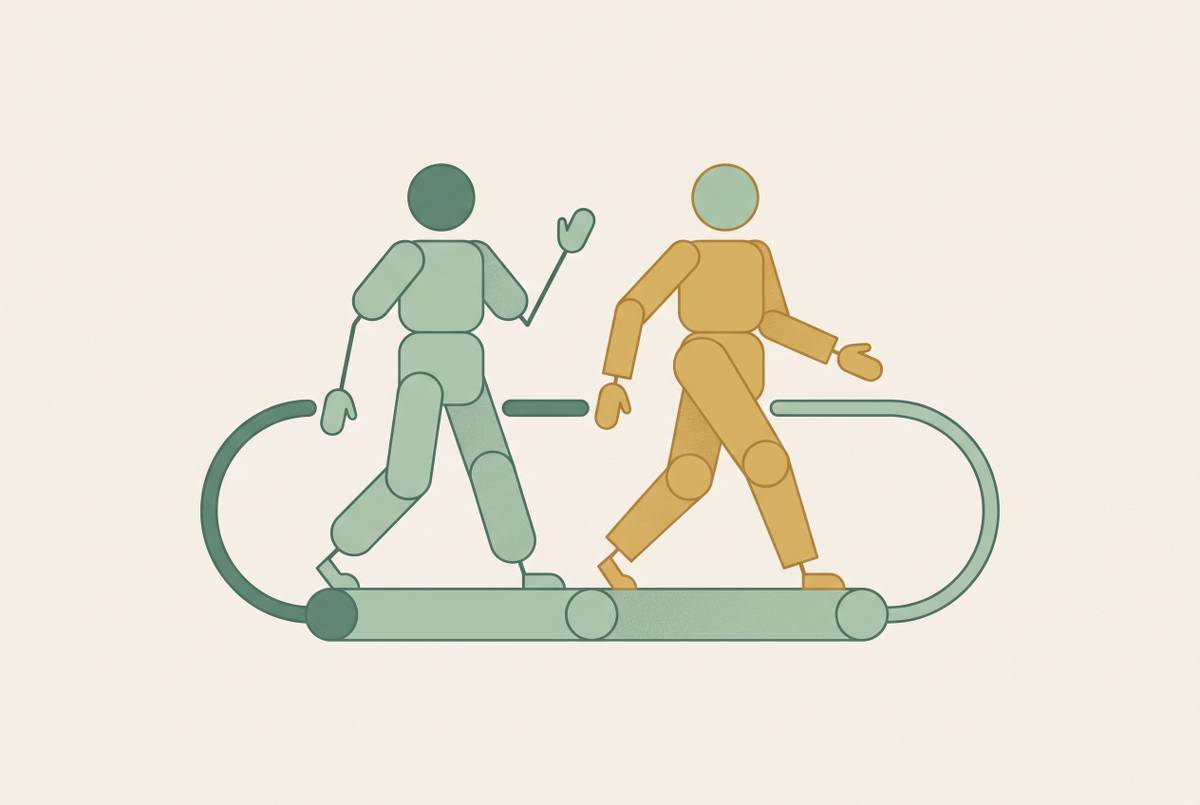
Long-distance partners can stay fit together by sharing a weekly workout goal and a photo check-in from each session, even when they exercise at different hours. A shared fitness ritual needs proof each partner can see, a sense that each answers to the other, and light stakes, even when their calendars differ.
Why partners default to assuming shared time is the only shared experience
The usual picture of couples fitness puts two people in the same gym, taking the same class, at the same hour. Together means physically together. Under that model, a workout before one partner’s early shift and a run after the other’s late commute look like separate pursuits. Both people exercise, but neither feels part of what the other is doing. The calendar becomes the gatekeeper of a shared experience, which is quite a promotion for a grid of boxes.
A weekly recap seems like the obvious substitute, but its accountability arrives late. Sunday cannot do much about a skipped Tuesday. By then, the choice has been made, and the chance for a partner’s attention to influence it has passed. Different shifts, sleep cycles, and commutes then start to seem like reasons the couple cannot stay fit together. Rather than rethink what “shared” requires, couples opt out of it entirely.
How can couples in different time zones exercise together and feel connected?
When a partner can see that a workout happened, an otherwise private effort becomes part of the relationship. The signal belongs to that session. Shared ritual rests on three elements, which are visibility, the social cost of skipping, and light stakes. None requires two people to occupy the same room or the same hour.
The social cost comes from knowing that someone will notice. A missed workout is no longer just a private bargain with the sofa. It becomes a missed commitment that another person can recognize, which gives a vague intention a firmer edge. That does not require a scolding message or a partner appointed head of attendance. The useful pressure is the expectation that each person’s effort will be visible to the other.
A small consequence, such as dinner or a chore, gives skipping a defined cost rather than leaving it weighed against a fuzzy future goal. Loss aversion is the pull to avoid that small penalty. When both partners are pursuing similar goals, the exchange also creates positive interdependence, because each person’s follow-through reinforces the other’s. Accountability then runs in both directions, rather than leaving one person to supervise and the other to submit reports.
Why a photo gives more connection than a check-in, a stat, or a text
A workout photo gives that visibility a recognizable form. “They probably worked out” becomes “there they are, sweating, at 6 a.m.” A photo shows a person in a moment, with a face, a location, and the context of the session. That specificity helps bridge the gap between separate workouts because the distant partner has something concrete to witness.
A number on a chart answers a narrower question. It may describe a logged set count, but it does not show the person behind it. A text check-in is also easy to delay or fake and offers none of the sensory detail of someone mid-rep or just back from a run. The photo’s useful distinction is proof of presence. It can make showing up unmistakable without turning the exchange into a spreadsheet with pet names.
The act of taking the photo also gives the session a repeatable marker. Les Mills research identifies preparation and instigation habits, the reliable cues that precede and trigger exercise, as having greater impact on long-term adherence than goal-setting alone. The photo-taking moment provides a concrete action within the session. Its role is mechanical as well as emotional.
Over time, the photos become a small archive. A partner sees consistency accumulate rather than having to reconstruct it from scattered claims about a busy week. Each image still records one occasion, but the sequence reveals a pattern of showing up. That growing record compounds the social reward of being seen. The value is in the repeated presence.
How SweatCam turns the photo into a shared weekly ritual rather than a one-off gesture
SweatCam gives the photo exchange a repeating weekly structure. Partners agree on how many workouts they will do. Each workout is logged with a SweatCam photo that the other partner can see immediately. The design separates the commitment from the timetable. One person can run and the other can lift, with neither required to adopt the other’s activity or gym.
Immediate visibility is different from requiring an immediate reply. The photo becomes available when it is sent, even if a partner in another time zone is asleep. The shared elements are the weekly cadence and the visible record.
A small wager supplies the light stakes. Missing the weekly goal puts something like dinner or a chore on the line, with the consequence kept small enough to invite a shrug and a laugh. Treat mode rewards a shared streak. Neither has to turn the relationship into a courtroom over leg day.
Pinky Promise, added mid-2026, helps when someone exercises but forgets to log it. A partner who forgot the photo can appeal to the other, who decides whether the session counts. That decision acknowledges a real-life lapse without removing accountability altogether. There is also a practical subscription caveat before committing. Some users have noted that the subscription requirement appears after setup, so it is worth checking before investing in the routine.
Why the same mechanic works differently for beginners than for experienced exercisers
For beginners, one photo sent to one trusted person keeps the commitment at a manageable scale. There is no need to turn a new exercise habit into a public performance. Novice exercisers benefit from approaches that build confidence, reduce perceived complexity, and let them test whether a behavior fits before constructing a full routine around it. The photo check-in gives that early effort a small, repeatable form, namely one photo, one trusted person, once per workout. It is consequential enough to register without adding a second demanding project to the first. The photo keeps the accountability around exercising simple.
Experienced exercisers need a different kind of support. Their challenge may be less about starting than about making an established private discipline visible to a partner. Greater self-efficacy and clearer goals help experienced exercisers turn what they do regularly into habits that last, though they may say those routines grew naturally. A recurring photo makes that structure legible to someone else. For this group, the ritual is a connective layer around momentum that already exists, allowing a partner to participate without following the same program.
The honest limitation — photo check-ins prove presence, not effort
A photo check-in is a proof-of-presence system. Its lack of logs for workout type, duration, intensity, or progressive overload leaves a real gap for couples seeking quantified athletic improvement, because appearing at a workout and completing effective training are different claims. For couples struggling to show up at all, however, presence is the relevant measure. The cause of the skipped sessions matters. Photo accountability can help with motivation and visibility, while programming and progressive load need a different tool.
The two-person structure also has a fragile point. A reliable partner gives the commitment social force, but an unreliable one leaves no group to absorb the lapse. Pinky Promise and Treat mode offer partial responses by allowing for forgotten logs and rewarding shared streaks without treating every interruption as failure. They cannot supply mutual investment where it is missing. The approach suits partners who will notice each other’s efforts, rather than send photos back and forth that neither pays attention to.
What makes the asynchronous photo ritual sustainable across months, not just weeks
The ritual has to fit an ordinary week. Taking a photo adds little effort to a workout, on roughly the scale of an exercise snack, rather than creating another substantial task to arrange. Keeping it this easy is part of what lets people stick with it. Busy partners already have enough things to do that need a time when both are free. A shared ritual that also takes back-and-forth over calendars can become harder to keep up than the exercise it was meant to help.
Habit stacking gives the photo a reliable place. Linking the new action to an existing one, such as the moment a workout ends, lets the session itself become the cue. The person does not have to remember an unrelated task later in the day. The photo’s role as a habit marker becomes useful over months. The check-in belongs to the workout instead of lingering afterward as unfinished administration.
A weekly goal also leaves room for different days. Partners share a cadence without requiring every session to line up, which allows separate shifts, commutes, and sleep patterns to remain separate. The wager or shared reward keeps the commitment tangible, while its small scale keeps the emotional burden low. Forgotten photos can be addressed through a conversation rather than treated as automatic evidence of indifference.
A partner watching weeks of photos arrive is seeing a relationship with fitness take shape, including the repeated choice to make room for it. Without a long conversation each time, the exchange shows that one person showed up and lets the other see it. Across different hours, different gyms, and different routines, two people can share a fitness life because their efforts remain visible to each other.
Sources
- Social Behavior: Rituals and Social Bonding
- Social bonding through shared experiences: the role of emotional intensity
- Time to Form a Habit: A Systematic Review and Meta-Analysis of Health Behaviour Habit Formation and Its Determinants
- Self‐enactable technique use and physical activity: A comparative qualitative study of habit formation and maintenance - Hintsa - 2025 - Applied Psychology: Health and Well-Being - Wiley Online Library
- (PDF) Habit Formation Among Regular Exercisers at Fitness Centers: An Exploratory Study