Exercise Routines for People With Unpredictable Work Schedules
Twenty-seven percent of workers face unpredictable schedules and need workouts designed for chaos.
Exercise Routines for People With Unpredictable Work Schedules.
How many workers have unpredictable schedules
Per Gallup, 27% of U.S. employees deal with schedule unpredictability, 28% face outright instability, and 41% say they have little or no control over when they work at all EPI rstsleep.com drantti.com marathonhandbook.com RP3 Rowing. That's not a niche problem affecting a handful of night-shift nurses and delivery drivers. That's tens of millions of people.
EPI puts a slightly different number on it: at least 17% of the workforce has an unstable schedule, split between about 10% doing irregular or on-call work and another 7% rotating through split shifts drantti.com. Different surveys, different methods, same basic picture.
This isn't just a restaurant-and-retail phenomenon. Schedule instability appears more often among part-time workers, Black workers, and people under 35, sure, but it also occurs among a serious chunk of full-time and middle-aged workers, and it is built into industries like construction, production, and transportation, not just the industries people usually picture when they hear "shift work." Add to that a CEPR finding: inconsistent hours are now the single biggest driver of month-to-month income instability, with about a third of non-retirees reporting involuntary income swings in 2024 rstsleep.com marathonhandbook.com RP3 Rowing. For a lot of people, schedule chaos is the operating system. It's the operating system.
So if a calendar app feels like it's mocking you, you're in enormous company. And the standard fitness advice, the one that assumes you can just "book the 6 a.m. class," was never built with this group in mind. According to BLS data, 16% of wage and salary workers have non-standard schedules, with 6% working evenings, 4% nights, and the rest on rotating, split, or irregular arrangements rstsleep.com European Heart Journal marathonhandbook.com RP3 Rowing.
Why irregular schedules make exercise harder than willpower alone can fix
Three separate problems gang up on people with unpredictable hours, and they attack three different parts of a routine. Energy fluctuates because circadian rhythms get disrupted, timing becomes a guessing game because advance planning is basically impossible, and mental bandwidth gets eaten up by the constant work of adapting to a new schedule every few days. Each one chips away at a different pillar: when you work out, how long you work out, how hard you push.
Circadian disruption in particular is a quiet tax that nobody budgets for. When sleep and wake times keep shifting, workouts feel heavier, recovery drags, and motivation tanks because the body is fighting the schedule instead of following it. Night shift workers get 20 to 30% less deep sleep than day workers, according to RST Sleep's figures, and less deep sleep means less recovery iwh.on.ca rstsleep.com British Journal of Sports Medicine marathonhandbook.com RP3 Rowing. The next day's realistic workout ceiling drops whether anyone likes it or not.
Then there's the all-or-nothing trap, and it's a doozy. AARP has flagged this pattern: a lot of people believe that anything under 45 minutes doesn't "count," so instead of doing a shorter version, they skip the whole thing. Guilt from the skipped session erodes motivation, and eroded motivation makes the next attempt even harder to start, a cycle that a rigid, fixed-schedule routine actually speeds up rather than slows down. On top of that, shift work strips away a layer of social scaffolding that day-shift workers take for granted: the friend who meets you at the 6 p.m. class, the coworker who walks with you at lunch. That's a structural loss, not just bad luck.
None of this is a character flaw. It's a design flaw. The routine was built for a predictable life, and the person living an unpredictable one gets blamed for the mismatch.
Why flexibility should be the design principle, not the fallback plan
Picture the conventional workout plan: same time, same length, same gym, same intensity, week after week. Every single one of those assumptions snaps the moment a schedule stops behaving. So instead of treating flexibility as damage control, the smarter move is to design around the chaos from day one.
Nobody has to make an emergency decision about whether today "counts. The decision was already made months ago, when the routine was built.
It also means swapping daily targets for weekly ones. Aiming to move three or four times across the week absorbs the inevitable schedule curveball without anyone declaring failure. The week becomes the unit of accountability, which matters more than it sounds like it should.
Effort works the same way: think of intensity as a dial, not a switch. Same workout format, dialed up on a rested day and dialed down after a rough shift, so the session still happens even if it looks different from one week to the next. None of this is fitness on discount. It's fitness that fits the actual life being lived, which, it turns out, is the version people can keep coming back to for months instead of abandoning by week three. Two people on different schedules can even share a weekly target instead of a workout buddy time slot, checking in on the goal rather than the clock⟧c14⟦. The relationship stays intact even when the calendars never overlap.
What short workouts deliver, according to recent research
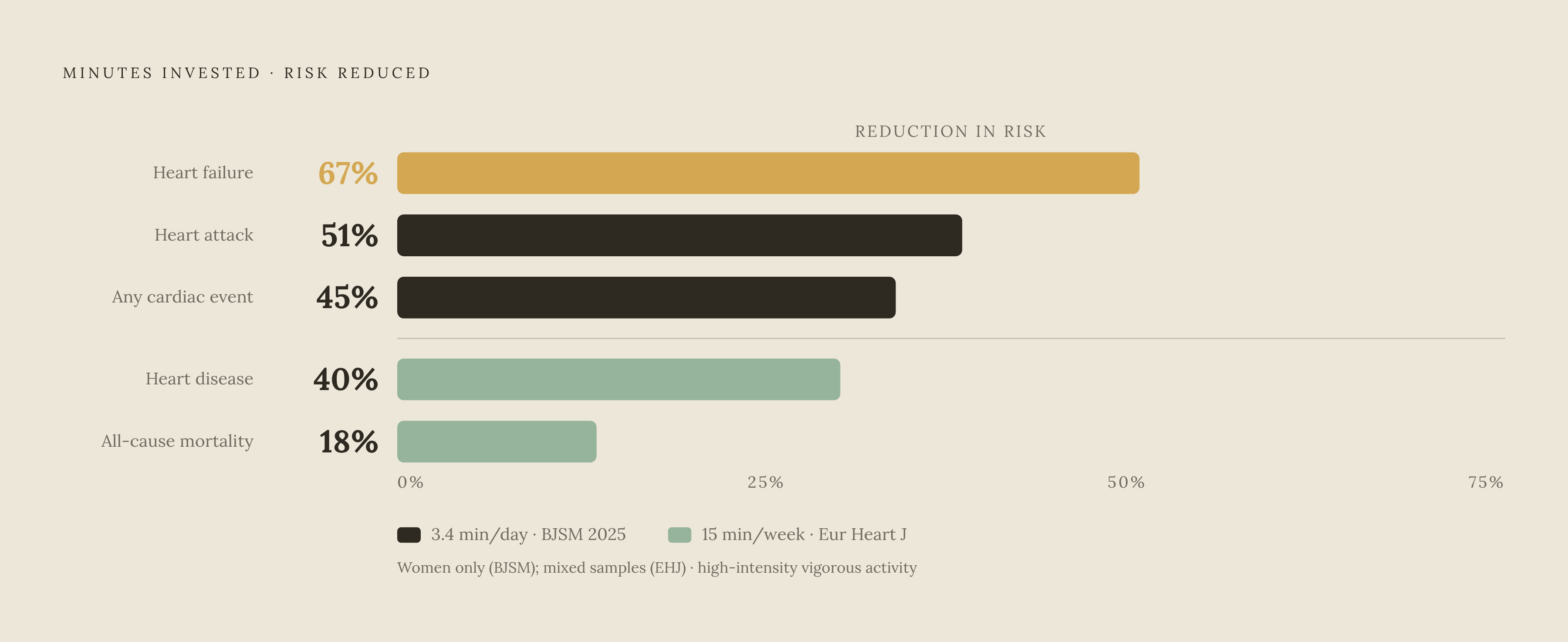
One number here deserves close attention. A 2025 study in the British Journal of Sports Medicine found that women averaging just 3.4 minutes of high-intensity exercise per day were 51% less likely to have a heart attack, cut their heart failure risk by 67%, and were 45% less likely to experience any cardiac event or stroke, according to UPMC HealthBeat's reporting EPI rstsleep.com drantti.com marathonhandbook.com RP3 Rowing. That's shorter than most people's coffee order.
Even smaller doses counted. One-to-two minute bursts of intense movement lowered heart problem risk by 30% iwh.on.ca British Journal of Sports Medicine. The bar for "doing something worthwhile" is a lot lower than the fitness industry has led anyone to believe. The European Heart Journal backs this up from another angle: just 15 minutes of vigorous activity per week, broken into short bouts, was tied to an 18% lower risk of dying during the study period, a 40% lower risk of heart disease, and a real drop in cancer risk, according to reporting in The Conversation rstsleep.com marathonhandbook.com RP3 Rowing.
For anyone trying to plan an actual workout, not just accumulate scattered minutes, HIIT holds up well under time pressure rstsleep.com marathonhandbook.com RP3 Rowing Communications Psychology. Researchers have a name for this whole category of scattered, opportunistic effort: VILPA, or vigorous intermittent lifestyle physical activity. It's a mouthful, but the point is that this is a legitimate training approach with its own research base. It's a legitimate training approach with its own research base.
So the person squeezing in three 15-minute sessions during a genuinely chaotic week isn't doing a lesser workout European Heart Journal. In any meaningful health sense, they may be doing enough European Heart Journal.
Exercise types that hold up when time and energy are unpredictable
Not every workout survives contact with an unpredictable calendar. The ones that do share a few traits: they're time-efficient, they need almost no setup, they deliver broad benefit instead of targeting one narrow thing, and they scale by intensity rather than requiring a whole different format when energy is low.
Full-body compound movements, squats, deadlifts, rows, hit multiple muscle groups at once, delivering maximum output for minimum time spent, exactly the trade a busy schedule demands. Rowing deserves specific mention here: it engages roughly 85% of the body's muscles at once while staying low-impact, delivers a full cardio-and-strength session in 20 to 30 minutes, and the session length stretches or shrinks without any real cost to the workout's structure rstsleep.com marathonhandbook.com RP3 Rowing Communications Psychology. Bodyweight circuits, push-ups, squats, lunges, planks, burpees, need zero equipment and zero location, which makes them the always-available backup plan; intensity slides anywhere from gentle to brutal depending on the day.
HIIT earns its spot on this list too, delivering real results inside 20 to 30 minutes, with the intensity knob doing the work on low-energy days instead of the format changing entirely rstsleep.com marathonhandbook.com RP3 Rowing Communications Psychology. The session shape stays constant. Only the effort behind it moves.
Walking and light jogging round things out as the low-barrier default: always available, easy to shorten or extend, and legitimately the workout on a depleted day rather than a consolation prize for skipping the "real" one. Fitness expert Zarina del Mar, quoted via Stridekick in 2026, recommends two-minute mobility bursts scattered through the day, spine waves, hip circles, shoulder glides, as a way to bank movement without needing a dedicated block of time, alongside minimal props like a resistance band, a towel, or just a wall rstsleep.com marathonhandbook.com RP3 Rowing. And Fredo Lopez of Core Collective Fitness, also via Stridekick, points out that mixing formats across the week, one strength session, one yoga session, one long walk, keeps things interesting and lowers the mental friction of actually showing up rstsleep.com marathonhandbook.com RP3 Rowing. Put three or four of these formats into a rotation and there's always something that fits whatever the day throws at you.
When to exercise on a shifting schedule, including nights and rotating shifts
Forget the clock on the wall.
Timing the intensity matters more than people assume. Hard intervals done too close to bedtime were linked to a 7.39% drop in sleep efficiency and a 10% increase in time spent awake after falling asleep, per RST Sleep's data EPI rstsleep.com marathonhandbook.com RP3 Rowing. A killer workout right before bed can quietly sabotage the very recovery that makes tomorrow's workout possible. Vigorous evening exercise has also been shown to delay melatonin production the following night, according to MD Anderson, a detail that matters a lot for anyone whose "evening" is actually 4 a.m. after a night shift.
Worried that a pre-shift workout will leave nothing in the tank for actual work?
On days off, the smart move is timing workouts to align with the upcoming shift pattern rather than whatever feels convenient in the moment, which keeps circadian disruption from compounding further. And here's the honest part nobody likes admitting: there's no universal best time for shift workers. The right time is whichever one protects sleep and can actually be repeated, and that's something each person has to figure out through a few weeks of paying attention to their own patterns, not by following a chart. For night shift workers, training 2–3 hours before the shift begins is a practical option: if a shift starts at 11 PM, aim for 8–9 PM, and if at 7 PM, aim for 4–5 PM, per RST Sleep rstsleep.com marathonhandbook.com RP3 Rowing. On work days, keep sessions short (15 to 25 minutes) and schedule intense effort 2–5 hours after waking, not close to sleep, per Nightowling rstsleep.com European Heart Journal marathonhandbook.com RP3 Rowing. RP3 Rowing frames pre-shift workouts of 1–2 hours before the shift as a way to boost alertness and performance, useful framing for people who worry exercise will drain them for work.
How to build a modular workout library that covers every scenario
Building a library sounds like a big project. Build the routine around three scenarios (15 minutes, 30 minutes, and 45 minutes) so a shorter day becomes a shorter workout European Heart Journal Communications Psychology. It's a plan.
Break those blocks down further into modules, separate short pieces for cardio, strength, and flexibility that mix and match depending on what today allows. Then build shift-specific templates, one for morning shifts, one for evenings, one for nights, one for days off, so the decision at 6 a.m. or midnight isn't "what should I even do" but simply "which template." Shift-specific templates remove decision fatigue, which is exactly what wrecks motivation on the hardest days.
Keep both a gym version and a home version of everything. Minimal-equipment options, a band, a towel, bodyweight only, aren't a nice-to-have backup. They're load-bearing. And always keep a five-minute option in the back pocket, the micro-commitment that stops a bad day from becoming a zero day; five minutes often extends naturally once someone actually starts moving.
Ditch the daily tracker in favor of one weekly check-in. Did three or four sessions happen this week? Two people on different schedules can run this same modular library together, checking in weekly instead of daily and keeping a shared tally of sessions logged, without ever needing to be in the same room to feel like they're doing it together. And handle the logistics in advance: pack the gym bag the night before, lay out clothes, pick one home workout spot, so that a narrow, unpredictable window doesn't get eaten alive by "where are my shoes." The three-block system calls for designing one workout at each of three lengths (15 minutes, 30 minutes, 45 minutes), targeting the same fitness goals so any block stands as a complete session European Heart Journal Communications Psychology. A weekly check-in instead of daily tracking, one review at the end of the week asking whether you moved three or four times, measures what actually matters and avoids the guilt spiral of missed individual days.
Keeping momentum when the schedule derails anyway
A missed week is a data point, and a useful one at that. It's a data point, and a useful one at that: the person who does three 15-minute sessions on a chaotic week may be doing enough, and 4-6 rounds of 4-6 exercises with 30-60 second rest produces full benefits European Heart Journal https://marathonhandbook.com/hiit-workout-with-weights/. That information is worth more than the guilt most people default to instead.
Consistency beats perfection, full stop. Celebrating any movement that happened, rather than measuring against some flawless plan that never survives contact with real life, keeps the weekly total climbing even when individual days fall apart. Habit stacking helps here too: pairing movement with something already happening, a walk during a phone call, mobility work while the coffee brews, keeps the identity of "someone who moves" alive even during a week when structured workouts vanish entirely. That identity is what makes it possible to pick the real routine back up later, instead of starting from zero.
Del Mar's 3D Five-Minute Rule, again via Stridekick in 2026, offers a low-stakes floor: pick one body area a day, core, glutes, posture, legs, breath, and give it five minutes rstsleep.com marathonhandbook.com RP3 Rowing. The bar sits low enough that people actually clear it, and clearing it keeps the thread from snapping completely.
And when fatigue gets severe, sleep wins, no argument. RP3 Rowing points out that inadequate recovery raises injury risk and tanks workout quality anyway, so skipping a session to actually rest counts as the system working as intended. It's the system working as intended. The best kind of accountability here isn't a spreadsheet, it's a partner or friend asking "did you get anything in this week?" instead of auditing every single session; the tone of that question does as much work as the question itself. And the routines that actually last aren't the ones that survive one great week. They're the ones both people keep coming back to, month after month, especially during the weeks that go sideways.