When Couples Need an App to Hold the Accountability Neither Person Can Hold Alone
An app removes the awkward negotiations so both partners can keep a shared fitness promise.

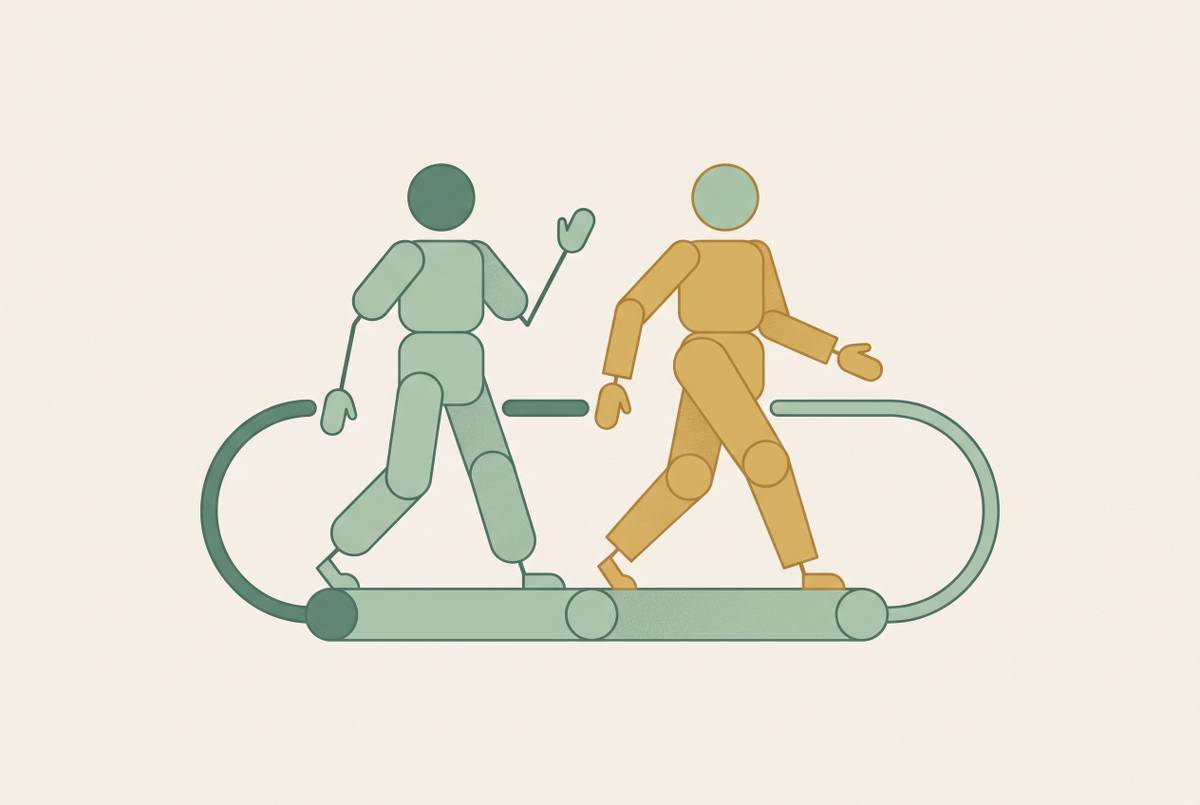
To stay fit together in a long-distance relationship, set a shared weekly workout goal, exercise on your own schedules, and make each session visible through a photo check-in. An app helps when it holds that commitment without making either partner the enforcer. The structure needs to keep working when motivation fades.
Why willpower is the wrong foundation for couples' fitness accountability
One partner skipped Tuesday, and the other said nothing. By Friday, neither had gone. Saying something might have sounded like nagging, while staying quiet felt kinder, at least until the shared plan became something both only pretended to follow. Nobody had formally abandoned it. The agreement simply had no way to survive the moment when keeping it became inconvenient.
When accountability depends on goodwill, one partner has to decide whether to bring up every missed session, what to say, and whether it is worth talking about. Demirci et al. in Expert Systems with Applications found that personalized guidance and social dynamics play a key role in keeping people going to the gym. That puts the focus on the conditions supporting attendance, rather than on whether two people can summon enough resolve to keep each other going.
The habit formation window where couples need external structure most
The awkward stretch comes after novelty fades but before exercise feels automatic. Think of weeks three through eight as a recognizable version of that gap. Research on habit formation shows that automaticity can take from a few weeks to many months, depending on the person, so couples cannot set a date when they will no longer have to talk each other into exercise. Demirci et al. found that specific periods of attendance are especially important for habit formation, and that group involvement provides social support and accountability in the early stages. Timing is part of that support. If one partner only learns on Sunday that the other skipped Tuesday, the chance to influence Tuesday’s decision has gone. A weekly recap can describe the gap, but it cannot fill it. During this stretch, a visible commitment gives the social signal a chance to arrive while the choice to show up is still open.
What makes an app structurally different from a partner's good intentions
The reminder asks one person to apply pressure now, with all the emotional weight that comes from being the person applying it. A commitment recorded in an app refers back to something both people already agreed to. Both can follow their shared arrangement without having to make up the rule midweek.
Visibility is the first part of that arrangement. When each partner can see whether the other showed up, skipping has a social cost without requiring an awkward message. Pre-committed stakes add a defined consequence, such as a coffee or cooking dinner, to the goal of “exercise more. Loss aversion gives that small, agreed consequence a different pull from a vague aspiration. The stake is decided before either person has a missed workout to defend.
The check-in then determines how much interpretation remains. A self-reported “yes I went” records an assertion, while a photo taken during exercise makes the effort visible. These are commitment devices. Their useful work happens around the decision to attend.
How can couples in different time zones exercise together without adding friction?
Nanyang Technological University found that older adults who exercise with their spouse are less physically active than those who exercise without their spouse. The proposed explanation is that engrained couple routines can impede behavior change, because changing a shared routine is more complex than changing an individual one. The objection deserves to stand on its own. Exercising as a couple can become harder when two schedules are interdependent.
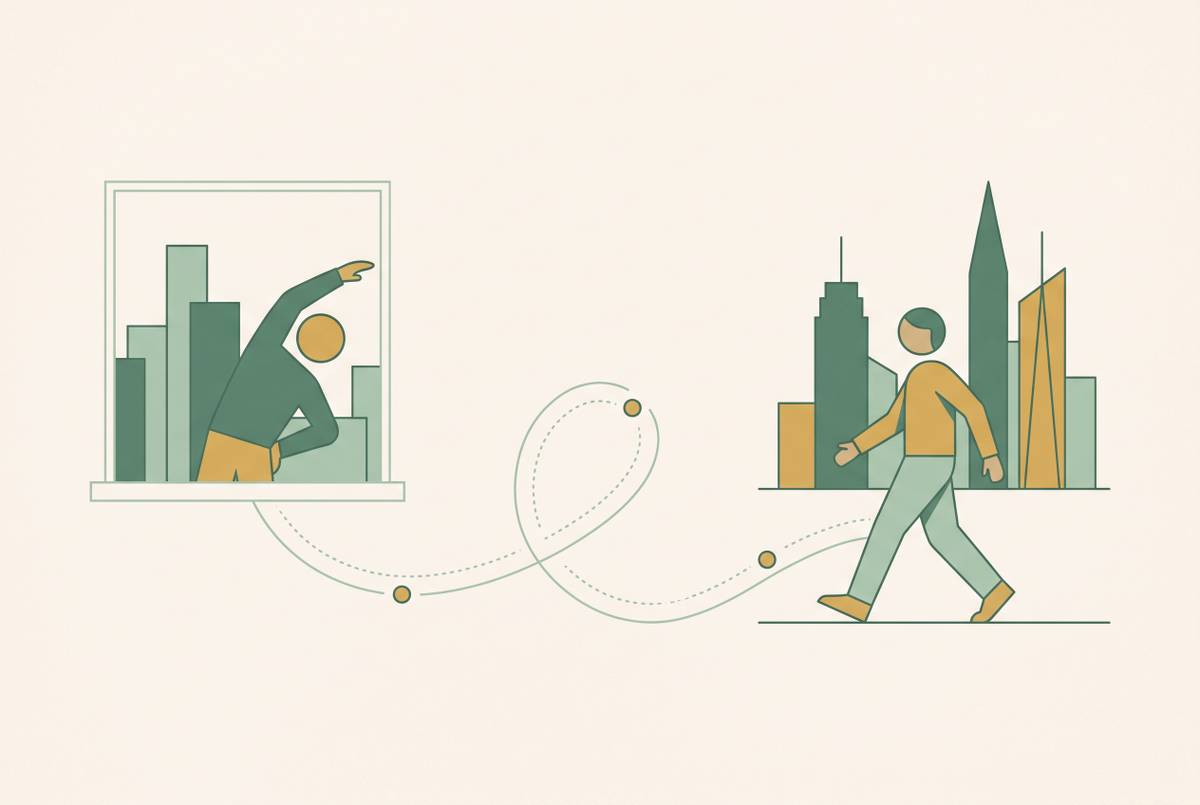
That finding concerns older adults. Its design implication is still useful when considering different jobs, commutes, energy peaks, fitness levels, or time zones. An accountability tool should make effort visible without requiring simultaneous exercise. One partner can run at 6 a.m. while the other lifts at noon, with both working toward the shared weekly goal.
For long-distance partners, that distinction also changes what “together” means. A photo check-in lets each person see the other’s effort without requiring a joint session or matching routines. The connection comes through showing up for an agreement and making that moment present to the other person. Scheduling need not become a competitive sport. The useful design separates coordination, which may be difficult, from accountability, which can still be shared.
How SweatCam photo check-ins solve the honor-system problem
SweatCam makes that separation concrete through a weekly goal and photo check-ins. Partners agree on how many days to work out, then log each session with a photo taken at the time of exercise. The other partner sees it when it happens. The check-in is evidence of a moment. It gives the shared goal something more definite than a promise to report back later.
The honor system’s weakness is the room left for interpretation when someone decides that Sunday’s walk counts, or that being active at work was close enough. Without a clearer check-in, the other partner either accepts that interpretation or becomes the judge of what qualifies. A workout photo shows what happened without the partners having to debate what counts. It does not need to be a courtroom exhibit to be more concrete than a retrospective claim.
The image also makes the partner’s effort present in a way a number on a chart does not. “They probably went” becomes visible evidence that they showed up. That works without identical routines, the same gym, or the same fitness level, because a run and a lifting session can both count toward attendance. For a pair who keep struggling to get started, showing up is what they need to hold each other to.
Where the photo-check-in approach fits and where it does not
A pairs-only tool fits couples and other two-person training pairs. If the plan includes a friend group or a family, exactly two places is the wrong shape. A couple deciding whether to use it needs to know who belongs inside the agreement.
It also covers only workouts. Couples who want to track sleep, nutrition, mood, and fitness together need more than a workout photo check-in. A photo-first approach also suits people who are happy to share photos to help keep each other on track. If that is not an acceptable routine for both partners, its central mechanic is a mismatch.
Attendance and training quality are also different problems. Photo logging without performance data suits a couple who know what they want to do but struggle to turn up. It does not provide structured programming or detailed training logs for partners who need those things. A photograph can make showing up visible without explaining whether a training plan is effective. Choosing it for that second job would ask the proof of attendance to moonlight as a coach.
Other tools worth knowing when the pairs-only, photo-first design is not the right fit
HabitShare suits couples who want to see each other’s habit lists without competing. It is free and lets each person choose who can see each habit, so they can share without showing every habit they track. It has no shared challenges or leaderboard. That makes its structure different from a shared workout target, because each partner maintains an individual list while choosing what the other can see. This lets couples track habits they share an interest in beyond exercise.
HabitShare’s App Store version history had no update after January 2023 as of the comparison material supplied for this guide. That is a dated limitation on the available information, leaving its present update status undetermined. It also does not establish how well the app will work for a particular couple.
Hevy has detailed training logs along with social features and a shared feed. It fits lifting couples who want workout data as well as visibility into each other’s attendance. The distinction is depth of logging. A photo check-in shows the moment happened, while detailed workout records serve partners who also want information about the training itself. That does not make a social training log a remedy for poor programming or progressive overload.
Extra features help only when they deal with what is getting in the couple’s way. Otherwise, the couple has acquired a more elaborate place to not record a workout.
Choosing the right tool starts with diagnosing which failure mode your relationship actually has
The practical next step is to identify where the routine breaks. Is the problem showing up, or is it training quality? If both partners already know what to do but keep missing sessions, a photo check-in and a light wager address the gap more directly than a periodization program. If the plan itself needs work, proof of attendance is not enough.
Long-distance partners and couples in different time zones need visibility that does not depend on exercising at the same time. Partners who reliably train together may find a tool that rewards joint sessions a stronger fit. Phone compatibility is another basic condition. If one or both partners use Android, an iPhone-only tool will not work for the pair, however much they like its approach.
With those conditions clear, the lesson is to agree on a simple weekly goal, how each workout will become visible, and any small stake before the week begins. The consequence should be defined in advance, rather than negotiated after someone misses a session. That lets the structure hold the agreement. Both partners can then put less effort into deciding whether to step in and more into doing what they agreed to do.
The aim is consistency. Start with the arrangement both people are willing to return to, including on an unremarkable, inconvenient week.