Using Photos Instead of Data to Track Fitness Progress
Photos reveal body changes the scale misses and document the consistency that drives results.
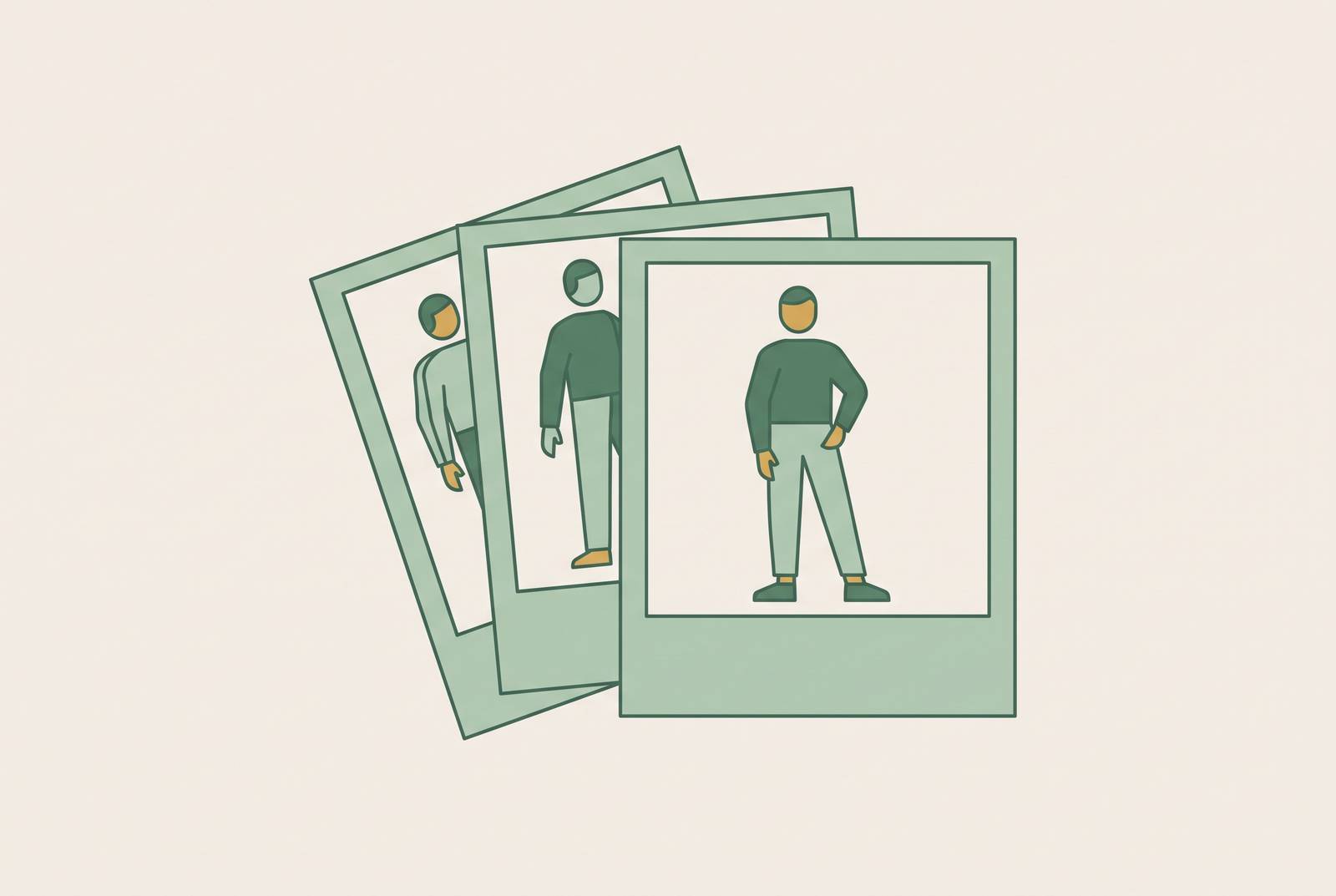
Your body can change while your weight stays put. For most exercisers tracking those changes, comparable photos offer a more honest record than the scale alone. Shared with a partner, they also record the habit behind the change, which is showing up.
Why the scale is a poor tool for tracking body recomposition
After weeks of training, treating an unchanged scale reading as evidence of training failure can mistake a measurement failure for a training failure. When you lose fat while gaining muscle, your total body mass can stay the same even as your body composition changes a lot. The scale has answered the question it was built to answer. It has not answered yours.
Bonilla et al.’s 2024 editorial defines body recomposition as “commonly defined as the simultaneous process of reducing body fat while maintaining or increasing lean mass, frequently with no changes in total body mass”. Equal masses of muscle and fat weigh the same, but take up different amounts of space.
Even without recomposition, hydration, food intake, time of day, and hormone-related fluid shifts make individual readings noisy. Weight measures the total mass of what your body contains. Treating it as the entire verdict on training gives one number a job well above its pay grade.
What a photo captures that numbers cannot
A photo serves two distinct purposes, which are a composition record and an attendance record. As a composition record, it captures changes in volume, shape, posture, and muscle definition. As an attendance record, a time-stamped gym photo documents that you showed up. The first helps answer whether your body is changing. The second helps answer whether you are maintaining the behavior that supports change.
That distinction matters because physical results and consistent effort do not run on the same clock. A workout photo can show that you showed up before any change in your body can be seen. Later, comparable progress photos can reveal changes that total weight obscures. A photo preserves evidence that a weight reading leaves out.
University of Pittsburgh researchers led by Lora E. Burke, PhD, MPH, concluded in a systematic review that “self-monitoring is the centerpiece of behavioral weight loss intervention programs” and found it consistently linked to better outcomes. That supports the value of keeping a deliberate record, rather than proving that one tracking format always wins. Photos make that record with less mental work than logging food or entering measurements. For a busy person, a useful tracking method has to survive contact with Tuesday.
How the brain responds to visual evidence of change
Low effort matters most when the excitement of starting wears off. A new routine brings a strong early reward, but that feeling diminishes over time. The workouts that once felt like a fresh start can begin to feel like one more thing on the calendar. If the scale also stays flat, effort can start to look pointless.
Visual evidence helps close that motivation gap by connecting effort with a result you can actually see. For beginners, an easy tracking act lowers the barrier to keeping that feedback loop running. For experienced exercisers, photos can show gains from recomposition even when weight has stayed the same for months.
A photo can also function as a “habit cue”, a concrete action that anchors the larger routine. It gives the workout a small, recognizable check-in. It gives motivation something sturdier to lean on than the enthusiasm of the first week.
How to take progress photos that stay comparable over time
For visual evidence to mean anything, the conditions need to stay consistent. Different lighting, clothing, or camera angles can make a body look different without any physical change. The aim is a repeatable record. Otherwise, the lighting department may deserve the credit for the change.
Use natural daylight and keep the lighting conditions as similar as possible. Harsh shadows and changes in artificial light can make your shape look different. Wear the same outfit, or similar fitted clothes, because loose clothing hides the changes you are trying to document. A plain wall or neutral background keeps the comparison focused on your body.
Take the photos in the morning before meals, at the same time of day, to reduce variation from food volume and hydration. Capture front, side, and back views, with optional flexed poses if you are tracking muscle development. Keep both the pose and camera angle consistent with the earlier image. Pose drift is especially troublesome because a changed stance can masquerade as a changed body.
Keep the “bad” photos, too, because the starting point is the most important reference in the series. Take composition photos every two to four weeks. Wait at least four weeks between comparisons. For muscle gain, eight or more weeks gives changes more time to become visible.
The one risk that makes photo tracking go wrong, and how to avoid it
A useful record can become frequent body-checking, the main risk of photo tracking. For a minority of exercisers, repeated review raises dissatisfaction. Geiger et al.’s 2024 naturalistic experimental cross-over study found that women with high body concern experienced worse body dissatisfaction in the increased body-checking condition. The study also reported a significant sequence effect that required split-data analysis, so the finding needs that qualification. It is a reason to take review frequency seriously.
Photographing every two to four weeks and comparing images eight weeks apart gives the record time to contain useful change. Comparing one week with the next is more likely to lead to picking apart each photo than to seeing where things are headed. The purpose is evidence over time.
An attendance photo also deserves a different reading from a composition photo. Its message is that the workout happened. Reviewing progress with a supportive partner can add a buffer against self-criticism. A second perspective helps keep the record in proportion, which leads to the social value of sharing it.
How sharing a photo with a partner turns a solo habit into a connected one
A shared check-in has an audience who can notice when it is missing. That changes the role of the record. A private dashboard stores information, while a partner responds to your presence or absence. An empty entry in an app cannot wonder where you went.
The useful feedback is not limited to appearance or performance. A partner seeing the workout photo acknowledges the behavior the habit needs most, which is attendance. Photo proof also makes that attendance more concrete than a passive step count or a calorie estimate. The reward shifts from getting an impressive number to doing what was planned.
That support matters while exercise is still becoming a habit. When personal motivation dips, the shared expectation remains part of the routine. It also allows partners to exercise independently without losing the connection. Different schedules and locations need not mean separate accountability systems, because the photo becomes the shared record of otherwise independent workouts.
This is not the same as asking a partner to inspect every physical change. The composition record still benefits from long comparison intervals. The social check-in serves the more immediate purpose of saying that the planned work happened.
How SweatCam builds this habit into a simple weekly loop
SweatCam puts that attendance check-in into a single act. To log a workout, the user takes a quick photo in SweatCam, and the photo is instantly visible to their partner. No stats or metrics are required to confirm the activity. The partner’s view takes the place of a dashboard as the immediate feedback point.
Weekly goals give those individual check-ins a frame, while a shared history makes consistency visible over time. Optional light stakes, such as a friendly wager to buy dinner, add a playful consequence. The design needs no wearable sync, complex metrics, or dashboard maintenance.
Sweater applies the same SweatCam mechanic to friend accountability pacts. Users set a weekly goal, lock in an accountability amount, and log proof through a live workout photo inside the app. In both cases, someone else can notice whether the attendance record is there.
Workout check-ins can help with the weekly goal without making every photo a chance to judge how the body looks. Deliberate composition photos and comparisons remain spaced out, so the social habit does not require constant scrutiny.
Other apps that use photos as their primary tracking tool, and what each one does best
SweatCam focuses on the partner relationship around attendance. Other options emphasize private records, combined measurements, or consistent image capture. None of the alternatives here replicates that partner accountability layer.
fitstitch suits exercisers who want photo-first tracking with strong privacy controls and a simple check-in flow. The fitstitch website states that photos sync only to the user’s own private iCloud container, never to the developer’s servers, and that iCloud sync can be turned off. Face ID / Touch ID locks the app. The app also includes before-and-after comparisons, a personal timeline, recurring reminders, and weight logging in pounds or kilograms. It is available for iPhone and iPad running iOS 17 or later, with no Android version.
MacroFactor suits people who want photos and measurements in a single dated record with nutrition tracking. It supports up to three photo views, including front, side, and back, and up to 21 body metrics. Those metrics cover areas such as shoulder, chest, waist, and hips, as well as arm and leg measurements. Ratios include waist-to-height and waist-to-hip.
Fitness Camera focuses on comparable progress photos and before-and-after viewing. Its Google Play listing describes a camera that helps users take photos with the same pose and angle each time. That addresses a different need from private storage or nutrition context. It also points toward the next step for visual tracking, which is reducing the work required to make the evidence trustworthy.
What AI pose detection and photo-to-measurement tools change about visual tracking
Pose detection helps with a weak point in comparing photos, which is standing differently from one shot to the next. Fitness Camera’s June 2026 update introduced a feature that recognizes a previous pose and fires the shutter when the user matches it. Instead of relying entirely on memory to reproduce a stance, the camera helps align the new image with the old one. When the angle changes less, it is easier to tell what else has changed.
3DLook’s 2026 AI-in-fitness overview describes solutions that process two smartphone photos into 80+ body measurements, body-composition outputs including body fat percentage and lean mass, and a 3D body model. That makes the photo both a record and an input for measurement. It does not mean every ordinary progress shot provides those outputs, or that appearance alone establishes clinical accuracy.
The important shift is that photos are not merely a softer substitute for data. They are becoming a source of it, while retaining the low-effort act that makes them useful for tracking in the first place. Better tools can improve the comparison without making the habit more complicated. The lasting method is still simple enough to repeat, which is to show up, take the photo, and share it.