Solo Training vs Partner Accountability for Fitness Consistency
Partner accountability closes the consistency gap solo training leaves unguarded.
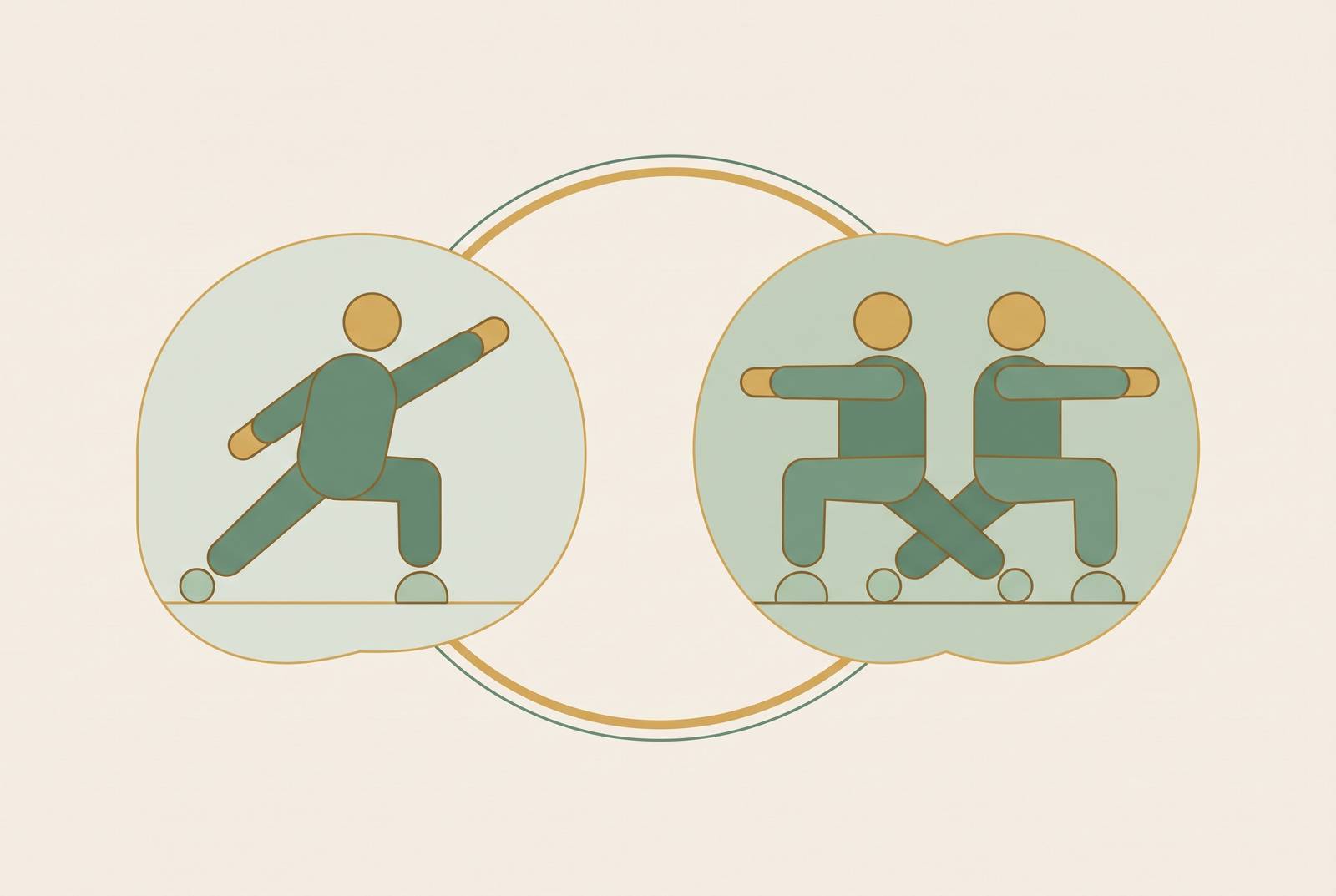
To stay fit together in a long-distance relationship, set a shared weekly goal, exercise when each person can, and use photo check-ins to make the effort visible. Solo training offers freedom, but partner accountability brings someone who notices when a person shows up or stays home. Couples in different time zones do not need matching workout hours to build consistency together.
Why solo training fails most people before the habit forms
A solo fitness plan can specify every exercise and still leave one crucial job unfilled. Nobody is responsible for noticing when it stops happening. The plan explains what to do, but not what makes returning feel necessary after the initial excitement fades. That is a structural gap. Even a beautifully laid-out workout schedule can sit quietly while its owner does something else.
The excitement of starting makes that gap easy to miss. Something new brings a dopamine lift, so starting can feel easier than keeping going once the routine feels familiar. Stress, travel, and illness then compete for the willpower that must bridge the difference. In a solo system, a missed session creates no social consequence. The workout drops out of the day without anyone having to talk about it.
A tracking app can record that disappearance, but recording is not the same as noticing. A private log has no personal stake in whether its next entry arrives. It can show a broken streak without giving the person behind it any sense of being missed. This is the social silence of solo training. More information does not necessarily fill a gap created by the absence of another person.
What the consistency gap actually looks like in practice
The consistency gap often looks unremarkable in the moment. A checkmark goes unticked, a streak breaks privately, and the rest of the day continues. The long-term cost may be real, but there is no immediate social cost to skipping. Each missed workout can feel like an isolated event, obscuring its cumulative cost to the habit.
Weight loss and better endurance are long-term goals, while the effort of today’s session is due now. Without a social signal connecting the two, the daily choice depends heavily on how attractive that distant reward feels at the time. The couch offers an easier time and is always free. A private dashboard can display the destination without making today’s departure any more compelling.
Individualized programs can produce faster progress toward specific technical objectives, including muscle gain and marathon preparation, particularly for advanced athletes using periodized programming. A partner’s schedule can introduce friction in that setting. Flexibility is valuable when the habit already holds. For many beginners, however, the same freedom also removes any social consequence for staying home, and that weakness compounds as missed sessions accumulate.
How do long-distance partners motivate each other to work out consistently?
Partner accountability changes the decision by making it interpersonal. Missing a workout means walking back a commitment made to a specific person. The added psychological cost comes from feeling that someone is counting on them, even when they exercise apart. For a long-distance couple, the shared promise can survive the distance even when the workout schedules cannot overlap.
The University of Aberdeen study found that gaining a new exercise companion increased exercise frequency, with a stronger effect when the companion offered emotional support. Support quality counted more than shared logistics. The mechanism is support attached to a commitment.
Michigan State University research on the Kohler effect shows that the less-fit partner in a pair works harder than they would alone to avoid letting the other person down. The social connection changes how much effort feels worth making. It raises the minimum effort someone is willing to give as well as their best performance on an enthusiastic day. The finding helps explain why a partner can change the payoff of showing up without supplying a new program, a motivational speech, or suspiciously energetic morning messages, although its applicability to every remote check-in remains unestablished.
Why community has become the driver fitness consumers are actually seeking
The ABC Fitness Mid-Year 2026 Wellness Watch Report found that a strong majority of members say community is the biggest driver of motivation and accountability in their fitness routine, up meaningfully year over year. Connection is not merely an optional social perk. It is something consumers identify as part of what keeps their routine going. That widens the argument beyond couples or individual exercise companions. The same need appears at the level of the fitness environment.
The report also found that studio check-ins rose 27% while cancellations fell, which differed from what happened at gyms. Studios tend to offer more community structure than traditional gyms. The contrast is consistent with that structure helping people return, although it does not isolate community as the sole cause. Attendance data is not a controlled experiment. Even so, the pattern supports the individual mechanism rather than treating accountability as a niche preference for people who enjoy group workouts.
ABC Fitness CEO Bill Davis puts the change in plain words. “Fitness consumers are no longer looking only for access, novelty or inspiration. They are looking for systems that help them keep going”. Access gets someone through the door once. A social system gives returning a place in an ongoing relationship, which is a different service from supplying equipment or inspiration. For an individual couple, the practical question becomes how much of that structure they need, rather than whether they must join a larger community to benefit from connection.
How beginners and experienced exercisers need different amounts of external accountability
Beginners need more external support because they are building the behavior while also learning how to do it. Low self-confidence, low self-efficacy, and fear of judgment can make those early weeks fragile. The habit has little momentum of its own. Accountability is therefore doing more than reminding someone about an appointment. It helps support a routine that has not yet become familiar or personally rewarding.
Hintsa et al.’s 2025 qualitative study in Applied Psychology: Health and Well-Being found different themes across exercise experience levels. Novices relied on information seeking and external support, while intermediates focused on overcoming initiation inertia. Experts emphasized environmental restructuring and personal growth. These differences describe exercise experience levels without establishing a universal timetable. They nevertheless show why the same accountability arrangement can help one person and irritate another.
For an intermediate exerciser, getting started may be the sticking point even when the exercises themselves are familiar. Experienced exercisers more often think about rewards they feel right away, including mood and energy, than about results far in the future. The reward comes soon enough to help them keep doing it. A beginner may still need a partner to make today’s effort feel worth it, while an expert already expects to feel better afterward. More pressure is not automatically more useful once that feedback loop is established.
Too much external pressure can annoy an internally motivated exerciser. Partners can be equally committed even when one needs more cheering on or checking up on than the other. A good accountability system scales down its external structure as the person scales up their habit strength.
Why photo check-ins work where checkmarks and dashboards don't
A checkmark tells a partner that a workout happened. A photo makes the person’s effort visible. Seeing a partner mid-workout at 6 a.m. turns an abstract report into a specific moment, with someone familiar inside it. That changes the emotional register of the check-in without requiring a longer message. For couples apart, the image can make training feel like a shared part of the day.
Photos also give consistency a record beyond a streak counter. An image from week one beside one from week eight can make change easier to see than looking in the mirror every day. The record can show the person doing the work over time, with visible physical progress on a fixed schedule remaining uncertain.
Visible proof and loss aversion work together when a partner sees the check-in. A partner sees the evidence of attendance, while a missing photo becomes an absence someone else can notice. A photo stored without anyone attending to it can become decorative proof, a more attractive version of the same private log. The camera alone does not create accountability.
SweatCam puts that distinction into a simple design. Partners set a weekly goal together, and each workout is logged with a photo that the other partner sees in real time. Both people can follow the week’s progress without being in the same place. The verification comes from the partner’s attention. Its relevance is that it turns an individual routine into something another person can follow.
For couples in different time zones, that model separates shared commitment from simultaneous exercise. Each person can train at a workable hour while contributing to the same weekly goal. The photo connects the efforts without forcing the schedules together. This preserves one of solo training’s strongest advantages while addressing its central weakness. The accountability depends on the other person paying attention, however, because a photo sent into silence is still silence with better lighting.
The dependency objection and when partner accountability actually sticks
The strongest objection is that social pressure can become a crutch. If someone trains only because a partner expects it, the routine may disappear when that expectation does. Support from someone else may never turn into the drive to train for its own sake, and when a partnership ends, it can show that the habit never took root. The purpose of accountability is to help the behavior become routine.
Mismatched commitment creates a more immediate risk than dependency. If one partner stops caring while the other still needs support, the arrangement can dissolve before the habit develops. Commitment symmetry is the relevant test. Matching enthusiasm on the first day is not enough if the ongoing effort means very different things to each person. Partners can also be equally committed without being equally fit, doing the same workouts, or having the same long-term goal.
Emotional support also separates useful accountability from a standing obligation. The Aberdeen study’s stronger effect with supportive companions points to the quality of the relationship. The partnership needs more than a scheduled exchange. Different weaknesses can help when each person is strong where the other struggles, but struggling with the same things can make it too easy to give each other permission to skip. A pair can be perfectly synchronized and still be heading toward the couch.
A practical starting point is a partner whose commitment level matches your own, followed by a simple shared goal and a visible check-in. The social layer should act as scaffolding while the habit sets, with less external pressure as the routine becomes established. This can work at a distance because a partner can pay attention without being in the same place. Consistency built with someone is easier to return to than consistency built alone because showing up has a witness.